Infotech's Tech Trends 2027 Report Names 14 Trends Shaping IT Strategy
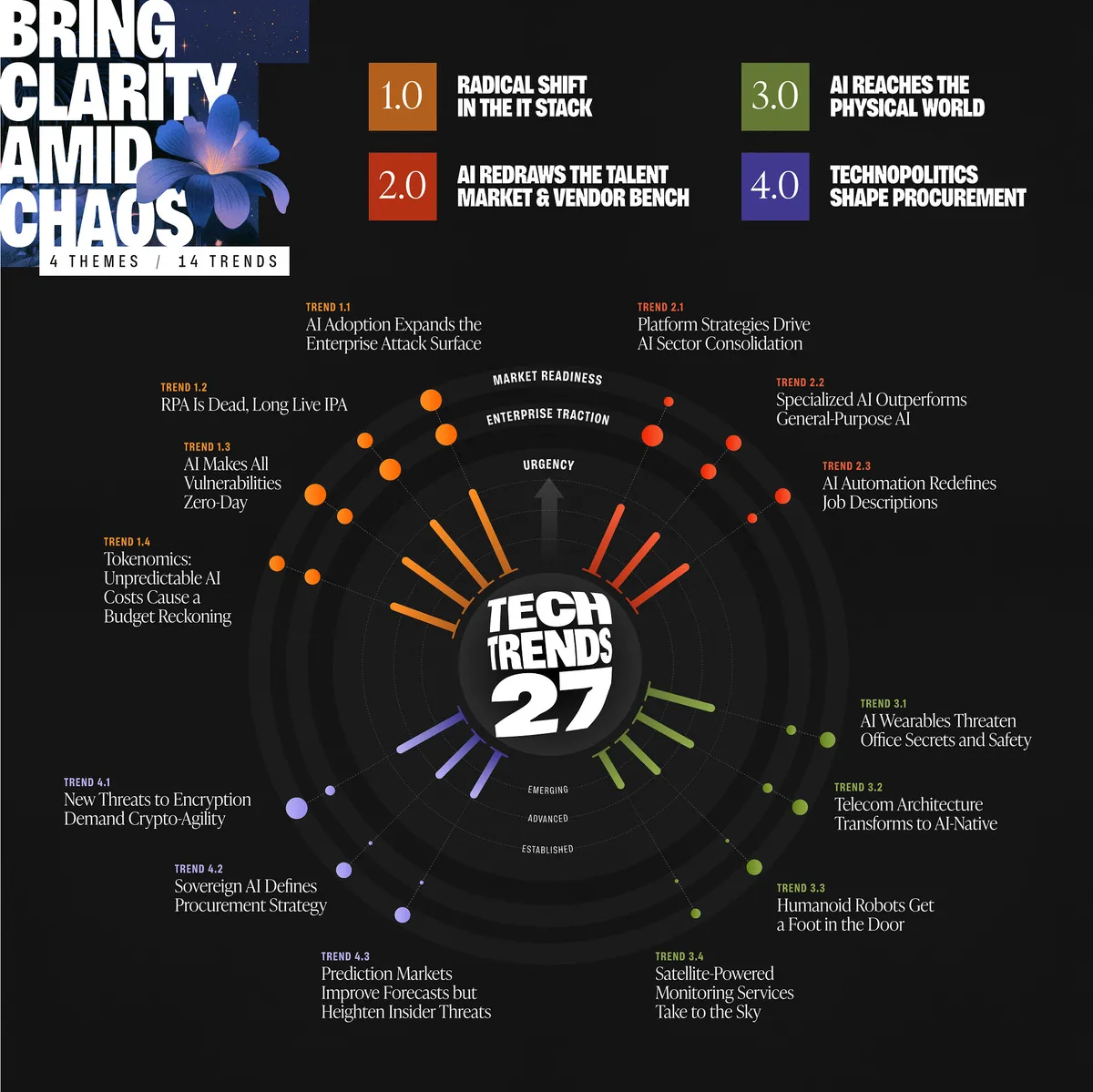
Research and advisory firm Infotech has released Tech Trends 2027: Bring Clarity Amid Chaos, its annual flagship report, which examines 14 trends across four themes. According to Infotech, the report is meant to help technology leaders see how AI is changing the cost, security and viability of their investments.
- Infotech released Tech Trends 2027: Bring Clarity Amid Chaos, covering 14 trends across four themes.
- The report says that as AI model capabilities converge, architecture, tooling and governance will matter more for enterprise outcomes.
- Trends include AI-expanded attack surfaces, unpredictable AI costs, vendor consolidation and humanoid robot pilots.
- Infotech advises access to at least two competitive frontier AI providers for critical applications.
- Each trend is assessed for market readiness and enterprise traction.
What the report covers
Infotech describes itself as a global research and API-driven advisory firm. Its report draws on expert interviews and primary and secondary research. It looks at how the trends apply to financial services, healthcare, legal services, manufacturing and government, and it tracks policy and procurement developments in the United States, Canada, the United Kingdom, Australia and the European Union.
Each trend is assessed for market readiness and enterprise traction, meaning how well the market can support adoption and how organizations are responding. According to Infotech, these assessments should help leaders decide which developments need action and which deserve further testing or monitoring.
A central finding is that as AI model capabilities converge, supporting architecture, tooling and governance will matter more for enterprise AI outcomes. Infotech says deployment decisions will increasingly decide whether organizations can control costs, change providers and maintain oversight as automation expands.
Brian Jackson, Principal Research Director and lead author, said technology leaders will face pressure from "vendors that are obsessed with driving AI demand, executives that mandate AI use without defining desired outcomes, and employees that just want to get their hands on it."
Security, costs and the workforce
The first theme, a radical shift in the IT stack, has four trends. The report says personal AI accounts, unsanctioned connections and agents embedded in approved software create new entry points for attackers, and that stronger identity controls and an accountable human owner for every agent will become essential. It also argues that AI increases the pace at which software flaws can be found and exploited, which will require continuous security testing and greater vendor accountability.
On budgets, the report says consumption-based pricing and multi-step agent workflows make spending harder to forecast. Linking AI spending to business value will depend on clearer cost attribution, appropriate model selection and usage controls. The report also describes intelligent process automation platforms, where AI agents interpret information and plan actions while established robotic process automation handles repeatable execution.
The second theme covers talent and vendors. Infotech expects competition to control enterprise orchestration and supporting tools to drive consolidation through 2027. It warns that deals that hire away a vendor's core team may disrupt product development and support without triggering contract protections tied to an acquisition, and advises buyers to negotiate continuity, data portability and transition provisions while they still have leverage.
The report also says specialized AI outperforms general-purpose AI, most clearly in regulated industries, which can make switching providers harder and give vendors more pricing power. On jobs, it notes that AI agents are taking over tasks that once helped junior employees build experience, so organizations will need to redesign entry-level roles.
Physical world and technopolitics
The third theme, AI reaching the physical world, covers wearables, telecom, humanoid robots and satellite monitoring. Recording-enabled wearables offer uses in fieldwork and accessibility but bring privacy and confidentiality risks, so the report recommends acceptable-use policies that leave room for employees who rely on such devices as assistive tools. It says mobile networks are becoming an AI services layer as 5G Advanced rolls out through 2027 and 6G follows by 2030. On humanoid robots, falling unit costs and rising investment create pilot opportunities, though autonomy remains limited, so bounded testing should come first.
The fourth theme, technopolitics, addresses encryption, sovereignty and prediction markets. Quantum computing and AI-assisted attacks could weaken widely used encryption, and governments are issuing guidance and timelines for post-quantum migration. The report advises identifying where cryptography is embedded and adding post-quantum readiness to vendor assessments. On sovereign AI, it says provider selection will increasingly involve jurisdiction, operational control and continuity of access. For critical applications, it recommends keeping access to at least two competitive frontier AI providers and designing workloads to shift between them. The final trend concerns prediction markets, which the report says improve forecasts but heighten insider threat.
What it means for IT leaders
The report's message is that AI adoption in 2027 will be as much a governance and procurement question as a technology one. Jackson put it this way: leaders should remember that "it's not their priority to unleash unbridled AI power onto their organizations, but instead to take the reins and steer its potential in the direction the organization wants to go."
For buyers, the practical points in the report are contract terms that anticipate vendor consolidation, cost controls for consumption-based AI, named human owners for agents, and planning for post-quantum encryption.