Inworld's Realtime TTS-2 Adds Reasoning to Decide How a Line Should Sound
Inworld AI has shipped two updates to Realtime TTS-2, its text-to-speech model. According to the company, Reasoning makes it the first speech model that decides how to say a line before saying it, while a refreshed model generates speech faster and stays more consistent over long text and sessions.
- Inworld says Reasoning makes Realtime TTS-2 the first speech model that decides how to say a line before saying it.
- Reasoning is opt-in via one request field and works on TTS-2 synthesis, streaming and async requests; WebSocket, duplex and batch are coming soon.
- Compared with the previous TTS-2, short utterances generate about 13% faster and mid-length about 9% faster, according to Inworld.
- Cekura ranks Realtime TTS-2 Flash fastest of 27 models in non-streaming, with a 46 ms median to first audio.
- Realtime TTS-2 read 93.4% of difficult items correctly in Cekura's benchmark.
Reasoning: a delivery direction before synthesis
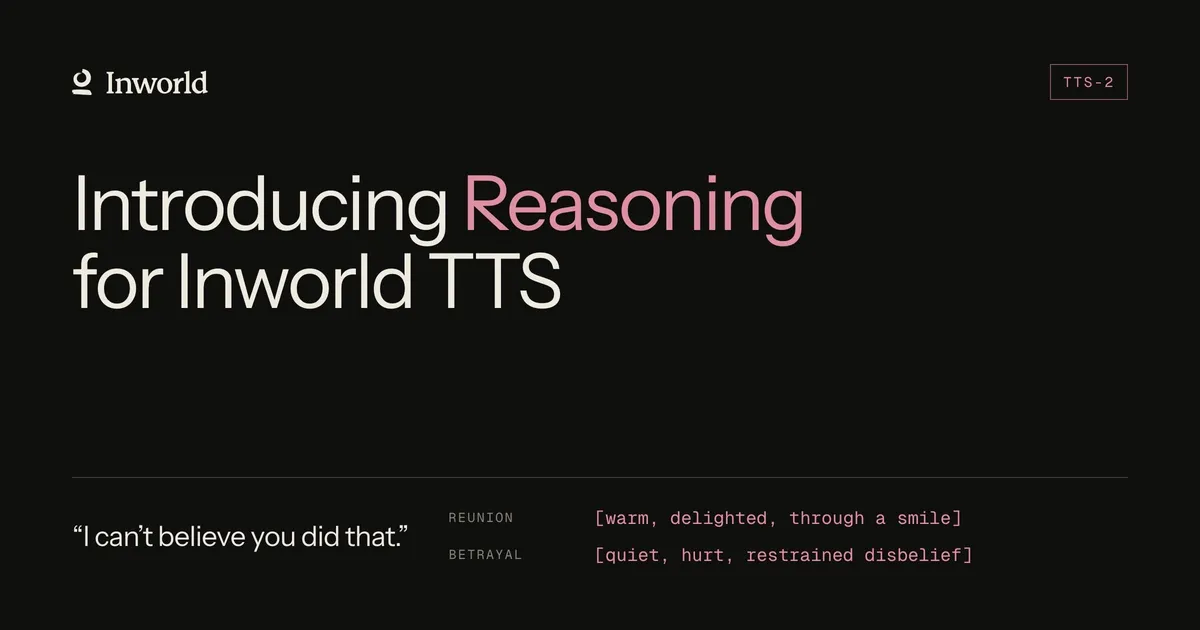
Inworld argues that speech models read the text they are given, but nothing tells them how it should sound. A line such as "I can't believe you did that." can express delight, hurt or disbelief, and without context the model gives each the same neutral read. In consumer apps where an LLM writes every reply at runtime, nobody is available to add that direction by hand.
Reasoning adds one step inside the same TTS-2 request. The model reads the text and any context the developer sends, writes a short delivery direction, then performs it. The reasoning step is a language model whose only job is to write that direction. In Inworld's example, the same line with the context "A friend has arranged an unexpected reunion" gets a direction of "warm, delighted, speaking through a smile", while a line following a partner's admitted betrayal gets "quiet, hurt, with restrained disbelief".
Explicit instructions and inline tags set by the developer always override the direction Reasoning writes. The direction is returned in the API response, so it can be logged next to the input and the context adjusted when a read sounds off.
Inworld contrasts this with emotion tags, which are a fixed list of labels such as [happy] that something, usually the developer's own LLM following prompt rules, must pick for each line. Reasoning instead writes a free-form direction that can set emotion, tone and pacing together.
How to use it and where it runs
Reasoning is opt-in and takes one field on the request. Developers set reasoning to REASONING_ON inside synthesisContext and pass context in a separate reasoningContext field. Context shapes the delivery but is never spoken. Both updates run behind the same public model ID, inworld-tts-2, and reach existing integrations automatically as they roll out by serving region.
At launch, Reasoning works on TTS-2 synthesis, streaming and async requests. Inworld says that suits audio generated per message or ahead of time:
- voice messages from a companion or coach
- generated stories, recaps and lessons
- audiobooks
- pre-generated character lines for games and social apps
WebSocket streaming, duplex (including the Realtime API) and batch synthesis are listed as coming soon.
Faster and steadier generation
The updated model targets failures that show up in real workloads, such as a voice gradually changing, a word skipped in a long passage, or a consonant lost at the end of a sentence. In comparisons with the previous version of TTS-2, Inworld says short utterances are about 13% faster to generate and mid-length utterances about 9% faster. Generation speed is also more consistent across input lengths, which matters for agents and tutors whose replies range from a few words to a long explanation.
Inworld stresses that these figures describe TTS generation only. The delay a listener experiences also depends on turn detection, language model generation, network transit and playback buffering, which it advises measuring separately.
On voice quality, the company says the update improves voice similarity in Stable mode, particularly for voices that have been hard to clone accurately, and reduces voice drift during long duplex sessions. It also fixes cases where TTS-2 skipped words in long utterances or dropped plosives such as /p/, /t/ and /k/ on some word endings. Creative mode now produces more natural delivery with light built-in steering. Inworld recommends Stable mode when consistency matters most and testing Creative mode where a more expressive performance fits.
Benchmark figures and what they mean for developers
Inworld cites Cekura's independent benchmark, with results updated October 28, 2026. For Realtime TTS-2 Flash, Cekura measured a 46 ms median and 73 ms p90 to the first audible sound with the complete text supplied upfront, and ranks it the fastest of the 27 models it tested in the non-streaming category. Word-by-word input is a separate test. For Realtime TTS-2, the benchmark found 93.4% of difficult items read correctly, covering numbers and shorthand, codes and addresses, context-dependent words and medical terms.
For developers building companions, voice agents, audiobooks or game characters, the practical change is that expressive delivery no longer requires a tag vocabulary or hand-tagged scripts: they enable Reasoning and pass the context they already have. Inworld advises testing the improvements on full passages and extended sessions, comparing cloned voices with their references, checking early and late samples for drift, and checking output against the source text for omitted words.
Inworld AI: Realtime TTS-2 updates: reasoning, speed and consistency