IVADO and Eon Institute Find Gaps in Canada and Mexico on AI Intimate Images
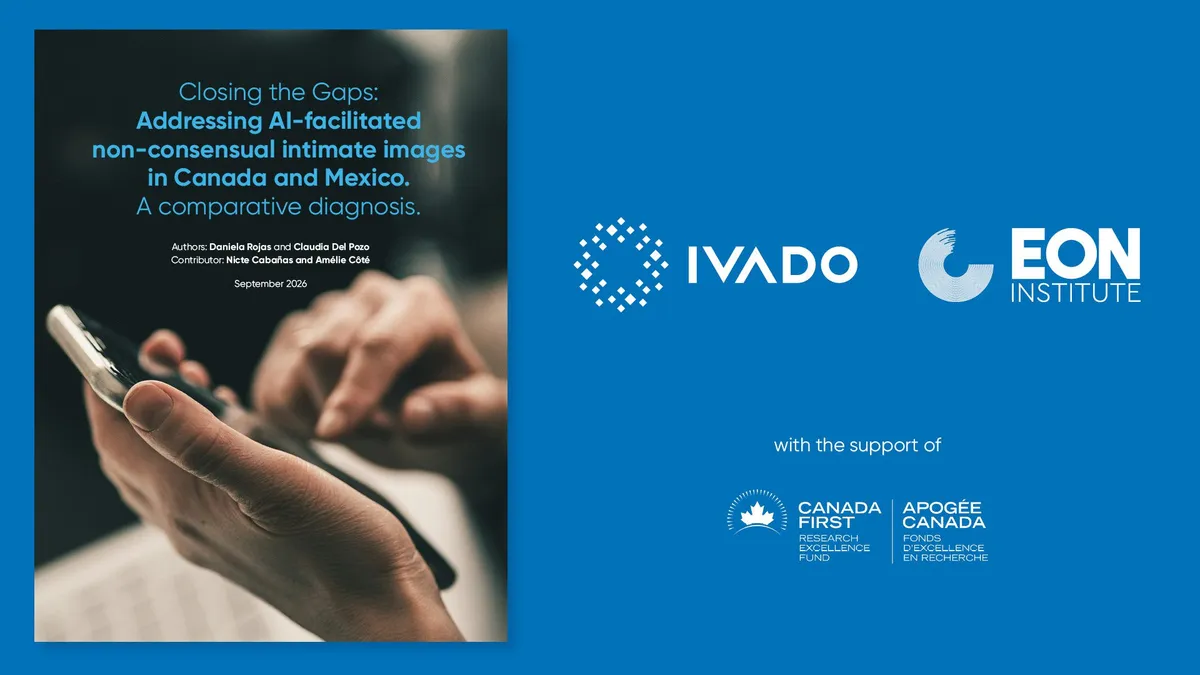
Canada and Mexico still face significant challenges in protecting people affected by AI-facilitated non-consensual intimate images, despite legislative progress, according to a new joint report from IVADO and Eon Institute. The report, titled Closing the Gaps, compares how the two federal states handle the problem and proposes steps to improve prevention, access to justice and platform accountability.
- IVADO and Eon Institute published a joint report comparing how Canada and Mexico address AI-facilitated non-consensual intimate images.
- The report says 99% of deepfake videos identified online in 2023 depicted women.
- In Mexico, only 0.5% of complaints related to these images reach court, according to the report.
- Canada adopted legislative changes in June 2026, while platform regulation remains under consideration.
- The report urges both countries to set minimum standards for digital platform accountability.
What the report examines
The report, Closing the Gaps: Addressing AI-Facilitated Non-Consensual Intimate Images in Canada and Mexico, was published on October 26, 2026 in Montréal. It compares two countries with distinct political systems that share challenges in the division of powers. Both also operate within the same North American economic space, where major US-based digital platforms wield considerable influence, according to the authors.
The authors note that generative AI has made it easier to create and distribute intimate images without consent, particularly through sexually explicit deepfakes. They describe this as a form of technology-facilitated violence that can undermine dignity, privacy and safety, with significant social, economic and professional consequences.
Women are particularly targeted. The report states that in 2023, 99% of deepfake videos identified online depicted women. Minors, racialized women and Indigenous people also face significant barriers to obtaining support and accessing justice.
Where Canada and Mexico stand
In Canada, legislative changes adopted in June 2026 reflect efforts to better address these harms, while the regulation of digital platforms remains under consideration.
In Mexico, the Ley Olimpia exists, but law enforcement varies across states and specialized capacity remains limited. According to the report, only 0.5% of complaints related to these images make it to court in Mexico.
In both countries, the report says, challenges persist in implementing measures and ensuring access to justice.
Recommendations: beyond passing laws
The report argues that passing laws is not enough to ensure effective protection. Its recommendations include:
- Strengthening specialized training for law enforcement and judicial personnel
- Improving reporting mechanisms and support for survivors
- Accelerating the removal of images
- Better coordinating responses
It also calls on Canada and Mexico to work together to establish minimum standards for digital platform accountability, given that these platforms often operate across national borders.
Professor Catherine Régis, Director of Social Innovation and International Policy at IVADO, said it is essential that states, "particularly middle powers such as Canada and Mexico, work together to prevent harm and hold the relevant actors accountable." Claudia Del Pozo, Founder and Director of Eon Institute, said current responses "remain largely insufficient" despite promising initiatives.
Authors, method and next steps
IVADO commissioned the report as part of its efforts to strengthen Canada-Mexico cooperation on AI. It was written by Daniela Rojas and Claudia Del Pozo, with contributions from Nicté Cabañas of Eon Institute, under the direction of Amélie Côté of IVADO. It draws on a comparative analysis of the two countries' legal frameworks and public policies, as well as nine interviews with Canadian and Mexican experts. The report is available in French, English and Spanish.
IVADO and CEIMIA will also host Democracies Under Pressure from AI, a free morning of talks and discussions on October 28 at the Grande Bibliothèque (BAnQ) in Montreal. Del Pozo will take part in a panel on AI and digital violence targeting women in politics.
For policymakers and platforms, the report's message is that legislation must be matched by trained enforcement, faster image removal and cross-border standards for platform accountability.