LangSmith links coding agent spending to pull request outcomes
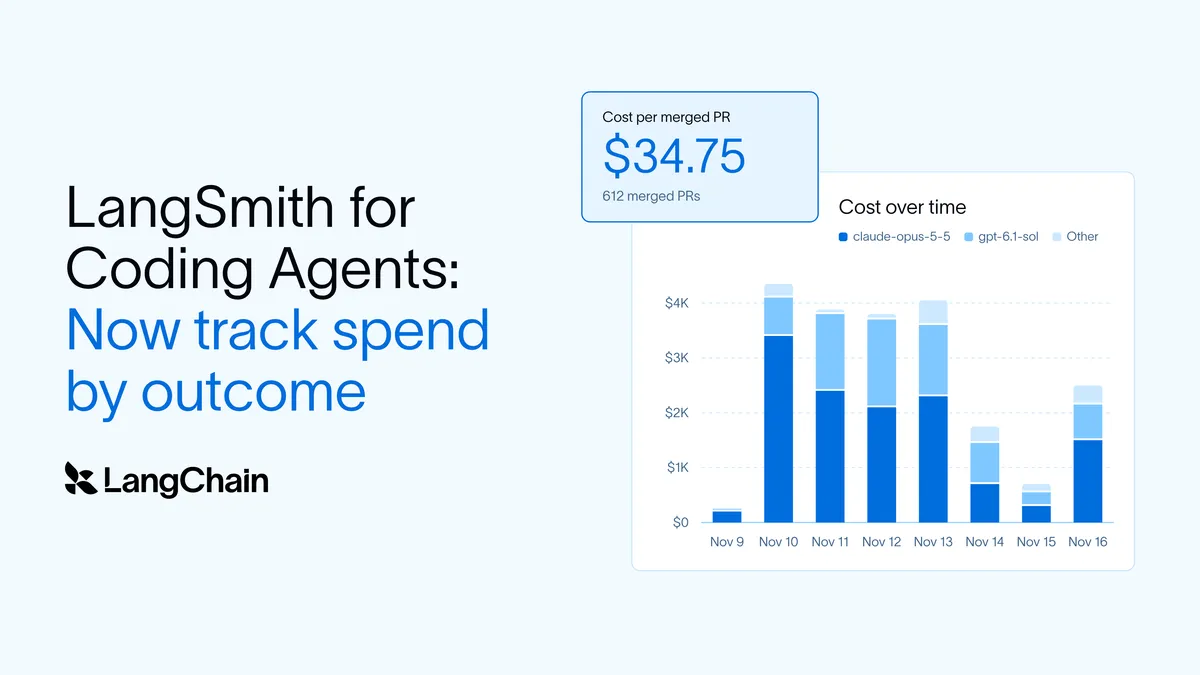
LangChain has added coding agent reporting to LangSmith, linking spending to GitHub pull requests and GitLab merge requests. The company says the feature is designed to help teams measure what their coding agents produce and investigate costs that do not result in a pull request.
- LangSmith links coding agent threads to pull requests and merge requests.
- The dashboard breaks down spending by pull request state and work type.
- Unattributed spend covers sessions that do not result in a pull request.
- Supported agents include Claude Code, OpenAI Codex, Cursor, GitHub Copilot and Deep Agents.
- The feature is in public beta on LangSmith Cloud.
Connecting agent costs to engineering work
LangSmith’s new concept of outcomes connects coding agent threads to pull requests or merge requests. Spend in each trace is automatically attributed to the pull requests an agent contributed to, including cases where one thread opens several pull requests or one pull request requires several threads.
The company said coding is the largest category of enterprise AI application spending, reaching $34B in 2026. Traditional usage analytics and AI consumption figures can show how much teams use an agent, but they do not show what the tokens produce. LangChain says the new reporting gives teams a way to connect spend across users and teams with the work delivered.
A dashboard for costs, outcomes and unanswered questions
The coding agent overview page aggregates costs across an organization and connects them to pull requests. It shows key performance indicators, trends over time and spending by pull request state, including open, closed and merged work. Teams can compare results before and after changing models or other policies.
LangSmith separately tracks unattributed spend from sessions that do not end in a pull request. This can include code review, investigation and exploring a codebase. The dashboard also labels threads by work type, such as features, bug fixes, investigation and code review, while showing the share of threads and cost for each type.
Additional views cover the skills agents call, the most expensive pull requests and how costs change with conversation length. Every metric links back to the relevant threads and sessions, allowing teams to inspect what happened in a specific interaction.
Support for multiple coding agents
LangSmith brings traces from different coding agents into one dashboard. Supported agents include Claude Code, OpenAI Codex, Cursor, GitHub Copilot in VS Code and Deep Agents, which teams can use to build a custom coding agent.
LangChain describes several uses for the metrics. Engineering teams can examine expensive pull requests and the models, threads and GitHub users behind them. They can compare the cost and results of different models or providers, assess whether smaller models reduce spending, and study which skills appear in short threads that end in merged pull requests.
The reporting can also give engineering and finance a shared view of cost. Cost per merged pull request appears alongside unattributed spending, although LangChain cautions that unattributed work may still be valuable even when it does not produce a pull request.
LangSmith for Coding Agents is in public beta on LangSmith Cloud. Teams must install the LangSmith plugin for each coding agent, connect GitHub and open the coding agent overview page. Coding agent traces count toward regular LangSmith tracing usage.
LangChain: LangSmith for Coding Agents: Now track spend by outcome