LangChain Rebuilds LangSmith Around a Unified Agent Record
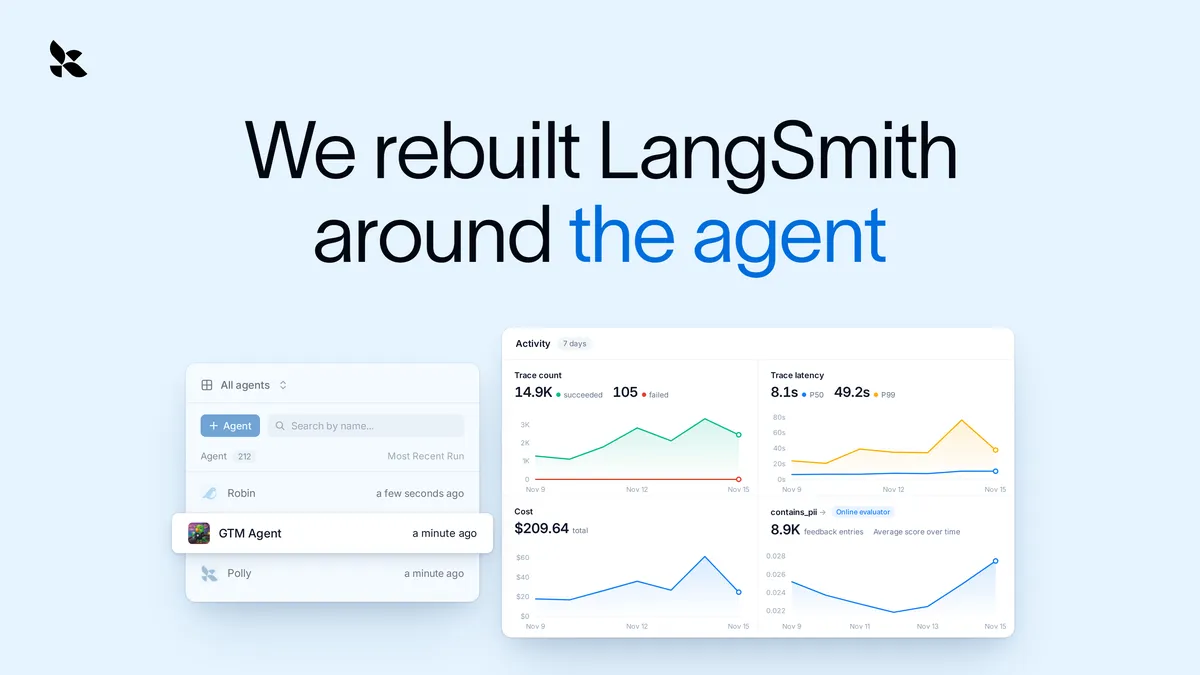
LangChain has rebuilt LangSmith around the agent, making agents the core object for building, running, improving and governing systems across an organization. The company says the redesign is intended to replace fragmented workflows with a single view of each agent and its environments.
- LangSmith now uses the agent as its core object.
- Agent records group ownership, environments, traces and evaluations.
- General purpose and coding agent types are available today.
- LangSmith supports agents on platforms using OpenTelemetry Protocol.
- The redesigned product is available globally in cloud, BYOC and self-hosted environments.
A single platform for the agent lifecycle
LangChain introduced the redesigned product as part of its new LangSmith Agent Platform. The platform connects the main stages of agent development through a shared agent record, while allowing teams to choose which parts of LangSmith they use.
Developers can describe an agent with the natural language builder in LangSmith Studio, build with LangChain's open source harnesses or use another framework. They can deploy on LangSmith Agent Server or keep an agent on an existing runtime. Tracing, evals, datasets, annotation and Engine can then be used with any agent that sends traces to LangSmith.
The agent registry and LLM Gateway provide organization-level visibility and controls. Each agent's traces, evals, Agent Server and Engine issues are available from its record. Local, development, staging and production environments are grouped under the same agent ID, making it easier to compare performance after changes.
A data model built around ownership and evaluation
Previously, traces sent to LangSmith used a flat project hierarchy and were not associated with a particular agent. Under the new model, every agent record includes an owner, a globally unique and immutable ID, and a type.
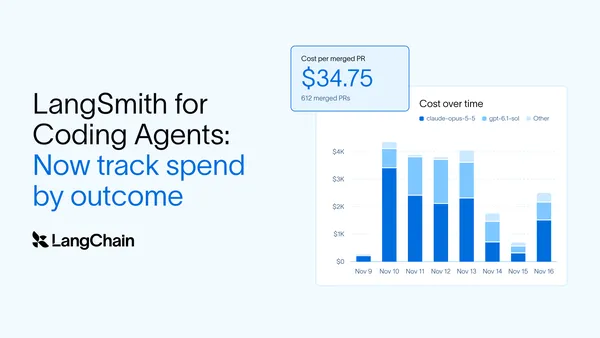
The type determines which information, data connections and evaluation criteria appear in the agent's dashboard. LangChain has started with general purpose and coding agents. A general purpose dashboard can include recent activity, online monitoring, common models and tools, and failures surfaced by Engine. A coding agent dashboard can show merged pull requests, token cost and the work the agent completes.
These predefined views are intended to avoid manual setup and make measurements consistent between agents of the same type. The coding agent type can also connect to a GitHub repository to track downstream outcomes. LangChain says it plans to add types for agents with different evaluation needs, including voice agents, where latency and audio quality matter.
Governance across an expanding agent fleet
LangChain says agent sprawl is creating a governance challenge because agents are built by engineering teams, adopted from vendors such as ServiceNow and Glean, or selected by employees for coding and productivity work. Requiring every team to use one platform is not realistic, according to the company.
LangSmith can connect to agents running on platforms that support OpenTelemetry Protocol, including labs and hyperscalers. Registered agents receive an owner, ID and type, while cost and quality metrics roll up across their environments. This gives platform teams a consistent way to monitor agents and identify who is responsible when costs rise or a failure occurs.
Availability and planned additions
The new LangSmith is available globally in cloud, BYOC and self-hosted environments. Users can start by building an agent with LangSmith Studio or connecting an agent they already run.
LangChain says it is working on more agent types, including voice, organization-level dashboards and the ability to register agents with an identity provider. The company also describes plans to connect red-teaming, production review, evaluation datasets and fine-tuning workflows to the same agent record. Workspace-level dashboards are available today, while organization-level dashboards are in development.
LangChain: Why we rebuilt LangSmith around the agent