LangSmith Adds Access Controls for Sensitive Agent Trace Data
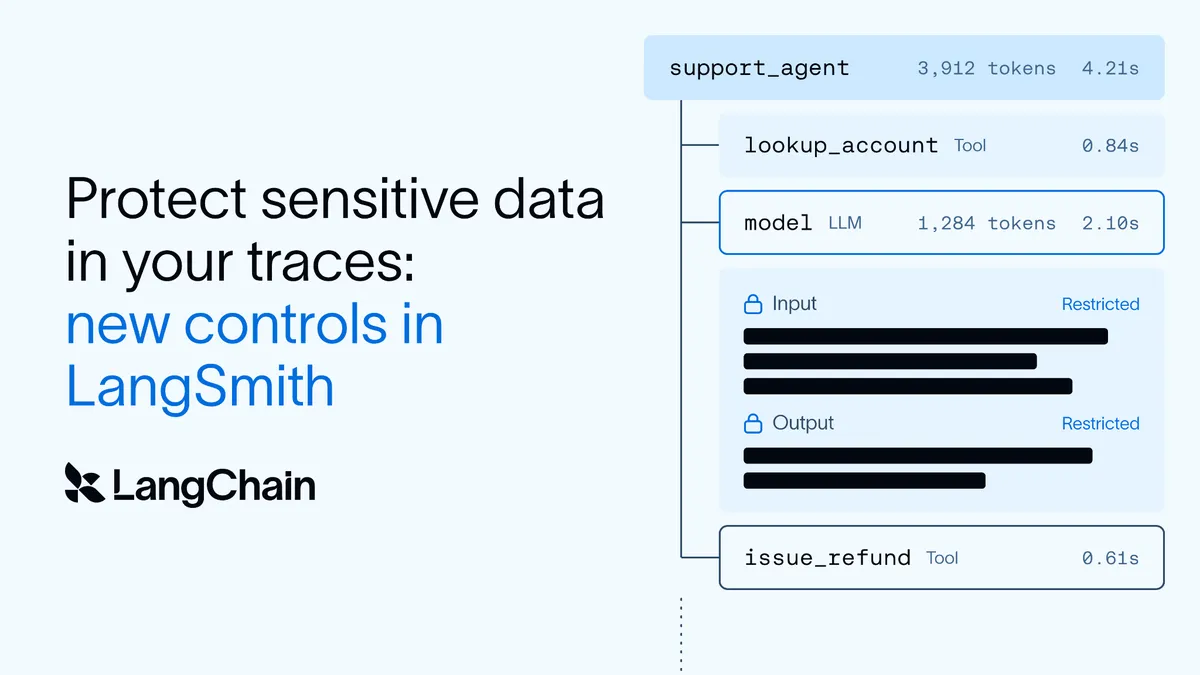
LangChain has added three controls to LangSmith for governing access to sensitive data in production agent traces. The tools let organizations restrict trace inputs and outputs, manage permissions by user group and apply access policies based on metadata.
- LangSmith now restricts access to trace inputs and outputs.
- Admins can manage permissions through user groups and workspaces.
- Metadata-based policies provide trace-level access control.
- The controls can be layered to enforce least-privilege access.
- The features are available in LangSmith Enterprise plans.
Balancing debugging with data protection
Production traces can help engineers understand how an agent behaved, identify slow or repetitive tool calls and improve performance. They can also contain sensitive customer information, including names, health information and payment details.
LangChain says this creates a conflict between engineering needs and security requirements. Engineers need visibility into production behavior, while security and compliance teams need least-privilege access, so people see only the data required for their jobs. The company points to regulatory requirements such as GDPR, HIPAA and CCPA, as well as customer contracts and frameworks including ISO 27001 and SOC 2 audits.
According to LangChain, teams have often addressed this tension with custom observability setups, duplicate traces or multiple workspaces. Others have avoided sending traces to observability platforms, which limits engineers’ ability to investigate issues. The new controls are designed to provide visibility without requiring those workarounds.
Three ways to restrict trace access
The first control lets administrators decide which users can see trace inputs and outputs, where sensitive user messages and model responses are most likely to appear. Engineers can instead work with run trees, performance statistics such as latency and cost, and other trace data while those inputs and outputs remain hidden. Users who need the complete context can be granted access.
The second control introduces user groups in LangSmith. Administrators can define permissions for each group and workspace, in addition to the role-based access controls and attribute-based access controls already used across an organization. LangChain gives clinicians as an example of a group that could view inputs and outputs for trace annotation, while agent engineers could be limited to run trees, latency and token usage.
The third control uses root run metadata to create trace-level attribute-based access policies. Administrators can set conditions based on information such as a customer ID or user ID. This can limit customer support agents to traces for the customers they support, or developers to traces from their own coding agents.
Layered controls are available to Enterprise customers
LangChain says the controls can be combined. Organizations can send complete traces to LangSmith and attach metadata such as a customer ID or user ID, without creating redacted or duplicate copies. A support team could then see inputs and outputs only for assigned customers, while agent engineers could view run trees and performance data across traces without seeing sensitive content.
These policies can also be updated independently. For example, when a support team takes on another customer, administrators can change its metadata-based policy without changing input and output permissions or the engineering team’s access.
The new controls are available now in LangSmith Enterprise plans. Existing customers can use LangChain’s documentation for input and output access, user groups and metadata-based access policies. LangChain asks new customers interested in the controls to contact its team.
LangChain: Protect sensitive data in your traces: new controls in LangSmith