Liquid AI's d1-ultra decision model now available on Vercel's AI Gateway

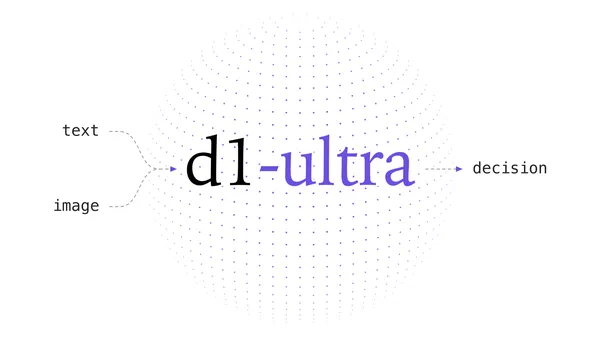
Vercel has made Liquid AI's d1-ultra available on AI Gateway. The multimodal model does not generate text. It returns structured answers with probabilities for classification, routing and scoring tasks across text and images.
- Liquid AI's d1-ultra is now available on Vercel's AI Gateway as liquid/d1-ultra.
- The multimodal model returns structured answers with probabilities instead of generating text.
- Question types are Boolean, Choice and Score, and several can be asked about one input in one request.
- It supports a 32,768-token context window and is billed on input tokens only, including images.
- AI Gateway reflects provider pricing with no markup and no platform fee on inference, according to Vercel.
A model that returns probabilities, not prose
According to Vercel, d1-ultra is a multimodal decision model built for classification, routing and scoring across text and images. Listed use cases include visual defect inspection and checking damage claims against customer photos.
Instead of producing free-form text, the model gives structured answers with probabilities. Vercel describes three question types:
- Boolean: returns the probability of a yes or no answer.
- Choice: selects among named categories.
- Score: rates an input on an ordered scale.
Developers can ask several questions about the same input in a single request. The probabilities can then be used to decide when to automate an action and when to request human review.
Vercel says d1-ultra is designed for harder real-world decisions, with an emphasis on calibrated probabilities.
Context window, billing and usage
The model supports a 32,768-token context window. It is billed on input tokens only, including image input, and there are no output-token charges. The model name to use is liquid/d1-ultra.
Vercel's changelog includes a code example using the AI SDK. It imports experimental_decide from the ai package and passes the model name, a text description of the case and a set of questions. In the example, the state is a customer report that a delivered laptop has a cracked screen, and a Boolean question asks whether the customer reports that the item arrived damaged. The result is read from result.answers.damaged.
The same question can also be asked through an OpenAI-compatible Decisions API and a TypeSafe-compatible API, according to the source. Vercel points to its decision models documentation for question types and further usage details, and to a model playground for trying d1-ultra.
How it fits into AI Gateway
AI Gateway is Vercel's unified API for accessing models and tracking usage and cost. Decision calls appear in logs and count toward budgets alongside other model requests.
Vercel states that AI Gateway reflects provider pricing with no markup and does not charge a platform fee on inference, including on Bring Your Own Key requests. The company also lists all decision models available on the gateway on a separate page.
What it means for developers
For teams that route or screen cases automatically, such as insurance-style damage checks or quality inspection, the format offers a way to base automation on a probability rather than parsing generated text. Because multiple questions can be asked about one input in a single request and billing covers input tokens only, a single image or description can be evaluated against several criteria. Vercel does not publish performance figures for d1-ultra in this announcement, so the quality of its calibration will need to be tested by users on their own data.
Vercel: Liquid AI's d1-ultra now available on AI Gateway