Liquid AI releases d1-ultra, a multimodal decision model priced at $0.042
Liquid AI has released d1-ultra, a multimodal decision model that reads text, images or both and returns probabilities instead of generated text. According to the company, it is available now on the Liquid API at $0.042 per million input tokens.
- Liquid AI released d1-ultra, a multimodal decision model that returns probabilities without generating tokens.
- It is available on the Liquid API at $0.042 per million input tokens, with Vercel and OpenRouter to follow soon.
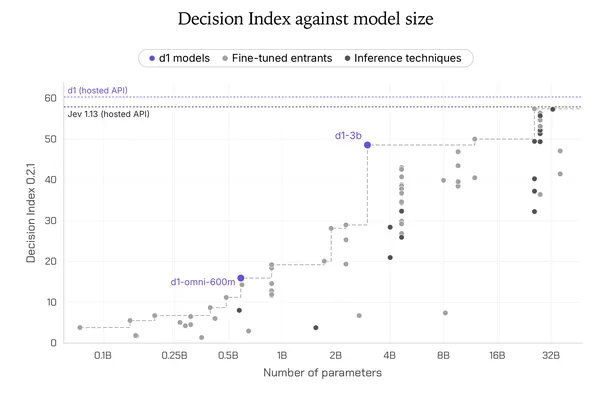
- Liquid AI says it beats Jev 1.14 across all tasks and leads the Artificial Analysis Decision Index by at least 8 points.
- The model was trained for better-calibrated probabilities, since most decision models are overconfident, according to the company.
- Images are billed as input tokens at 1.5 tokens per 32×32-pixel patch.
What d1-ultra does
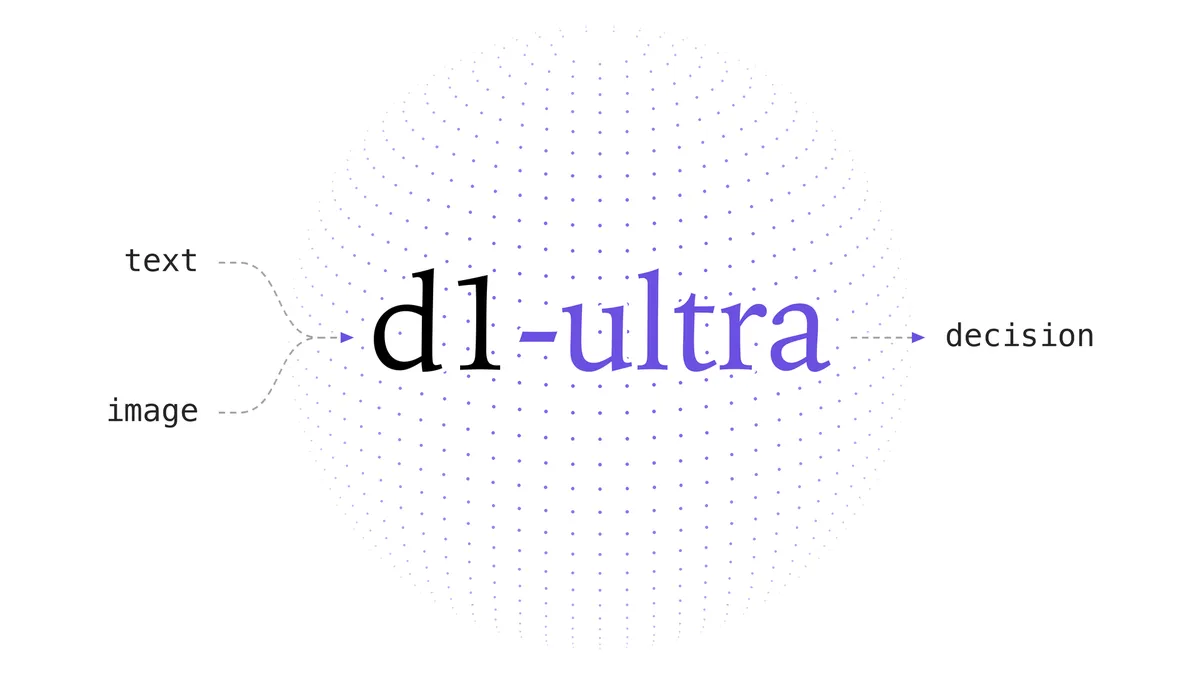
Decision models answer questions about a situation by giving a probability for each possible answer. According to Liquid AI, d1-ultra takes unstructured data (text, images, or both) and one or more questions as input. It reads the input in a single forward pass and returns the probabilities without generating any tokens.
The company says it built the model for harder, messier real-world use cases than those most decision models handle well. Its examples are spotting a defect on a circuit board against its spec and checking a damage claim against a customer's photo.
d1-ultra answers the same three question types as the earlier d1 model:
- noul: a yes/no question, answered with a probability from 0 to 1.
- Choice: one label from many, with a probability for each label.
- Score: a position on a scale.
Larger base model and a focus on calibration
Liquid AI says d1-ultra is based on a larger open-weight model than d1, with a series of Liquid-specific heavy customizations. Combined with the company's training pipeline, this gives significant gains, especially on knowledge-related tasks, according to the post.
The company compared the model with its earlier d1 and with Jev 1.14 across 112 unique evaluations. It argues that accuracy alone is not enough, because decision models also output probabilities that must be properly calibrated. Liquid AI says it found most decision models to be overconfident in their responses, and that it trained d1-ultra specifically to produce more reliable probabilities.
According to Liquid AI, d1-ultra outperforms Jev 1.14 across all tasks, with better-calibrated answers and higher accuracy at the same price. The company also states that it outperforms all other decision models on the Artificial Analysis Decision Index by at least 8 points. Demos running on the model are available in the d1 Playground.
Availability, pricing and API use
d1-ultra is available on the Liquid AI API, and developers can create an API key and start building. Liquid AI says it will soon also be available through Vercel and OpenRouter.
Billing is based on input tokens only, with no output tokens. Images count as input tokens at the same rate as text: 1.5 tokens per 32×32-pixel patch, so a 1024×1024 image costs 1,536 tokens. Each question is billed as its own prompt, including its text and all images.
The post includes a Python example that sends a circuit board photo and a noul question, "Does this circuit board have a defect?", to the decisions endpoint and prints the returned answer. The full API reference is in the decision models documentation.
What it means for developers
For teams that want structured, probability-based judgments on images and text, d1-ultra offers a way to get them without generating text. Because each question is billed as its own prompt, costs scale with the number of questions asked about the same inputs.
Liquid AI calls d1-ultra its most capable decision model so far. It says it is committed to continuing work on decision models across a range of sizes, with new features, higher decision quality and lower latency, and plans to provide regular updates.
Liquid AI: d1-ultra: Introducing the World’s Best Decision Model | Blog