Liquid AI Launches LFM3, a 2B-Class Multimodal Model Family With Open Weights

Liquid AI has released LFM3, a new generation of its Liquid Foundation Models that places text, vision, audio, omni and decision models on a single shared backbone. The first release covers six models of around 2B parameters, with base and post-trained weights open and available now.
- Liquid AI released LFM3, a family of six models around 2B parameters built on the shared LFM3-1.7B-Base backbone.
- The family covers text, vision, audio and omni models plus two decision models; base and post-trained weights are open.
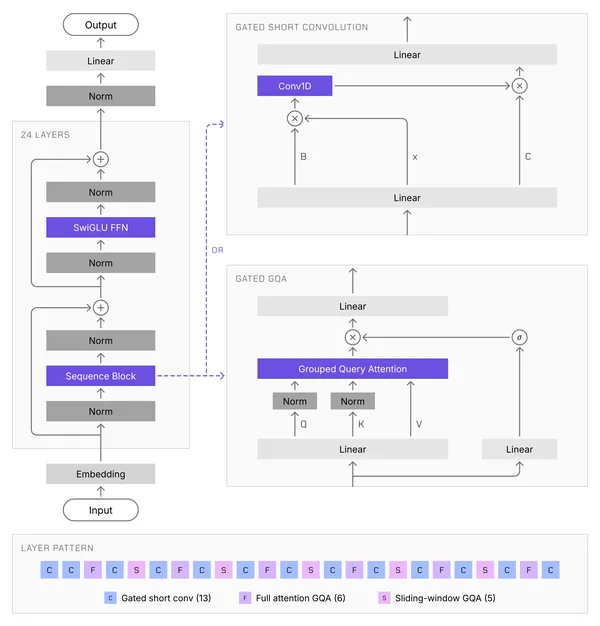
- The architecture uses 13 convolution, 5 sliding-window attention and 6 global attention layers, with a 256K-token context window.
- Liquid AI says LFM3-1.7B averages 49.37 on its benchmark set, ahead of Qwen3.5 4B and close to Qwen3.5 9B.
- Larger models still lead on agentic coding and knowledge tasks, according to the company.
Six models from one backbone
According to Liquid AI, the LFM3 family is multimodal by nature. All six models in the first release branch from the same LFM3-1.7B-Base backbone and sit around 2B parameters. Four cover input modalities: text, vision, audio and omni. The remaining two are decision models, specialized from the vision and omni models.
The company's pitch is that users no longer need to run one large general-purpose model. Instead, they can pick the model that fits their use case, customize it and run it on-device. Liquid AI says the models can be fine-tuned locally, run on any device, and are capable enough to become reliable experts on a specialized task.
The base and post-trained models are open-weight and available on Hugging Face, Liquid AI's Playground and the Liquid AI API.
A redesigned hybrid architecture
LFM3 builds on the hybrid design of LFM2, which mixed short convolutions with attention. Liquid AI again used its automated hardware-in-the-loop architecture search, this time aimed at agentic use cases that need more capability per parameter and fast inference over long contexts. The hardware in the loop grew from CPUs in one phone and one laptop for LFM2 to 14 device and backend combinations. These include the Samsung Galaxy S26 Ultra, OnePlus 15, a Raspberry Pi 5, an Apple M4 Max, AMD Ryzen AI, Arm and x86 cloud CPUs, GPUs and the Qualcomm Hexagon NPU.
The model has 24 layers: 13 gated short convolutions, 5 sliding-window attention layers with a 256-token window, and 6 global attention layers. The convolution kernel size rises to 7 from 3 in LFM2. Other changes include head-wise gated attention, partial RoPE in the global attention layers and a sandwich norm. The vocabulary is the same 128K one used by LFM2.5-8B-A1B.
Liquid AI states that, per parameter, LFM3-1.7B matches LFM2-1.2B on short prompts across edge devices, and is about 25% faster with 8K tokens in context.
Training and the text model
LFM3-1.7B-Base was pre-trained on 22T tokens. Compared with LFM2, the data mix adds more scientific papers, repository-level code, a wider range of knowledge sources and considerably more math. The final 3.5T tokens form a mid-training stage on curated data with more agentic traces and tool calls, and this stage extends the context window to 256K tokens.
The text model, LFM3-1.7B, is post-trained to run in agentic harnesses such as Hermes Agent, Pi and OpenClaw. Liquid AI says it can triage an inbox, manage a calendar, research topics on the web and use tool search across thousands of options. It can be adapted with a short fine-tuning run on a single GPU. Post-training included supervised fine-tuning on 1.75T tokens, mixed reinforcement learning, multi-domain on-policy distillation from six specialist teachers, and agentic reinforcement learning.
Benchmark claims
In Liquid AI's own comparison, LFM3-1.7B scores an average of 49.37, against 31.55 for LFM2.5-2.6B, 39.19 for MiniCPM5 2B, 31.74 for Gemma 4 E4B, 39.27 for Qwen3.5 4B and 47.24 for Qwen3.5 9B. The company says the model leads on instruction following and on function calling in BFCL and ToolSandbox, and beats Qwen3.5-9B on long browser and business-app tasks such as WebArena-Verified and AutomationBench.
Liquid AI acknowledges limits: larger models still win on agentic coding and knowledge. On SWE-bench Verified (OpenCode), for example, LFM3-1.7B scores 43.40 against 51.20 for Qwen3.5 9B. These figures are the company's own and have not been independently verified.
What it means for developers
AMD and Ambarella both gave statements of support. Ambarella's Malhar Palkar said the company has begun enabling LFM3 on the platform where developers already run LFM2.5-VL models. For developers, the open weights, local fine-tuning and broad device coverage make LFM3 a candidate starting point for small, specialized on-device models, as far as Liquid AI's benchmarks hold up in practice.
Liquid AI: Introducing LFM3: Every Modality for Specialized Intelligence | Blog