Liquid AI Releases Open d1 Decision Models for Text, Vision and Audio

Liquid AI has released d1-3B and d1-omni-600M, two open-weight models in its d1 decision model family. According to the company, d1-3B scores 48.57 on the Decision Index v0.2.1 (public split), ahead of every model under 10B, and both models are available on Hugging Face.
- Liquid AI released open-weight d1-3B and d1-omni-600M decision models, available on Hugging Face.
- d1 models produce an answer in a single forward pass instead of generating tokens.
- According to Liquid AI, d1-3B scores 48.57 on Decision Index v0.2.1, on par with the 12x larger Decider 35B-A3B.
- d1-3B answers a question in 8 ms on an RTX 4090 and 50 ms on a Jetson Orin Nano.
- d1-omni-600M is an experimental checkpoint handling text with image or audio, scoring 15.95.
Decision models that answer in one pass
Unlike Liquid AI's generative Liquid Foundation Models (LFMs), the d1 models do not produce tokens. They produce an answer in a single forward pass. Because there are no output tokens, the company measures end-to-end latency from input to output.
According to Liquid AI, d1-3B's score of 48.57 on the Decision Index v0.2.1 is on par with Decider 35B-A3B, a decision model 12x its size. d1-omni-600M, described as the company's first experimental checkpoint, scores 15.95 on the same index. It handles text and image, as well as text and audio.
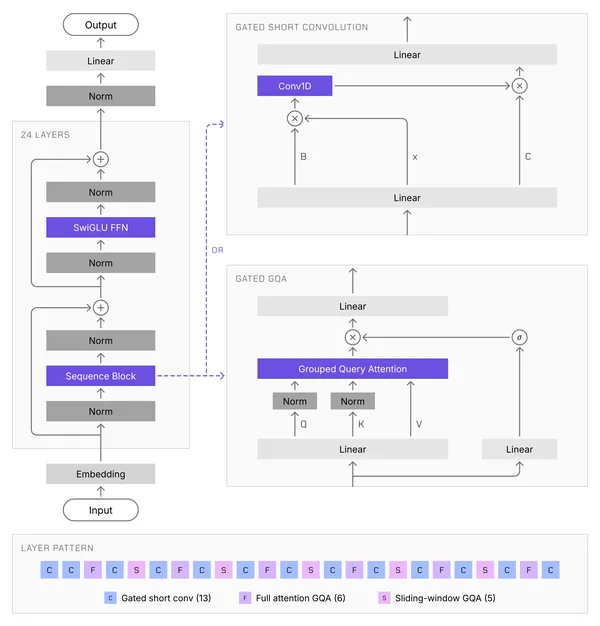
The two models are built on different backbones. d1-3B is trained from LFM2.5-VL-3B, a decoder-only vision-language model that accepts text and images. d1-omni-600M is trained from LFM2.5-Encoder-350M, a bidirectional encoder, with added vision and audio encoders.
How the models were trained
For d1-3B, Liquid AI averaged the weights of LFM2.5-2.6B and the text backbone of LFM2.5-VL-3B to create a better base model. It then fine-tuned checkpoints with different random seeds and data mixtures and merged them again. The company says training on long inputs, shuffling answer options and fixing shortcuts in the data made a bigger difference than more advanced techniques.
For d1-omni-600M, the team first fine-tuned the encoder on decision tasks, then added audio and vision in stages. Audio uses a FastConformer encoder with an adapter. Vision uses the encoder from LFM2.5-VL-450M, plus an adapter and LoRA updates that were active only when the input included images.
Benchmarks and speed
On seven public text benchmarks covering reading comprehension, toxicity detection, intent classification, medical QA and cross-lingual understanding, d1-3B reaches a mean of 82.9, the highest in the company's table and ahead of Decider 4B at 81.1. d1-omni-600M reaches 78.4, ahead of Decider 2B at 77.1, at a quarter of the parameters. It also posts the table's highest scores on Civil Comments (95.8) and PAWS-X (79.5).
Liquid AI does not report results on the private vision split of Decision Index v0.3 in this release. It says it validated that d1-3B retains the vision capabilities of its backbone and that d1-omni-600M handles all three modalities. The company calls dedicated audio decision benchmarks an open problem.
Latency figures are given for d1-3B, measured one request at a time. A single question takes:
- 8 ms on an NVIDIA RTX 4090
- 9 ms on an AMD MI325X
- 16 ms on a Jetson AGX Thor
- 26 ms on a Jetson AGX Orin 64 GB
- 30 ms on an Apple M5 Pro
- 50 ms on a Jetson Orin Nano
Three questions over one state take about 1.3x the time of one, according to the company. d1-omni-600M is an early research release, so no inference numbers are reported for it.
Availability and what it means
Both models are open-weight, and Liquid AI says they can be downloaded, fine-tuned and deployed without restrictions. It cites day-one llama.cpp support across Apple, AMD, Qualcomm and NVIDIA with NVFP4. The company also built ten demos that run d1-3B in a loop over live camera input, from gesture-controlled games to live content moderation, and showed the model navigating an environment in Isaac Sim, served on a Jetson in a hardware-in-the-loop setup.
For developers, the release offers two sizes: d1-3B for decision quality, and d1-omni-600M where footprint matters. Liquid AI positions them for fast, structured decisions, including from multimodal inputs, on hardware ranging from data center systems to small edge devices.
Liquid AI: Open d1: Edge decision models for text, vision, and audio | Blog