Luma Pitches Layers and Uni-1 as a Way to Turn One Ad Asset into 50 Variants

Luma AI argues that advertisers can turn a single approved hero image into 50 platform-ready ad creatives using its Layers editing tool, powered by the Uni-1 model, and its Ray 3.2 video generator. In a post on its news page, the company says the approach avoids rebuilding each variant from scratch.
- Luma says its Layers tool, powered by Uni-1, edits single elements of an approved ad while preserving the rest of the layout.
- The company claims campaigns with 15+ variants monthly achieve 23% higher ROAS than single-creative approaches.
- Luma says only 6-7% of variants become scaling winners, so 50 variants yield 3-4.
- Ray 3.2 is positioned for video variants such as 15-second cut-downs and 6-second bumpers.
- Luma claims complete variation workflows take 3.5-5 hours versus 15-20 hours manually.
The problem: volume without restarting
Luma opens with a familiar scenario. A creative director approves a hero image at 4 PM, and by the next morning a team needs 50 variants: six hooks for Meta, four aspect ratios for TikTok, localized versions for three markets and a dozen copy angles for performance testing.
According to Luma, traditional production treats every variant as a new project, so a product swap needs a new photoshoot and a headline change triggers a full design cycle. The company says such workflows cost 3-4 weeks of timeline, by which time the original campaign window may have closed.
Luma also cites figures on why volume matters. It says campaigns running 15+ variants monthly achieve 23% higher ROAS than single-creative approaches, and that only 6-7% of variants become scaling winners. By that math, 50 variants yield 3-4 sustained performers, which cannot be predicted in advance.
How Layers and Uni-1 work
Layers, powered by Uni-1, treats an approved creative as an editable working file. Objects, text and backgrounds become independent layers, whether the image was generated in Luma or uploaded from an existing campaign.
Luma gives the example of a beverage brand whose summer hero shows a bottle on a beach with the headline "Summer Refresh". The campaign needs three product colorways, four seasonal headlines, regional variants with localized text and an Instagram Stories crop. According to Luma, Layers changes one element while preserving the rest, so swapping the bottle leaves the beach, lighting and shadow relationship intact, and changing the headline keeps the bottle position and typography.
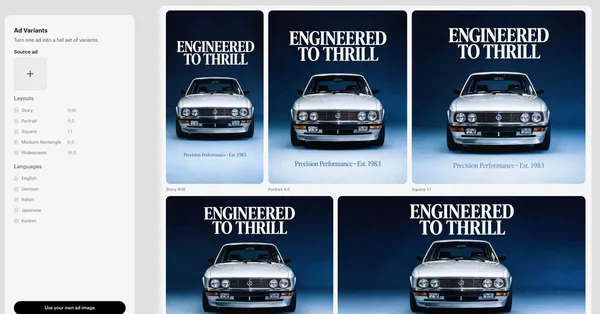
For localization, Luma says its Ad Variants feature creates variations across formats, colorways and languages while keeping the approved visual structure. Users review sample layouts and edit translated copy before generating localized versions.
On brand consistency, Luma says Uni-1 understands how images are constructed, recognizing layouts, objects, text and their relationships. The company says that when approved assets are uploaded, Uni-1 learns patterns such as color palette relationships, typography hierarchy and composition principles, and new variants inherit them. For product photography, it says the product remains pixel-accurate while the scene around it changes.
Video with Ray 3.2 and a testing framework
Luma says a full variant library should include video. Ray 3.2, it says, offers frame-by-frame control, with multi-keyframe sequencing, HDR workflows, EXR export and cinematic camera control meant to fit AI footage into professional post-production. Motion Transfer maps existing motion references onto new content.
As an example, a 30-second hero video could become:
- 15-second cut-downs for TikTok and Instagram Reels
- 6-second bumpers for YouTube pre-roll
- Vertical reformats for Stories placements
- Hook variations testing different opening moments
The post also lays out a testing structure built on hooks, angles and proof elements. Six hooks, six angles and four proof elements form a testing matrix of conceptually distinct variants. Luma notes that Facebook Dynamic Ads test component combinations automatically when campaigns have sufficient conversion volume (50+ conversions weekly), but that the system only works with genuinely diverse components. Fifty versions of one concept with minor text changes risk what Luma calls "creative similarity" penalties.
What it means for advertisers
The post is a company pitch, and its performance figures are Luma's own claims rather than independent results. Luma says complete variation workflows run 3.5-5 hours versus 15-20 hours for manual production, and that teams reaching 4-6x production increases keep quality through structured frameworks and checkpoints.
If those claims hold, the appeal for performance marketers is faster iteration: more distinct variants reaching media buyers while a campaign window is still open, without redoing the decisions already approved in the hero image.
Luma AI: 50 Ad Creatives from One Approved Asset | Luma