Lytx adds Speed for Conditions to flag drivers going too fast for the weather
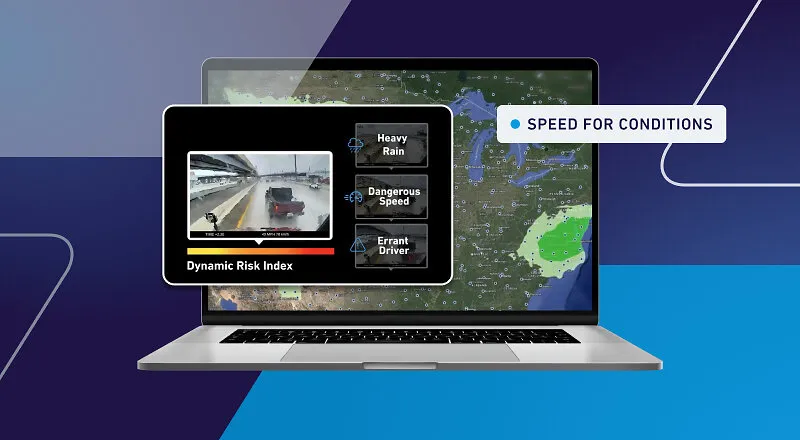
Lytx has expanded its Dynamic Risk suite with Speed for Conditions, an AI-based feature that alerts commercial drivers when they may be traveling too fast for current road conditions, not only when they exceed the posted limit. According to the company, the capability is available now.
- Lytx added Speed for Conditions to its Dynamic Risk suite, available now.
- The feature uses MV+AI to detect weather and applies a fleet-configured speed threshold.
- An in-cab alert triggers after a sustained 30-second interval above the adjusted threshold.
- Events are tagged separately from standard speeding, scored in the Dynamic Risk Index and queued for coaching.
- Dynamic Adjust for Zones and Route Hazards are listed as coming soon.
How Speed for Conditions works
Speed for Conditions relies on Lytx's machine vision and artificial intelligence (MV+AI) technology to detect changing road conditions caused by inclement weather. It then calculates a condition-adjusted speed threshold that each fleet can configure, and that threshold can be used to alert drivers in the cab when their speed may create elevated risk.
Lytx describes the process in four steps:
- Detect: on-device MV+AI classifies adverse weather conditions in real time.
- Calculate: the system computes a Condition Adjusted Speed Limit based on each fleet's configurable speed-reduction policy for weather.
- Alert: when a driver exceeds the adjusted threshold for a sustained 30-second interval, an in-cab alert can notify the driver through audio, LED, or both.
- Record and score: the event is tagged as Speed for Conditions, treated as a distinct behavior from standard speeding, reflected in the Dynamic Risk Index, and queued for coaching with supporting context.
Coaching with context
Coaches can review the full context of an event in the Event Viewer, including actual speed, effective threshold, and the detected road condition. According to Lytx, this helps managers explain why an event was unsafe, strengthen driver buy-in, and reinforce safer decisions without treating every speeding event the same.
Chris Cabrera, Chief Executive Officer at Lytx, framed the feature around the gap between legal and safe driving. "Every driver knows the speed limit, but the speed limit is not always the safe speed," he said.
Dynamic Risk is Lytx's suite of features for identifying, assessing and acting on environmental risk in real time. The company says it combines what is happening inside and outside the cab with road context, weather intelligence, and insights from over 341 billion miles of driving data.
The wider Dynamic Risk lineup
Lytx lists several other capabilities in the suite. Three are available now:
- In-Cab Weather Alerts: real-time notifications that raise driver awareness of approaching hazardous conditions, while manager notifications can support rerouting, scheduling changes or other precautions.
- Weather Tagging: covers close to 100% of events, including nighttime driving through ambient light detection. Wet Road and Snowy Road detection work at night when ambient light is present, while Low Visibility tagging remains daylight-only by design.
- Roadwork Detection: uses machine vision to identify active construction and roadwork zones so fleets can better understand delay, schedule and safety impacts.
Two more are listed as coming soon. Dynamic Adjust for Zones adds geofence-driven policy controls that can automatically adjust camera behavior, MV+AI enable/disable, and zone-specific speed control when a vehicle enters or exits defined areas. Route Hazards is meant to flag elevated-risk routes in advance, including low-clearance bridges and high-risk intersections.
What it means for fleets
For fleet operators, the change is that speeding can be assessed against conditions rather than a fixed sign. Because Speed for Conditions is scored separately from standard speeding, managers can see which events were tied to weather and coach accordingly. The thresholds follow each fleet's own policy, so the level of speed reduction is set by the fleet rather than by Lytx.
Lytx says the combined capabilities should help fleets protect drivers, reduce collisions, control claims and operate more efficiently. Those outcomes are the company's own claims, and the announcement does not include performance data for the new feature. Lytx says it protects and connects more than 6.3 million drivers. Fleets interested in the feature can request a demo through the company's website.