Harvard student uses machine learning to fix subseasonal weather forecasts
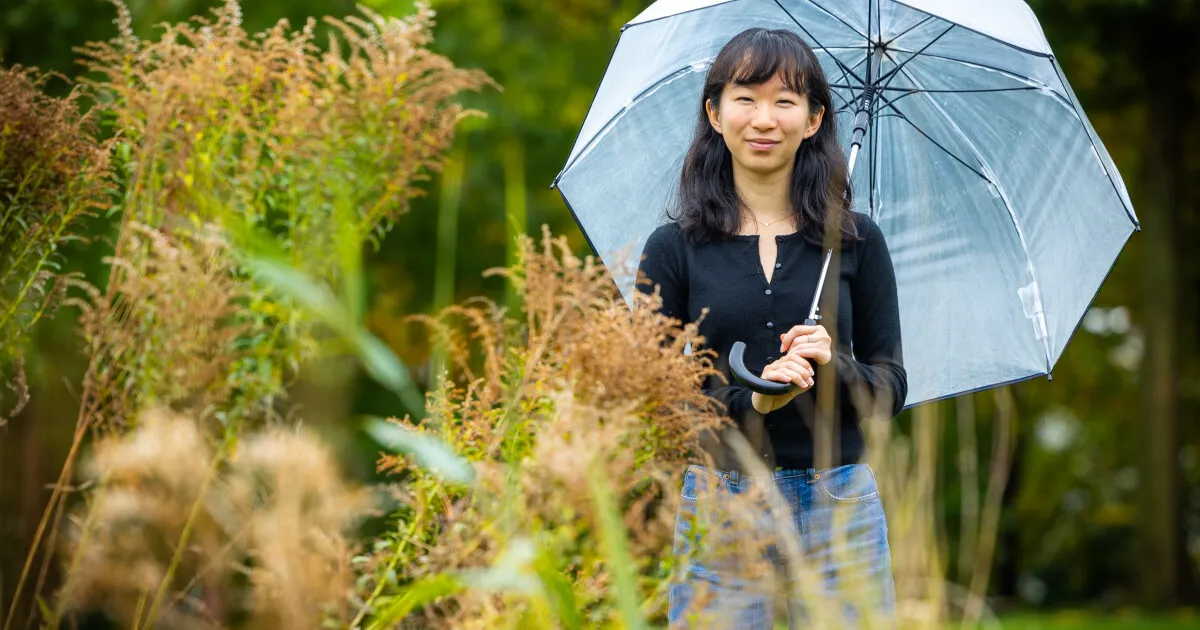
Hannah Guan, a fourth-year applied math concentrator at Harvard SEAS, helped develop a machine learning approach that corrects errors in existing weather models for forecasts two to six weeks ahead. The work began in a summer internship at Microsoft Research and led to a first-author publication in Nature.
- Hannah Guan, a Harvard SEAS undergraduate, worked on subseasonal forecasting at Microsoft Research.
- Subseasonal forecasts cover 2-6 weeks ahead, a range where Guan says models are less accurate and research is thin.
- The method predicts where existing weather models get it wrong and corrects those errors.
- According to Guan, it is not compute-intensive and can be applied to any existing weather model.
- The work led to a first-author publication in Nature.
A forecasting gap between weather and climate
Tomorrow's weather is easy to check on a smartphone, and climate scientists model patterns years into the future. The stretch in between, 2-6 weeks out, is known as the subseasonal range. According to Harvard SEAS, predictive models are critical in this period.
Guan says the horizon matters for several groups. "This time horizon is very important for farmers who are looking to plan when they want to either plant or harvest their crops," she said. She also pointed to city planners who must decide how much energy to allocate to the grid ahead of a cold front. In her words, little research has been done at this horizon, and existing models "just don't reach the same level of accuracy as the short-term or the longer models are able to do."
Modeling the error instead of the weather
Guan joined Microsoft Research after her sophomore year at the Harvard John A. Paulson School of Engineering and Applied Sciences. There she helped develop machine learning algorithms to better predict subseasonal weather and precipitation patterns. She kept working after the internship ended and became first author on a recent Nature publication.
Her starting point is that large physics-based models and AI foundation models already capture overall trends well but still make many errors on subseasonal timescales. "Instead of trying to predict the weather directly, we wanted to try to predict where these models that are typically used get it wrong," she said. "We're basically trying to build a model that models the error in existing models."
The research focused on probabilistic subseasonal forecasting. This breaks a prediction into a range of conditions or temperatures, each with a percentage likelihood. The team looked for potential errors in how a forecast was made and used its machine learning algorithms to remove them.
Guan named two advantages:
- The method does not require building something extremely large and compute-intensive.
- It is highly adaptable, because it can be applied to correct the forecasts of any existing weather model.
Research path and next steps
The internship was not Guan's first research role. She studied genetic variations and traits at the Harvard T.H. Chan School of Public Health and worked at the Kempner Institute of Natural and Artificial Intelligence during her first two years at SEAS. She sought out Microsoft Research to compare academic and corporate research. After being accepted, she was matched with a mentor who had been working on weather forecasting, and she said she was immediately interested because the problem is applied and its benefits are clear.
Outside research, Guan served as Co-Director of Programming for the 2025 Women Engineers Code (WECode) Conference at SEAS. In high school in San Antonio she founded Math Include, which Harvard describes as a now-international STEM tutoring nonprofit. She has also been a course assistant for several classes.
She is now working on a senior thesis about task memory challenges in artificial intelligence and is applying to Ph.D. programs related to computer science and applied math.
What it means for forecasting
The source does not give accuracy figures, so the size of the improvement is not stated in this account. What it does describe is a practical design choice: a correction layer that works with existing physics-based and AI models rather than replacing them. Because it can be applied to forecasts from any existing weather model, the approach could be used alongside the systems that agencies and companies already run. For users such as farmers and grid planners, the stated goal is more reliable guidance in the 2-6 week window.
Harvard SEAS: Predicting weather subseasons with machine learning