Meta's Muse agent hits 10.9 million downloads as rivals ship AI agents

A new personal AI agent has been downloaded 10.9 million times in the six weeks since its September 8 launch, according to Sensor Tower data reported by Yahoo Finance. The product is Meta's Muse, and the figures arrive as Yelp, Snap, SoundHound AI and Nextdoor all push their own AI features.
- Meta's Muse agent reached 10.9 million downloads in six weeks, with more than 10.2 million in the U.S., per Sensor Tower.
- Sensor Tower estimates about 2.5 million daily active users on October 16, up 15% week over week.
- Muse can send emails, book travel and negotiate, and asks for approval before sending or buying.
- Yelp, Snap, SoundHound AI and Nextdoor have all launched new AI agent or AI-driven features recently.
Muse's early numbers
According to Sensor Tower data reported by Yahoo Finance on October 20, more than 10.2 million of the 10.9 million downloads came in the United States. Sensor Tower estimates the agent reached about 2.5 million daily active users for the first time on October 16, with daily users up 15% week over week. The firm also says only 11 other apps have reached 10 million U.S. downloads within 40 days.
Yahoo Finance also reported that U.S. downloads of a leading chatbot app fell 25% over the past 30 days compared with the prior 30-day period. A Deutsche Bank analyst projected that the product could account for as much as 8% of its parent company's revenue by 2030, roughly $36 billion, with a low-end estimate of $2.4 billion, according to Yahoo Finance. The download and usage figures are third-party estimates.
What Muse does
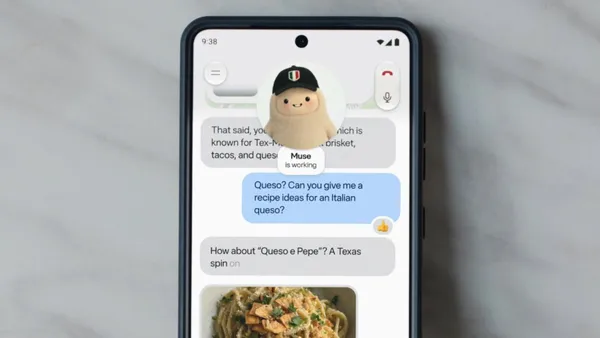
Meta introduced Muse on September 8 as a secure, private personal AI agent powered by its Muse Spark model. It is designed to send emails, book travel, fill out forms and negotiate on a user's behalf, and it asks for approval before actions such as sending an email or making a purchase.
Muse rolled out in the U.S. on iOS, Android and muse.ai, and can be messaged in WhatsApp. It is free for most uses, with subscription plans available. Meta has since added a small-business version and introduced new Muse Wonder models that it says will soon power experiences in Muse. The company reports third-quarter 2026 results after the market close on October 21.
The release frames the difference between an agent and a chatbot as action: instead of only answering questions, agents are built to book, call, compare and complete tasks, often inside apps people already use daily.
Other companies build their own agents
Yelp announced its 2026 Fall Product Release on October 20, with more than 30 new features, integrations and updates. Yelp Assistant can now book tables at tens of thousands of additional restaurants on iOS, bringing coverage to more than half a million restaurants when combined with existing partners. A feature called Check for Me uses an AI phone agent to call a restaurant, confirm the current wait time and text the answer back within minutes. It is rolling out in the coming months in the U.S. on iOS. Yelp said about 10% of its Request a Quote submissions came through Yelp Assistant in the second quarter.
Snap introduced SPECS Intelligence in September, described by the company as an anticipatory AI service for iPhone, Mac and its SPECS augmented reality glasses. Early access is by invitation through the SPECS Mac app, while U.S. users 18 and older can try a mobile preview in the SPECS iOS app. Snap said personal content from connected accounts will not be used to train its AI models or serve personalized ads.
SoundHound AI introduced OASYS Edge, an embedded architecture that brings LLM-powered voice AI agents to hardware in vehicles and smart devices, scheduled for deployment in late 2026. It also completed its acquisition of LivePerson in September.
Nextdoor introduced Neighborhood Intelligence on October 7, an advertiser product that uses AI to interpret local signals across 350,000 neighborhoods. The company said pilot campaigns showed a 1.28x lift in brand awareness. In September it upgraded its AI-powered search in the U.S.
What it means
The source argues that the market for AI assistants remains wide open. Companies with large, engaged audiences or specialized local data are in a position to compete, and several have shipped new AI features in the past six weeks. Muse's download pace shows how quickly users will try an agent that sits inside familiar apps. Whether that interest holds will depend on usage data in the coming months.
The article comes from Stock Preachers, a commentary publisher that says it owns shares of Meta, and it is not investment advice.