Meta details PrivacyLib, a shared library enforcing privacy at data access
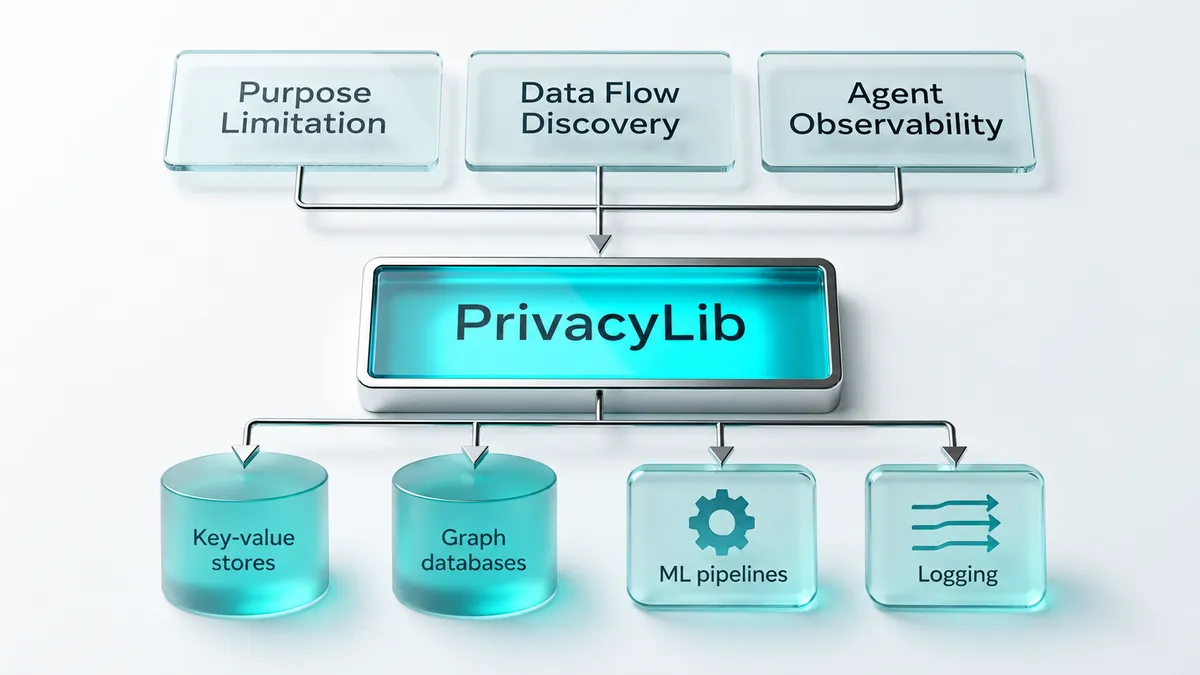
Meta has described PrivacyLib, a common library that runs inside the clients of hundreds of its data and processing systems and checks privacy requirements at the point of data access. According to Meta, it performs billions of checks every second.
- PrivacyLib is a common library running inside the clients of hundreds of Meta's data and processing systems, at the point of data access.
- Meta says it performs billions of checks every second.
- New privacy requirements plug in as enforcing or observing modules, avoiding separate implementations that previously could take months.
- An Agent Observability module covers internal AI agents by carrying agent context on supported tool-call paths.
- Enforcement ships through each owning service's own pipeline, with changes simulated and rolled out per module.
One integration, many privacy capabilities
PrivacyLib is part of Meta's Privacy Aware Infrastructure (PAI), which Meta says is built to answer a recurring question: can it prove that a piece of data goes only where it is allowed? Meta says that at its scale it does not want to rely solely on manual privacy audits, which can go out of sync as systems change. PrivacyLib covers what Meta calls the final stage of the PAI workflow: continuously enforcing and monitoring data flows.
Before PrivacyLib, Meta integrated privacy enforcement separately into the clients of each data and processing system for each requirement. According to the company, implementing a new requirement across systems could take months. PrivacyLib separates system integration from requirement implementation. A system is integrated once, and when a requirement can be met at the point of data access, it is built as a module shared across all systems already integrated.
There are two kinds of modules:
- Enforcing modules can block a data access. Policy Zones, which enforces purpose limitation, is one example.
- Observing modules only record a data access. Privacy Probes, which collects runtime signals used to discover data flows, is one example.
Meta also added an Agent Observability module as internal AI agents became a new way of accessing data. It observes agent-related data access events and helps safeguard the data agents can reach. For agents, whose access paths may not be known in advance, tool calls on supported paths carry agent context to PrivacyLib. That context links each access to its session, so modules can observe data use and block disallowed operations.
Scale and how Meta handles it
Meta lists the scope of PrivacyLib's operation: more than a hundred libraries used to access data services, from key/value stores to AI features, thousands of production services with versions of the deployed library, millions of assets accessed daily, and billions of checks every second. It names three challenges.
Coverage. Systems can have multiple client libraries and legacy integrations, accept direct network calls and offer direct database access. Meta integrates at two levels: typed client libraries, where PrivacyLib has full request context, and lower network boundaries on remaining RPC paths. Each system maps its native APIs to PrivacyLib's common operations, so the same module can then be enabled in several systems without separate integration work.
Scale. Even a small cost per check matters at billions of checks per second. Meta says it compiles requirements at build time into their simplest evaluable form and answers most checks from in-process caches, so the common path avoids a network call.
Reliability. Privacy logic runs in the hot path of critical systems owned by teams that release on their own schedules. Because a fleet-wide rollback cannot be the recovery path, enforcement is deployed as part of the service that owns it and reaches production through that service's own pipeline. Changes are also simulated and rolled out per module.
Example: protecting messaging metadata
Meta walks through a case involving messaging metadata. Messenger's backend systems process non-content data, such as information about when messages are sent or delivered, to improve product performance, detect abuse and protect users from harmful conduct, subject to applicable law. Many backend services write this metadata to data warehouse tables through Logger, a client library.
Before a record is written, the PrivacyLib integration inside Logger invokes Policy Zones to check whether the metadata may flow to the destination table. The annotation describing the data is declared once in the destination's LoggerConfig rather than by each writing service, so every writer shares the same description and declarations cannot disagree. Logger's code-generation pipeline then translates the configuration into an artifact PrivacyLib can consume, carrying the destination identity and the messaging annotation.
What it means
For Meta, the approach means a new privacy capability arrives as a module rather than a project. Meta says systems already integrated with PrivacyLib picked up the Agent Observability module without new integration work. The design is also meant to let products keep evolving quickly while privacy requirements are checked within the infrastructure itself.
Engineering at Meta: PrivacyLib: Privacy Controls at the Data Access Boundary