Meta details Prometheus, its gigawatt-scale AI supercluster in Ohio
Meta has completed the first phase of Prometheus, a gigawatt-scale AI supercluster in New Albany, Ohio, and says it trained the Muse family of foundational models. According to Meta, the cluster is being scaled toward roughly 1 million GPUs.
- Meta has finished the first phase of Prometheus, a gigawatt-scale supercluster in New Albany, Ohio, used to train the Muse models.
- Meta plans roughly 1 million GPUs at full scale; today the cluster has hundreds of thousands.
- Muse Wonder runs reached more than 85% goodput in pre-training and more than 90% in RL, according to Meta.
- MTBI rose from about 47k to more than 54K GPU hours after later fixes.
- Two NVIDIA platforms, GB200 and GB300, are deployed, with Vera Rubin NVL72 arriving soon.
From web traffic site to frontier training hub
Meta describes Prometheus as its most ambitious AI infrastructure project to date. According to the company, New Albany was a conventional data center running web traffic two years ago. Advances in hardware, networking and building design allowed Meta to rework it into a site for training frontier models.
The supercluster is being built in phases. The first phase is finished and was used to train the Muse models, including Muse Wonder, which Meta calls its new frontier models with state-of-the-art performance on personal and professional agentic tasks. Meta says the next frontier models from Meta Superintelligence Labs are the target for the continued scaling.
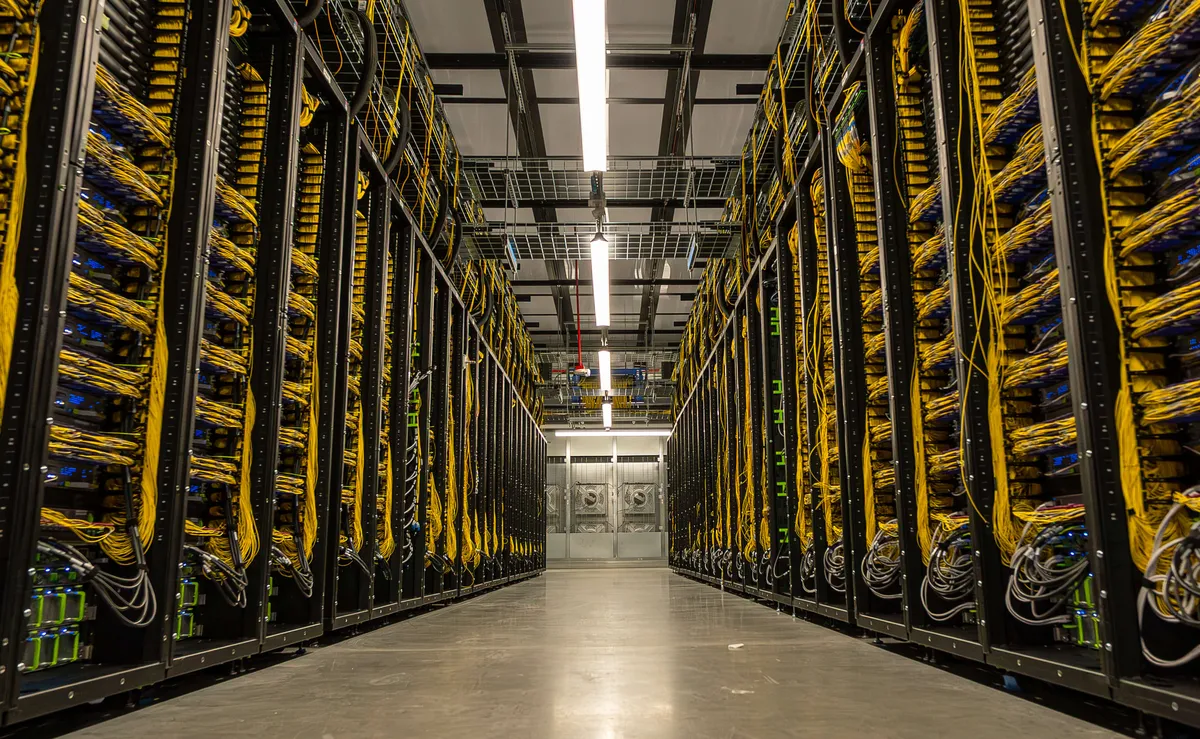
Today, Prometheus consists of hundreds of thousands of GPUs across several interconnected buildings. These include traditional and AI-optimized data center buildings and rapid deployment structures, linked by miles of fiber and working as a single machine. At full scale, Meta says, it will have roughly 1 million distributed GPUs working in lockstep. The company also points to closed-loop liquid cooling as a technology that helps the site run efficiently.
Reliability numbers for Muse Wonder
Meta stresses that a fault on a single host can slow or stop an entire training job, which lowers its goodput. By working on stability and reliability, the company says it reached more than 85% goodput for pre-training runs and more than 90% goodput for reinforcement learning runs of Muse Wonder.
During those runs, the wall-clock mean time between interruptions was about 47k GPU hours. Meta says later changes across its fleet, including firmware fixes, have raised that figure to more than 54K GPU hours, and that work continues.
Two NVIDIA platforms, a third on the way
Prometheus currently runs two NVIDIA GPU platforms, with a third based on NVIDIA's Vera Rubin NVL72 arriving soon. All use Meta's NVL72 rack architecture, in which 72 GPUs act as a single accelerator within the same network fabric.
- Catalina (GB200 NVL72): Meta deploys the Ariel variant, a two-rack setup with 36 GPUs per rack linked by NVLink into a 72-GPU domain. It pairs each Blackwell GPU with a Grace CPU and two ConnectX-7 400G NICs, giving 800G of I/O per GPU. Meta lists 13.4 TB of HBM3e, 720 peak PFLOPS of FP8 training compute and about 120 kW of total system power for the pair.
- Clemente (GB300 NVL72): According to Meta, it raises HBM per GPU by 1.5x, from 192 GB to 288 GB, and uses ConnectX-8 SuperNICs that deliver 800G per GPU natively. With a 2:1 GPU-to-CPU ratio, the full 72-GPU domain fits in one rack. Meta lists over 1 exaFLOP of peak FP4 compute, about 135 kW rack power and a 5-10% performance improvement over the GB200 NVL72.
Meta explains it chose the Ariel configuration because the GB200 NVL72 scaled up nearly every dimension relative to the H100, while scale-out bandwidth per GPU would have stayed at 400G. The company expected that imbalance to cost performance.
A dedicated network for GPU traffic
Meta says that in addition to its standard data center network, it added a second Ethernet-based network several years ago, called the Back-End (BE) network, for direct GPU-to-GPU communication within and across buildings. Its design reflects how large pre-training jobs split into data-parallel replicas: latency-sensitive and bandwidth-sensitive traffic stays inside a replica, while more tolerant traffic runs between replicas.
Within a building, each Ethernet fabric connects up to 20,736 GPUs. Meta first used a Disaggregated Scheduled Fabric, then moved to a Non-Scheduled Fabric using 51.2T Ethernet switches such as Minipack3 and Minipack3N as NIC technology advanced. Both run on Meta's FBOSS networking stack. Buildings are linked by the Backend Aggregation network, a multi-layer hub-and-spoke design spanning 2 km to over 100 km, built with Arista 7800-series chassis.
What it means
The post shows how Meta is tying model development to infrastructure scale. The company says the capacity lets it pursue larger models and longer context windows than were previously practical. Further phases are planned for Meta Superintelligence Labs' next frontier models.
Engineering at Meta: Inside Prometheus: Meta’s Journey to a Gigawatt-Scale Supercluster