Minisforum MS-S1 MAX-P495 Brings 192GB Unified Memory to a Compact AI Workstation
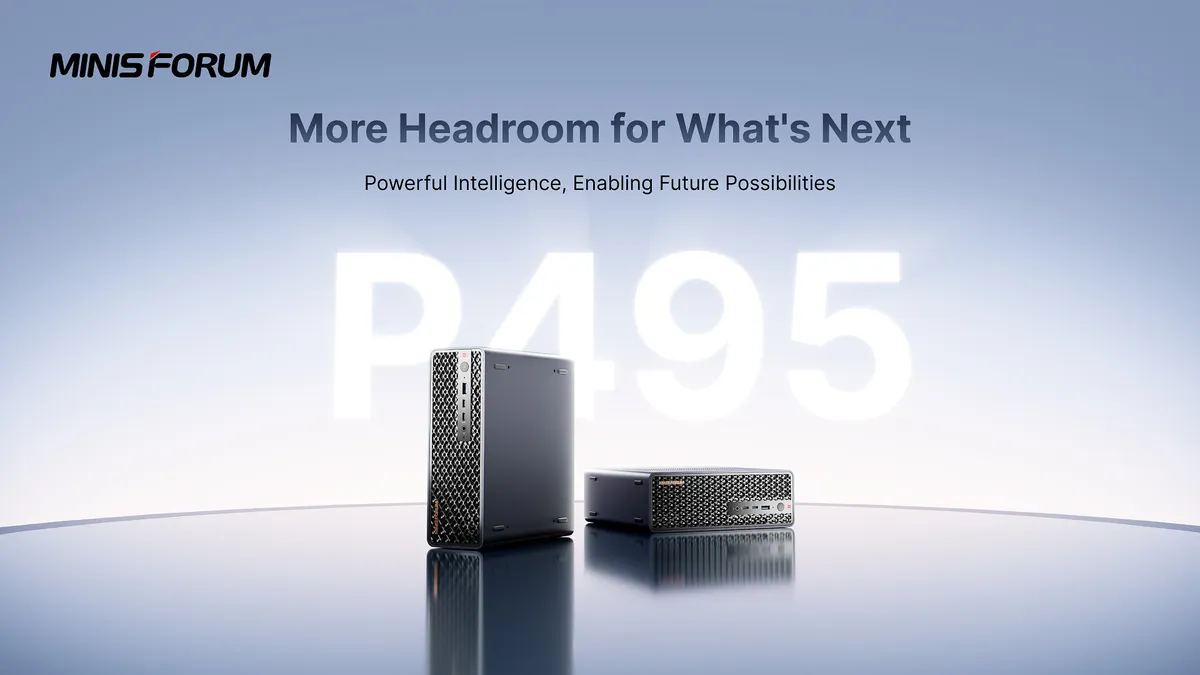
Minisforum has launched the MS-S1 MAX-P495, a compact AI workstation with up to 192GB of unified memory, aimed at running large language models locally. The company says it can handle 300B-class models on a single system and scale up through clusters.
- Minisforum's MS-S1 MAX-P495 uses the AMD Ryzen™ AI Max+ PRO 495 and offers up to 192GB of unified memory, up from 128GB.
- Maximum allocatable VRAM rises from 96GB to 160GB, and the company claims support for 300B-class models locally.
- Minisforum reports DeepSeek V4 Flash 284B (Q4) at approximately 12 tok/s on one system and Qwen3.5-397B at approximately 16 tok/s on two.
- A four-system setup ran DeepSeek-R1 671B Q4 (380GB) in testing, and 2U rack deployment is supported.
- Pre-orders start at US$7,399 after a 20% discount from US$9,249, with shipping expected in mid-October.
A new processor and a bigger memory pool
The MS-S1 MAX-P495 follows the MS-S1 MAX, which uses the AMD Ryzen™ AI Max+ 395. The new model is powered by the AMD Ryzen™ AI Max+ PRO 495. According to Minisforum, the chip is built on the Zen 5 architecture, with 16 cores and 32 threads, clock speeds of up to 5.2GHz and integrated Radeon™ 8065S Graphics.
Minisforum states that the processor delivers up to 55 TOPS of NPU performance and 131 TOPS of total AI compute. The company targets AI enthusiasts, developers, geeks and professional creators who need more local computing power.
The main upgrades over the previous model concern memory. Maximum unified memory rises from 128GB to 192GB, and the maximum allocatable VRAM grows from 96GB to 160GB. The larger shared CPU and GPU memory pool increases the size of the models a single system can handle, according to the company.
Test results for large models and clusters
Minisforum says the MS-S1 MAX-P495 supports running 300B-class large language models locally. In its model testing, DeepSeek V4 Flash 284B (Q4) ran on a single system at approximately 12 tok/s. The company lists local inference, AI application development, multimodal generation, AI-assisted creation and 3D rendering as possible uses.
The system can also be expanded through multi-system setups:
- Two 192GB units can form a dual-system cluster that runs Qwen3.5-397B locally at approximately 16 tok/s.
- The device supports 2U rack deployment, so multiple units can be linked into a distributed cluster.
- In testing, a four-system configuration ran DeepSeek-R1 671B Q4 (380GB, Q4_0 quantization).
Minisforum says this extends local AI computing from individual desktops to larger deployments for enterprises and research teams.
Pricing, availability and company strategy
The MS-S1 MAX-P495 with 192GB RAM and a 2TB SSD is available for pre-order at a regular price of US$9,249. A 20% discount brings the price to US$7,399. Shipping is expected to begin in mid-October.
The launch fits what Minisforum describes as its Local AI strategy. The company says it is moving from high-performance standalone AI systems toward scalable local computing platforms, with a portfolio that spans standalone workstations and multi-node deployments. It cites demand for local large-model processing, data privacy, low-latency performance and greater control over AI workloads as the drivers.
Minisforum was founded in 2018 and describes itself as a global edge computing solution brand and system integrator. It says it serves more than 4 million users across 100+ countries.
What it means for local AI users
For users who want to run large models on their own hardware, the larger memory ceiling is the central change. All performance figures in the announcement come from Minisforum's own testing, and the speeds quoted, around 12 tok/s on one system and around 16 tok/s on two, show the throughput the company reports for those specific models and quantization levels.
The price remains high compared with typical desktop PCs, but the company positions the device as a compact alternative for developers, creators and small teams that want to keep AI workloads local rather than in the cloud.