MIT's X-Hinges software designs 3D-printed objects that sense touch
Researchers at MIT CSAIL and Tianjin University in China have built X-Hinges, a design tool that automatically embeds sensors in 3D-printed objects so they can perceive and respond to human contact. According to the team, it avoids the signal interference that has limited earlier approaches to one axis of motion.
- MIT CSAIL and Tianjin University built X-Hinges, software that embeds sensors in 3D-printed objects.
- It uses one filament for sensors and another for traces to avoid signal interference.
- Users can choose up to three axes of motion: compressing, up and down, or sideways.
- Demos include a robot-teaching glove, an origami-style lamp and a shark-shaped game controller.
- Calibration between prints remains a bottleneck, addressed for now by a computer vision system.
Two materials to avoid signal confusion
Earlier 3D-printed sensing items typically used the same conductive material for both the sensors and the traces, the wire-like paths inside the object. According to MIT, the two components therefore emitted similar signals, much like hearing two radio stations at once. A glove that relays instructions to a robotic hand, for example, could not filter out the noise or verify the angle of a user's motions, which led the robot to make errors.
With X-Hinges, users customize a design and the software automatically embeds two different materials. One filament is meant for the sensors and is designed to send the strongest signal possible. The other is used for the wire-like elements so they do not interfere. The researchers say this allows objects such as small robots, household decor, object-detection systems and toys to respond in real time.
Up to three axes of movement
Users assemble an item by selecting and connecting shapes, then choosing how parts move. X-Hinges offers four shapes: a custom option, cylinder, rectangle and thin outline. Movement is not limited to one direction as in previous approaches. Users can select up to three axes: compressing, up and down, or to the sides.
The tool then places sensors where the object bends. In a robotic hand, fingertips might move vertically and laterally, so sensors at the joints capture motion data from both angles.
"Most methods only allow for one axis of motion, often due to signal interference. X-Hinges enables your 3D-printed item to move from three angles," says lead author Xiang Chang, a Tianjin University PhD student and visiting researcher at CSAIL. He adds that the device also records motion data in each of those areas at the same time.
Demonstrations: glove, lamp, shark controller
Chang and Jiaji Li, an MIT EECS postdoc and CSAIL researcher and a senior author of the paper, built several devices with the tool:
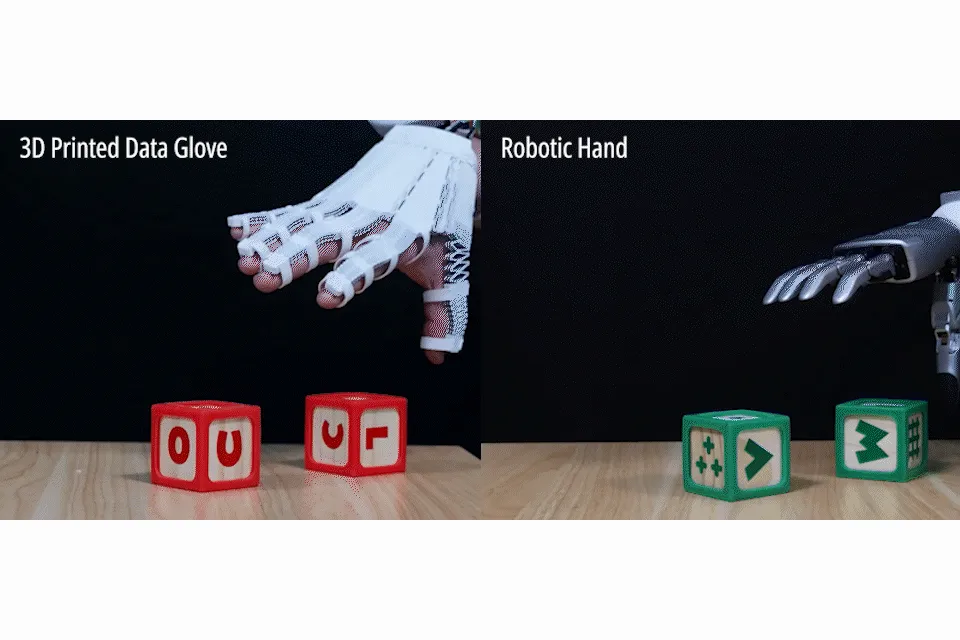
- A glove that teaches a robot to grasp blocks. It adjusts to the size of the user's hand, records how the finger joints bend and relays that to a humanoid hand to mimic it. MIT says it could be useful in factories or homes.
- An origami-style lamp that senses when a person pinches it closed and adjusts its brightness.
- A surface that identifies objects placed on it. It recognized a banana almost immediately from tactile data, and the team says such awareness could be integrated into detection systems in places like airports and grocery stores.
- A video game controller shaped like a cartoon shark, with a custom-designed tail that moves up and down like a joystick.
"It's kind of like adding a conscious element to everyday objects," Li says.
Calibration limit and next steps
X-Hinges currently faces a calibration bottleneck. Each print has a slightly different layout of electrical elements, so two outwardly identical devices may not produce the same sensor readings. That matters, for instance, for a fitness glove built for two separate users. Chang and Li built a computer vision system that recalibrates outputs to align, though they hope to develop a built-in signal recalibration mechanism.
Li says the next step is combining actuation and sensing in a single print. He previously built printed tendon-driven mechanisms that let objects move, and X-Hinges adds sensing. The paper's co-authors are MIT associate professor Stefanie Mueller and recent Tianjin University graduate Haiyang Yan. The work was supported in part by a postdoctoral fellowship from Zhejiang University and the MIT-GIST Program, and will be presented at the ACM Symposium on User Interface Software and Technology in early November.
What it means
The researchers argue that everyday items such as a water bottle or a lamp could become interactive gadgets. They compare it to a chatbot using digital intelligence to answer prompts, with an object using a kind of physical intelligence to carry out a physical task. For now, the tool remains a research project with a calibration step still needed for consistent results across prints.