NEURA's 4NE1 Wheels humanoid runs full laundry cycle live at GTC Berlin
NEURA Robotics says its humanoid robot 4NE1 Wheels autonomously completed a full laundry cycle, repeatedly and without cuts, at NVIDIA GTC Berlin 2026. The company also showed its new 4NE1 Gen 4 humanoid and laid out its plan for a European Physical AI ecosystem.
- NEURA's 4NE1 Wheels completed an eleven-minute laundry cycle autonomously, repeatedly, at GTC Berlin 2026.
- BSH appliance wash and dry cycles were shortened to about ten seconds; speed was traded for reliability and safety.
- The robot runs on Neuron AI, a multimodal model combining vision, touch, force, audio, language and memory.
- 4NE1 Gen 4 is designed for series production and is 20 percent lighter than its predecessor.
- NEURA's priority stays industry first, then service robotics, with households a longer-term goal.
An unedited demo at Booth 3031
According to NEURA Robotics, the demo ran at Booth 3031 in Hall 3 during GTC Berlin, held from October 20 to 22 at Station-Berlin. The company contrasts it with typical robot videos, which it says are edited to hide failed grasps and hesitation. Here, 4NE1 Wheels ran the task again and again throughout the show, both live at the event and online.
The robot sorted light and dark garments, loaded a washing machine and closed the door. When the cycle finished, it opened the door, unloaded the clothes, moved them into the dryer and closed the dryer door. NEURA says the full sequence took around eleven minutes and ran without human intervention.
Two details qualify the result. The wash and dry cycles of the BSH appliances were shortened to about ten seconds to keep the demo watchable. The company also says it made a deliberate trade-off: for this first public run, reliability and safety around visitors came before speed, and speed will be tuned in later model updates. On Wednesday the demo was streamed live on YouTube and LinkedIn.
Why closing the door is the hard part
NEURA argues that the difficult moment comes when the machine door closes. The garments leave the robot's view, yet it still has to know where they are, what it has already done and what comes next. The company compares this to object permanence, which humans develop in their first two years of life.
4NE1 runs on Neuron AI, the multimodal foundation model NEURA introduced on October 14. Its Perception-Language-Action (PLA) architecture combines 3D vision, touch, force, audio, language and the robot's own state with memory, and turns them into one stream of action. At the booth, this meant:
- Vision at two scales: a chest camera mapped the workspace, while cameras in the hands guided each grasp.
- Touch: inside the drum, where sight is blocked, tactile sensing takes over.
- Sound: a door latching or a connector snapping into place can be heard before it can be seen.
NEURA says the model learns which sense to rely on at each stage. It adds that the same principle applies in industry, where the quality of a weld seam can be judged by its sound.
The ecosystem behind the robot
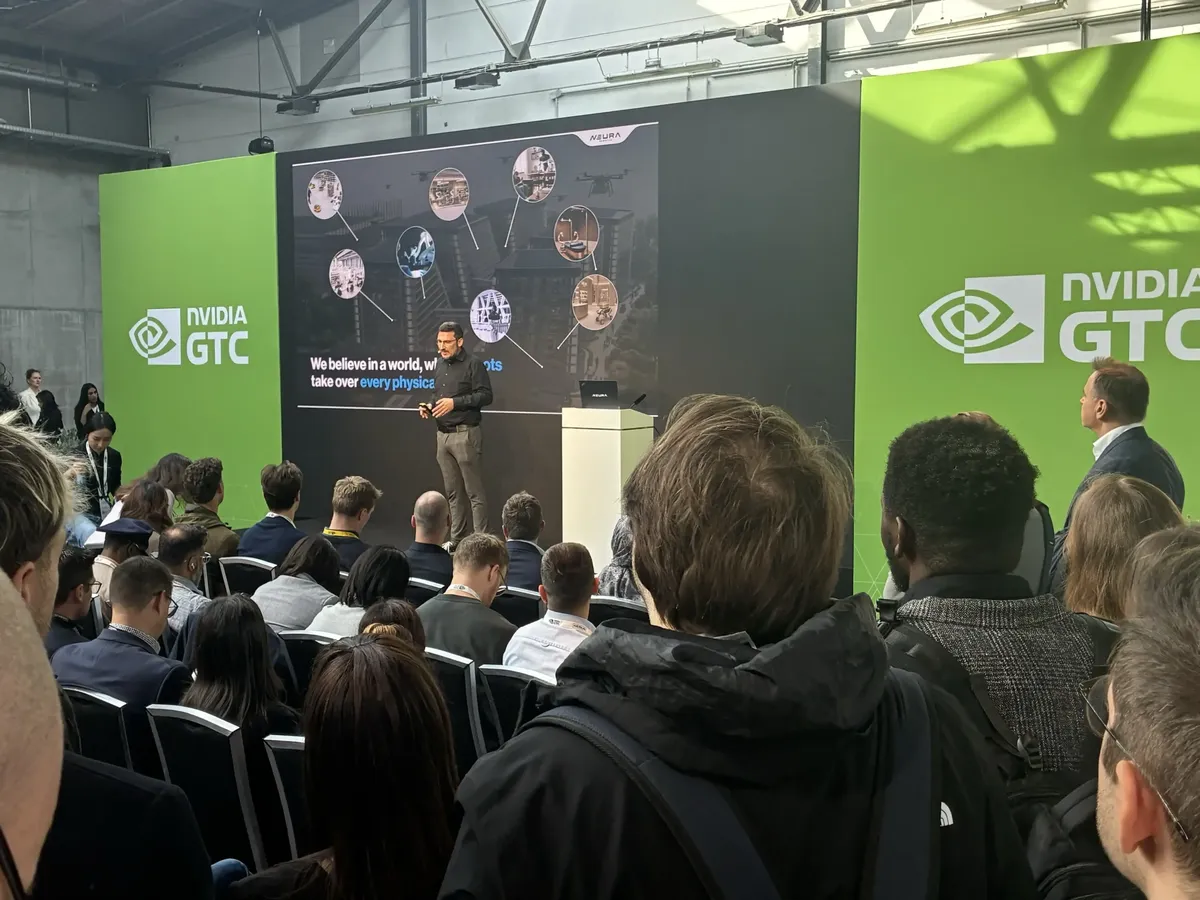
On Thursday, Arne Nordmann, VP Technology & Innovation at NEURA Robotics, gave the talk "From Europe, for the World: Building the Ecosystem for Physical AI" at the Sponsored Expo Theater. His argument was that a capable robot is the visible end of an ecosystem that must exist behind it.
In NEURA Gyms, domain experts such as master welders and manufacturing engineers physically teach robots their tasks. NVIDIA simulation tools then multiply that real-world data across hundreds of variations in lighting, object geometry and environment. Training runs in the cloud every day, while inference happens on the robot itself, on compute built into its chest.
Through the Neuraverse, a skill learned by one robot can be deployed across a fleet of different robot types, and partner companies can turn their own process knowledge into skills. Data partnerships with industrial companies, including Schaeffler and Bosch, add real manufacturing processes to the pipeline.
4NE1 Gen 4 and what comes next
The keynote ended with 4NE1 Gen 4 walking from the stage to the NEURA booth. The company says the new generation, launched the same day at the opening of the TUM RoboGym in Munich, is designed for series production, is 20 percent lighter than its predecessor, has a slimmer body with a textile outer skin and runs on Neuron AI. NEURA also said NVIDIA founder and CEO Jensen Huang stopped by the booth to see the robots at work.
Nordmann was clear about priorities. The laundry task is a household chore, but working with BSH is also meant to help test and develop machines that robots can easily interact with. NEURA's first focus remains industry, where, according to the company, demand is high and the operational return is clear. Service robotics follows, and households remain a longer-term goal.
NEURA Robotics: NVIDIA GTC Berlin 2026 Recap: Robot Autonomy Demonstrated Live