NVIDIA expands Agent Toolkit to ground enterprise agents in company data
NVIDIA has expanded its open source Agent Toolkit with a new Agent Knowledge Foundation, designed to let enterprise agents draw on company data while running inside defined security boundaries. According to NVIDIA, the foundation is already in use at several large enterprises and software vendors.
- NVIDIA expanded its open source Agent Toolkit with the new Agent Knowledge Foundation.
- The foundation adds an Auto-Ontology library and the Kumo family of open models alongside Nemotron Retriever.
- OpenShell provides the secure runtime, and NemoClaw blueprints include a new one for agent optimization.
- Palantir, Databricks, Snowflake, SAP, ServiceNow and Zoom are named as users.
- NVIDIA says companies can adopt it without moving data or changing governance controls.
What the expanded toolkit contains
NVIDIA frames the update around a simple idea: "Agents are only as useful as what they know, and only as trustworthy as the boundaries they run within." The company says enterprises are using the toolkit to customize and control agents, feed company data into their answers and actions, monitor behavior and govern how agents operate.
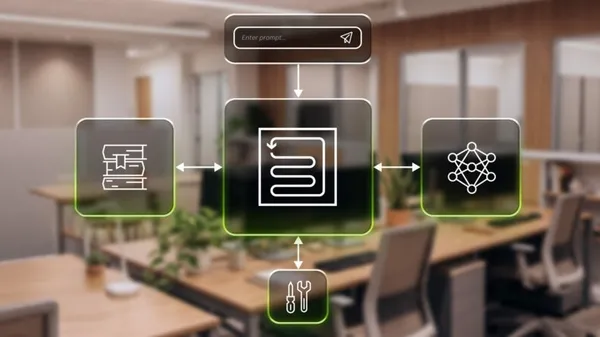
The Agent Toolkit now comprises several parts:
- The new NVIDIA Agent Knowledge Foundation, built on NVIDIA CUDA-X libraries
- NVIDIA open models, including Nemotron Retriever and the new Kumo family
- NVIDIA OpenShell, a secure agent runtime
- NVIDIA NemoClaw, a set of secure agent blueprints
- Tools and skills such as NeMo Relay and NeMo Compass
NVIDIA argues that builders need an open agent stack that brings together models, harness, runtime, data and tools if agents are to do real work and stay trustworthy from development to deployment.
How Agent Knowledge Foundation works
According to NVIDIA, the foundation helps companies turn data into intelligence that agents can use to find relevant information, understand what it means for the business and make predictions that help people decide what to do next. The company says enterprises can adopt it without moving data, rebuilding existing workflows or changing governance controls.
It includes CUDA-X libraries cuDF, cuGraph, cuML, cuOpt and cuVS, plus a new Auto-Ontology library. NVIDIA says Auto-Ontology translates raw company data into familiar business concepts, such as customers, products and orders, and maps how they relate to each other.
The foundation also bundles Nemotron Retriever and the Kumo Structured open models: Kumo Tabular, Kumo Relational, Kumo Time Series and Kumo Forecast. These models help agents locate relevant company information to answer questions and make predictions.
On the control side, OpenShell sets the secure runtime boundary, giving enterprises control over what agents can access and do. NemoClaw blueprints serve as reference designs for secure, specialized agents. The newest one, for agent optimization, offers a step-by-step starting point for improving agent intelligence so agents get better at their jobs over time.
Early adopters and reported results
NVIDIA names several organizations already using the technology. Its own supply chain organization works with Palantir, using Agent Knowledge Foundation through Palantir Foundry, Ontology and AIP to deploy specialized agents, create actionable intelligence from proprietary data, predict outcomes and optimize decision-making.
Databricks pairs NVIDIA Kumo Anomaly with Databricks Genie Ontology to power context-aware agents. Snowflake is enabling customers to use the NVIDIA Kumo Engine and Kumo Relational open models in Snowflake Notebook environments for more predictive capabilities.
For Nemotron Retriever, NVIDIA reports several results from partners:
- Amazon OpenSearch Service improved relevance with fewer search steps and virtually no added latency using the embedding model.
- SAP's fine-tuned reranker ran nearly 3x faster.
- ServiceNow improved reranking quality while cutting latency by nearly a quarter.
- Zoom is using the models to improve document understanding, search relevance and context retrieval for Zoom AI Services.
NVIDIA also lists AWS, ClickHouse, Cloudera, Cohesity, Dassault Systèmes, Dell, Elastic, Exa, IBM, NetApp, Oracle, Perplexity, Starburst and VAST Data among those building on the foundation.
What it means for enterprise teams
The announcement, made around GTC Berlin, points to an approach in which agent quality depends on access to well-organized company data, and agent safety depends on a controlled runtime. For enterprises, NVIDIA's pitch is that they can add this layer on top of existing data platforms and governance setups rather than starting over.
The partner list spans data platforms, search tools and enterprise software, which suggests the components are meant to slot into stacks companies already run. The performance figures come from NVIDIA's account of partner results. NVIDIA is also pointing interested builders to a GTC Berlin session on building, deploying and optimizing specialized agents in production.