NVIDIA Introduces Alpamayo 2 Edge for Real-Time AV Reasoning
NVIDIA has introduced Alpamayo 2 Edge, a 2B-parameter vision-language-action model designed to bring adaptive reasoning and trajectory generation to onboard autonomous vehicle systems. The model is built for real-time operation on NVIDIA DRIVE AGX Thor and is available for exploration through Hugging Face.
- Alpamayo 2 Edge is a 2B-parameter vision-language-action model.
- It is designed for real-time operation on NVIDIA DRIVE AGX Thor.
- Closed-loop reinforcement learning improved performance by 48.9%, according to NVIDIA.
- AlpaJudge evaluates reasoning and supplies rewards for post-training.
- NVIDIA reports 160-190 ms pixel-to-trajectory latency with its deployment recipes.
A compact model for onboard driving
Alpamayo 2 Edge is based on a 2B-parameter Nemotron reasoning backbone from NVIDIA Cosmos 3 Edge and is paired with a diffusion action expert. According to NVIDIA, it processes surround-camera observations, temporal context, historical ego-motion and navigation inputs to produce future driving trajectories.
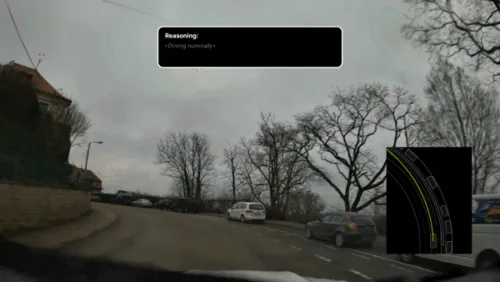
The model uses Chain-of-Causation reasoning, but does so adaptively. It can generate reasoning when needed and use special <NOMINAL> tokens instead of reasoning traces at other times. NVIDIA says this approach reduces unnecessary token generation and conserves inference compute during routine driving.
Its development also includes offline distillation using Chain-of-Causation autolabels generated by Alpamayo 2 Super, multi-resolution inputs for surround-view observations, and speculative decoding with DFlash2. NVIDIA has also provided recipes for quantization and inference acceleration with TensorRT and NVIDIA TensorRT-Edge-LLM.
Reinforcement learning and reasoning evaluation
NVIDIA says Alpamayo 2 Edge was post-trained with closed-loop reinforcement learning in AlpaGym. According to the company, this improved closed-loop driving performance by 48.9% compared with the best-performing checkpoint without closed-loop reinforcement learning.
The development process uses AlpaJudge, a human-calibrated evaluation and reward model for assessing reasoning traces. NVIDIA describes reference-based and reference-free variants, called AlpaJudge-RB and AlpaJudge-RF, for different evidence types.
The company outlines three workflows for developers. They can run AlpaJudge on PhysicalAI-AV samples, use its scores to identify higher-value training examples, and apply human-aligned reasoning scores as rewards during post-training. NVIDIA presents these workflows as a repeatable process for measuring and improving an edge driving model.
Targeting latency limits on DRIVE AGX Thor
NVIDIA’s deployment recipes use TensorRT and DFlash2 to optimize inference on DRIVE AGX Thor. The company says they achieve 160-190 ms pixel-to-trajectory latency on the platform.
NVIDIA also reports that Alpamayo 2 Edge achieves approximately 40× the distance between at-fault incidents in AlpaSim. These are company-reported results, while partner feedback describes early tests in simulation and on vehicles.
PORT CTO Metas Simonavicius said the model ran closed-loop in NuRec reconstructions of the company’s London street recordings within days of early access. Embedl CEO and co-founder Hans Salomonsson said, “In less than 48 hours, we made NVIDIA’s Alpamayo 2 Edge run at 10 Hz on AGX Thor for real-time planning.”
Developers can explore Alpamayo 2 Edge and AlpaJudge on Hugging Face, and NVIDIA directs questions and discussion to the Alpamayo developer forum. The release gives AV teams an edge-oriented model, optimization guidance and evaluation tools for testing reasoning-based driving within onboard compute and latency limits.
NVIDIA Developer: Running AV Reasoning Models Within Onboard Compute and Latency Limits