NVIDIA and Cisco Unveil USFP, a 400Gb/s-per-Lane Pluggable Optics Module
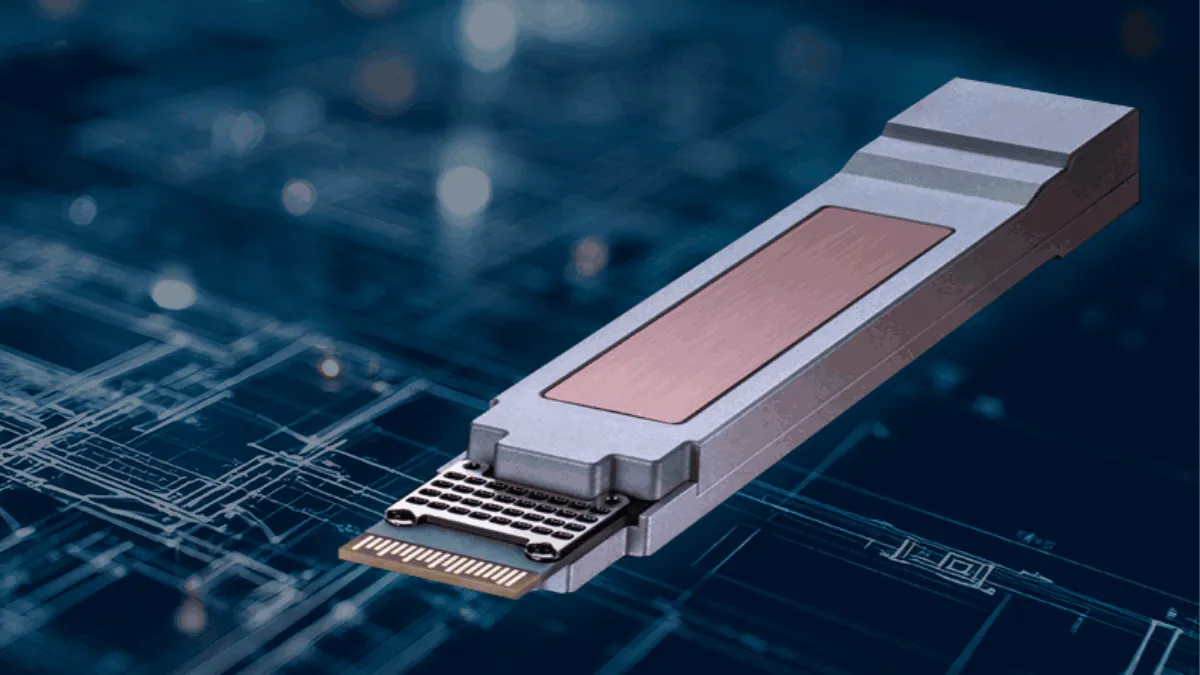
NVIDIA and Cisco have announced Ultra-Dense Small Form Factor Pluggable (USFP), a new optical module designed to be the first to support 400Gb/s-per-lane electrical signals. According to the companies, it lets AI factory builders connect more computing systems without adding network tiers.
- NVIDIA and Cisco announced USFP, a pluggable optical module designed to be the first to support 400Gb/s-per-lane electrical signals, with capacity up to 12.8Tb/s.
- According to the companies, USFP offers 4x the bandwidth density and approximately 1.3x the power efficiency of 200Gb/s-per-lane pluggable modules.
- First planned transceivers use 16 full-duplex lanes in an OSFP-sized footprint, with a path to 32 and more lanes.
- TE Connectivity and Amphenol are working with NVIDIA and Cisco on cages, connectors and modules.
- An open specification is planned through a community-led multi-source project; no pricing or availability was given.
What USFP is designed to do
The announcement was made at the OCP Global Summit on Oct. 12, 2026. USFP is a high-density pluggable optical module aimed at the next generation of AI factories. It supports capacity of up to 12.8Tb/s, according to NVIDIA and Cisco.
The companies frame the problem as one of scale. AI models are growing and inference demand is expanding, so operators must connect more computing systems while managing network complexity, power and costs. When a switch reaches its capacity, further expansion can require additional switch layers and optical links, which increases latency, power consumption and costs.
USFP is meant to let builders move from 200 Gb/s per lane to 400Gb/s-per-lane Ethernet AI fabrics while keeping a deployment model that the companies say has been proven at scale across multiple generations of data center networks.
Specifications and design
The first planned USFP-based transceivers will pack 16 full-duplex lanes in an octal small form factor (OSFP)-sized footprint. They will support both switches and SuperNICs, with the ability to expand to 32 and more lanes in the future. By doubling both lane count and bandwidth per lane, USFP enables AI fabrics to connect more 1.6Tb/s endpoints without adding network tiers, according to the announcement.
Compared with 200Gb/s-per-lane pluggable modules in an OSFP-sized module, the companies claim USFP delivers 4x the bandwidth and front-panel bandwidth density, with approximately 1.3x the power efficiency. In their words, this means builders can increase compute scale within the same network footprint while decreasing networking's share of the overall AI factory power budget.
Several hardware details stand out:
- A new two-dimensional array connector with a two-step insertion design that engages high-speed contacts after the module is inserted. The companies say this reduces contact wear, improves signal integrity and makes insertion force more predictable.
- Connector support for scaling to 32 full duplex lanes and more, plus improved performance at 200Gb/s per lane.
- Power dissipation of up to 100 watts without a separate, dedicated embedded cooling circuit within the transceiver, which the companies say reduces switch design complexity and improves reliability.
- Support for optical designs that reduce latency and power consumption by simplifying signal processing, across a broad range of optical technologies and connection distances.
Executives on the approach
Gilad Shainer, senior vice president at NVIDIA, said: "Building the world's largest AI factories starts with rethinking the smallest of connections."
Bill Gartner, senior vice president and general manager of optical systems and optics at Cisco, said AI builders need an interconnect architecture that can scale performance without locking them into a more complex operating model. He said USFP is designed to deliver a new level of bandwidth density while preserving "the serviceability, deployment flexibility and operational simplicity of pluggable optics." Gartner also pointed to a full-stack approach, from silicon and systems to optics and the network operating system.
Ecosystem and what comes next
NVIDIA and Cisco are working with TE Connectivity and Amphenol to build USFP cages, connectors and modules, and additional partners are expected to join. The shared form factor is meant to give suppliers a common foundation for high-density pluggable infrastructure for 400Gb/s-per-lane fabrics.
The work builds on existing collaboration to make NVIDIA Spectrum-X Ethernet networking and Cisco Silicon One-based Ethernet networks work together, which the companies say simplifies AI infrastructure deployment for enterprises, neoclouds and sovereign clouds.
NVIDIA and Cisco plan to create an open industry specification for USFP through an upcoming community-led multi-source project. The announcement describes plans and design goals, and Cisco notes in its forward-looking statements that the establishment of a USFP multi-source agreement and its expected benefits are subject to risks. The release does not give pricing or availability dates.
For data center operators, the pitch is to adopt 400Gb/s-per-lane optics without overhauling existing infrastructure, while moving more data per watt and per switch.