NVIDIA DSX MaxLPS Lifts AI Factory Throughput 49.2% Under the Same Power Budget
NVIDIA says its DSX MaxLPS software lets operators run up to 40% more GPUs within the same approved power budget. In a joint evaluation with Nscale, aggregate throughput rose 49.2% while per-instance throughput stayed effectively unchanged.
- NVIDIA says DSX MaxLPS enables up to 40% more GPUs within the same approved power budget.
- In a joint test with Nscale, 192 GPUs replaced 140 under the same 264.4 kW budget.
- Aggregate throughput rose 49.2%, and throughput per provisioned watt went from 4.10 to 6.12 tokens/s/W.
- Median and P75 latency stayed within 5% of baseline, but P99 time to first token rose 17%.
- NVIDIA recommends a five-stage validation process before production deployment.
Why static provisioning strands power
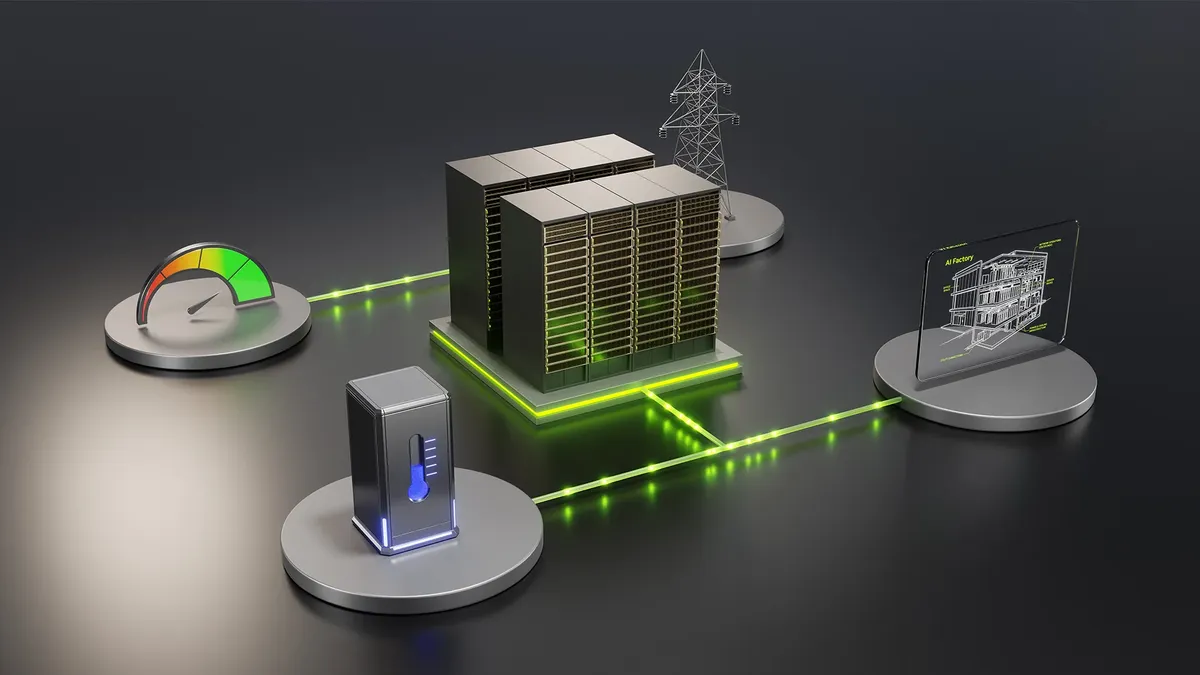
AI factories work within a hierarchy of electrical limits: utility service, substations, power-distribution equipment, racks, nodes and GPUs. Static power planning typically reserves enough power for every node to reach its specified peak at the same time. NVIDIA calls this approach conservative but notes that AI workloads rarely draw constant power.
Training moves through compute, communication, synchronization and checkpointing. Inference alternates among prefill, decode, memory-bound work, network activity and idle intervals. This variability creates a gap between reserved peak power and actual consumption. Under static per-node reservations, unused capacity in one reservation cannot be applied to another node, so the facility can stay below its limit while additional GPU capacity remains offline.
DSX MaxLPS monitors actual power consumption and reallocates available power across participating resources, while preserving the operator's aggregate budget and policy boundaries. NVIDIA stresses that this is coordinated allocation, not an increase in the site's power supply.
How the control loop works
DSX MaxLPS combines chip, system, thermal and software technologies to maximize output within land, power and shell (LPS) constraints. Dynamic Power Software provides the control layer. NVIDIA describes five technical elements:
- Topology and resource groups: operators map the infrastructure and organize nodes into a managed group with an aggregate power budget.
- Telemetry: GPU, node, rack and group power data is collected at intervals sufficient to detect headroom and emerging power events.
- Policy: operator-defined rules set node limits, group limits, allocation priorities, reserve requirements and responses to maintenance or emergency events.
- Allocation and control: when some resources draw less than their allocation, the software adjusts GPU power limits so others can use the capacity.
- Validation and enforcement: measured power is compared with the approved group budget, and allocations are adjusted as consumption nears a limit.
The Nscale test setup and results
The evaluation ran Kimi K2.5 in FP4 on NVIDIA GB300 NVL72 systems with NVIDIA Blackwell Ultra GPUs at Nscale's data center on the Verne campus in Keflavík, Iceland, which NVIDIA says is powered entirely by renewable energy. Nscale deployed the software and collected telemetry, while NVIDIA ran the workloads. The stack included NVIDIA Dynamo and NVIDIA TensorRT LLM, with an 8K input sequence length and a 1K output sequence length.
The static baseline used 35 four-GPU nodes, or 140 GPUs, running two high-throughput instances of 52 GPUs each and one low-latency instance of 36 GPUs. The DSX MaxLPS configuration used 48 four-GPU nodes, or 192 GPUs, adding a third 52-GPU high-throughput instance. Both used the same 264.4 kW provisioned power budget. Each distributed workload was confined to a single rack to control for cross-rack performance differences.
- Aggregate throughput rose from 1,084,503 tokens/s to 1,618,443 tokens/s, up 49.2%.
- Throughput per provisioned watt rose from 4.10 to 6.12 tokens/s/W.
- High-throughput output per instance went from 59,153 to 59,220 tokens/s, up 0.1%. Low-latency output per instance stayed at 2,265 tokens/s.
- Total measured power rose from 166.2 kW to 198.9 kW, and power-budget utilization from 62.9% to 75.2%.
Median and P75 latency stayed within 5% of baseline. P99 time to first token, however, increased 17% from a 15.7-second baseline. NVIDIA says this shows why tail latency should be evaluated alongside capacity and throughput.
A five-stage validation method for operators
NVIDIA outlines a repeatable process for operators before deploying at scale: define the managed boundary, establish a representative baseline, introduce policies conservatively, add capacity incrementally with testing at each stage, and set production operating limits only when all objectives are met.
The results suggest that headroom between reserved and actual power can be turned into additional GPU capacity without lowering the throughput of existing instances. The 17% rise in P99 time to first token shows the gain involves a trade-off at the tail, so operators with strict latency targets would need to check it against their own workloads. NVIDIA points readers to its DSX MaxLPS framework and Dynamic Power Software documentation for further detail.
NVIDIA Developer: How NVIDIA DSX MaxLPS Maximizes AI Factory Throughput and Efficiency