NVIDIA adds StormScope EU to Earth-2 as European firms build on open models
NVIDIA has added StormScope EU, a regional short-term forecasting model trained on European weather and climate data, to its Earth-2 family of open AI models. According to NVIDIA, organizations including AXA, Vaisala Xweather, the University of Manchester, TotalEnergies and Space42 are already building on Earth-2.
- NVIDIA added StormScope EU, a regional short-term forecasting model for Europe, to its Earth-2 open models.
- StormScope EU uses EUMETSAT data to predict cloud conditions across 16 Meteosat channels at 10-minute intervals.
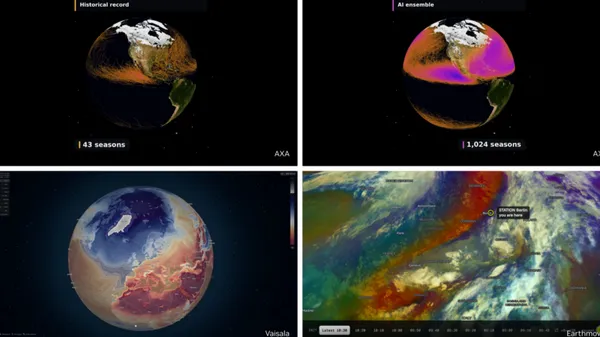
- A live demo with Earthmover at GTC Berlin serves results as map tiles, updated every 10 minutes.
- AXA, Vaisala Xweather, University of Manchester, TotalEnergies and Space42 are building on Earth-2.
- The open source PhysicsNeMo framework lets teams train models with proprietary data.
StormScope EU: satellite-based nowcasting for Europe
NVIDIA Earth-2 is a family of open AI models and tools that developers and researchers can customize with their own data. According to NVIDIA, the technology runs on NVIDIA computing and supports global weather prediction, detailed regional forecasts and environmental research.
StormScope EU is the latest addition. It is a regional version of the StormScope model, built for short-term forecasting and trained on weather and climate data for Europe. NVIDIA says it uses EUMETSAT satellite observations to predict evolving cloud conditions across 16 Meteosat channels at 10-minute intervals.
At GTC Berlin, NVIDIA is showing a live StormScope EU pipeline in an interactive weather demo built with Earthmover. The demo uses Earth2Studio to run forecasts, while Earthmover's data platform manages and serves the real-time results. These are refreshed every 10 minutes as new satellite observations arrive. Earthmover serves them as map tiles, so visitors can explore predictions across Europe without downloading entire datasets.
Combining models and training new ones
NVIDIA says developers can combine Earth-2 models in workflows tailored to regional needs. StormScope can handle short-term forecasting, while CorrDiff adds local detail to coarser weather data. The model architectures can also be trained for new environmental uses such as air-quality modeling.
The open source NVIDIA PhysicsNeMo framework supplies training and customization tools. Teams can use it to build applications that incorporate proprietary data and domain expertise.
NVIDIA frames the need in practical terms: a global forecast can show a storm forming, but decisions about solar farms, shipping routes or insured property depend on local conditions.
Who is building on Earth-2
- AXA uses FourCastNet 3 to study regional cyclone risk beyond the historical record across more than 1,000 simulated seasons. According to NVIDIA, the insights can inform risk assessments and help customers target prevention efforts.
- Vaisala Xweather combines Earth-2 with its proprietary observations, lightning data and forecasting expertise. It is adapting StormScope with lightning data to extend short-term forecasting lead time, and plans to make the warnings available through its software-as-a-service offerings and AI-assistant integrations.
- University of Manchester researchers adapted CorrDiff for U.K. air-quality modeling. They trained it on the Isambard-AI supercomputer and ran it locally on NVIDIA DGX Spark systems, moving environmental modeling from a national supercomputer to the desktop.
- TotalEnergies is exploring Earth-2 for solar-energy forecasting. It is evaluating StormScope-based solar-radiation nowcasts at two photovoltaic sites and developing models for weather information at subhourly intervals.
- Space42 developed SARDiff4Height with CorrDiff and PhysicsNeMo. The research estimates surface heights from a single radar image and produces uncertainty maps that show analysts where estimates need closer scrutiny.
What it means for users
The examples show Earth-2 models being adapted by insurers, energy companies, weather-service providers and researchers rather than used only as a ready-made forecast. Because the models are open and can be trained with proprietary data, organizations can tune them to their own regions and problems. The Manchester work also shows that some of this modeling can run on desktop-class hardware after training on a larger system.
NVIDIA points interested developers to the Earth-2 open models and tools, and to Earth2Studio's forecasting examples. It also links case studies from AXA and the University of Manchester.