NVIDIA Expands Local AI Lineup at GTC Berlin With Spark and Station Updates
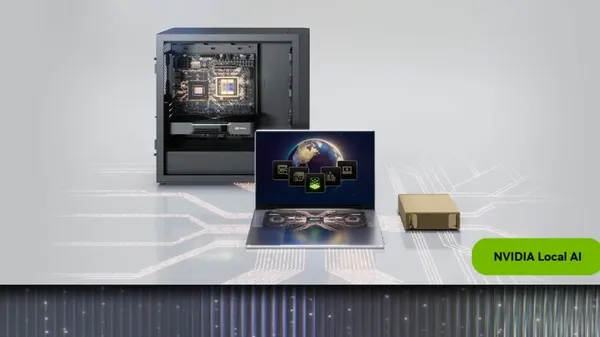
At GTC Berlin, NVIDIA presented updates across its local AI hardware: RTX Spark for personal agents on Windows PCs, DGX Spark for developers and DGX Station for enterprise teams. The announcements include a 64GB DGX Spark, larger clusters, a Windows version of DGX Station due in December and a new local coding model called Recursive Flint.
- RTX Spark, released October 16, offers up to 128GB of unified memory and 1 petaflop of AI compute, according to NVIDIA.
- DGX Spark 64GB ships from partners on Oct. 23, and clusters of up to eight units give 1TB of unified memory.
- DGX Station offers 748GB of coherent memory, and a Windows version is expected in December.
- Recursive Flint, a 40B mixture-of-experts coding model, is available with open weights under Apache 2.0.
RTX Spark brings personal agents to Windows PCs
According to NVIDIA, RTX Spark, which was released on October 16, runs personal agents, accelerated content creation and 1440p 100 frames-per-second gaming with up to 128GB of unified memory and 1 petaflop of AI compute. The company quoted early reviewers, including CGMag ("A dream machine for serious creators") and The Verge ("Designed for the future of AI").
Underdog, a desktop agent app built for fully local, private AI, is now available for download on RTX Spark. NVIDIA says its Husky model-specific inference engine runs models entirely on device, so user data never leaves the PC. Many RTX Spark laptops ship with an unlocked bootloader, which NVIDIA says helps developers and enthusiasts build and customize local agents.
Laptops from ASUS, Dell Technologies, HP, Lenovo, Microsoft and MSI are available today, with Acer coming soon. In the keynote, Jensen Huang showed AI agents on RTX Spark training Hugging Face's Microduck robot using NVIDIA Isaac Lab, Hermes Agent and Nemotron 3.5 Bolt 74B.
DGX Spark grows into clusters
New DGX Spark 64GB systems start rolling out from partners on Friday, Oct. 23. NVIDIA says they can run models including Nemotron 3.5 Bolt 74B 24GB, Qwen3.8 27B and Gemma 4 26B-A4B.
Developers who need more capacity can link several units through built-in NVIDIA ConnectX-7 networking and NVIDIA Sync Cluster Assistant. DGX Spark now supports clusters of up to eight units in manual configuration. According to NVIDIA, such a cluster offers 1TB of unified memory, enough for frontier-class models like GLM 5.3, and suits small teams sharing one backend with concurrent sessions on the same model.
NVIDIA Sync Model Launcher is due later this month. With a few clicks it downloads a model and a container suited to the configuration and connects the model to OpenCode, loading DGX Spark Skills for troubleshooting, device maintenance and documentation access. The October software update also adds a Wi-Fi Assistant for switching networks in appliance mode. DGX Spark is sold by Acer, ASUS, Dell Technologies, GIGABYTE, HP, Lenovo, MSI and NVIDIA.
DGX Station targets enterprise teams and robotics
DGX Station offers 748GB of coherent memory and up to 20 petaflops of AI performance, according to NVIDIA. The company says it can run models like GLM 5.3 and serve 30+ users at speeds comparable to cloud models. Seven new integrations, including Splunk by Cisco, Microsoft Intune, Tanium and Absolute Security, let IT teams manage the systems through existing enterprise processes.
DGX Station for Windows is expected from partners in December. It will support manufacturing applications from companies such as Siemens, Dassault Systèmes, MathWorks and Synopsys, and agents such as Hermes Agent, Perplexity or Aible can run on premises.
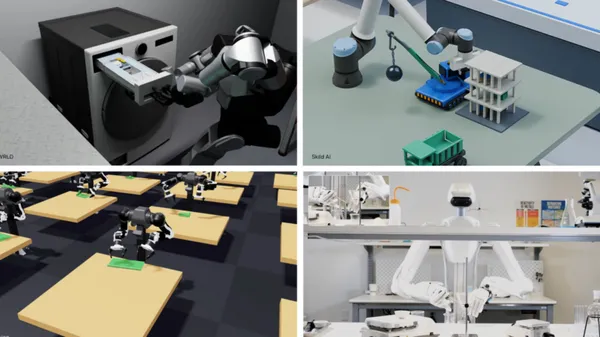
For robotics, NVIDIA released three open source reference workflows using Isaac Lab, Isaac Lab-Arena and Cosmos on DGX Station, for refining GR00T 1.7 models with reinforcement learning, training dexterous manipulation and post-training Cosmos world models. NVIDIA Cloud Functions is coming in early access to Linux-based DGX Station, letting teams register local model endpoints behind one OpenAI-compatible entry point.
Recursive Flint, a local coding model
Recursive Superintelligence released Recursive Flint, a 40-billion-parameter mixture-of-experts model with 2.5 billion active parameters. NVIDIA says it exceeds 220 tokens per second on a 64GB RTX Spark and posts best-in-class scores on agentic coding benchmarks including SWE-Bench Pro v2, Terminal-Bench 2.1 and SWE-bench verified.
The developer says its Eureka Machine, a system for automated AI research, created specialized kernels that raised generation speed on RTX Spark by 55% without changing the model's weights. The open weights are available on Hugging Face under the Apache 2.0 license and run on RTX Spark, DGX Spark, GeForce RTX and RTX PRO GPUs.
What it means for users
The announcements point to a layered local AI offering: personal agents on Windows PCs, clustered desktop systems for small developer teams and larger machines for enterprises that want to keep inference under their own control. NVIDIA also lists day-0 support for new Nemotron, GLM, DeepSeek, Qwen, MiniMax and FLUX.3 models, plus new accelerations for llama.cpp and vLLM.