NVIDIA shows how to tune Nemotron to local rules with France and Belgium personas
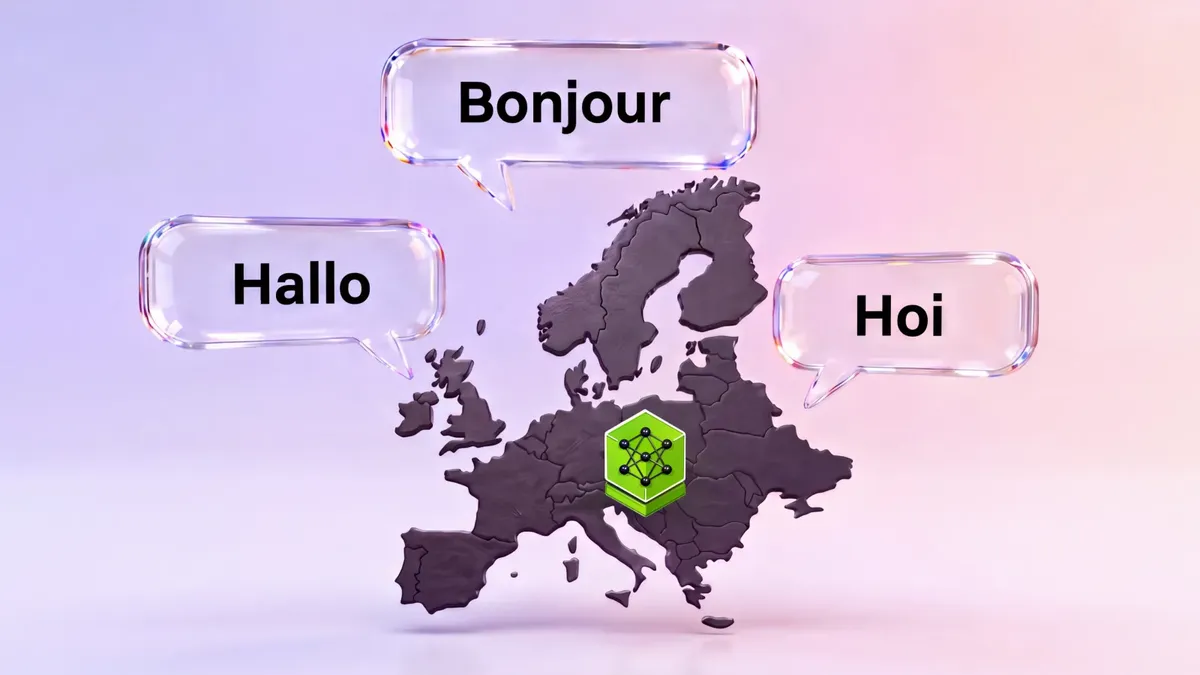
NVIDIA has published a post-training workflow that uses its new Nemotron-Personas datasets for France and Belgium to adapt open Nemotron models to local languages, procedures and cultures. The walkthrough fine-tunes Nemotron 3.5 Lightning with LoRA on NVIDIA NeMo and uses a French public-service assistant as its example.
- NVIDIA released Nemotron-Personas datasets for France and Belgium, part of a program covering 12 countries.
- The workflow fine-tunes Nemotron 3.5 Lightning with LoRA on NVIDIA NeMo, using personas and official procedure text.
- In a French passport example, fine-tuning corrected an answer that conflicted with government documentation.
- Pleias uses the datasets in Lamina, a spine-care assistant from a partner.
- NVIDIA says persona grounding does not guarantee fairness or proper representation.
Personas built on regional data
According to NVIDIA, general-purpose language models are a strong foundation but can lack the local knowledge, cultural nuance and precision a given application needs. Post-training an open model can address this, the company says, improving accuracy and usefulness while supporting safer interactions.
NVIDIA built Nemotron-Personas-France with the French AI startup Pleias, and Nemotron-Personas-Belgium with Pleias and the Belgian university KU Leuven. Both belong to the open NVIDIA Nemotron data program, which includes locale-grounded persona datasets for 12 countries. The Belgian set spans Dutch, French, German and English.
Each persona is a synthetic resident grounded in regional demographic, geographic, linguistic and cultural distributions. NVIDIA contrasts a generic persona such as "a French adult who needs a passport" with a grounded one that has an age, a commune, a job and a household following French census data, plus written profiles of work and daily life. Such details shape what a person asks and how, and can change the correct answer. NVIDIA gives the example of the passport stamp, which costs €43 in French Guiana against €86 in mainland France.
A passport question as a test case
The post illustrates the problem with a French passport agency agent. A customer writes that they can no longer travel because of their health and asks how to apply. According to NVIDIA, a foundation model without post-training suggested applying by post with a registered letter. NVIDIA calls that answer unspecific, unsupported and in conflict with government documentation, which requires an official to make a home visit.
After fine-tuning, the sample reply says an agent can come to the home, that a medical certificate less than 3 months old is needed, and that the process can be started online through the ANTS site or at a town hall with a registration station. It also reminds the user to bring original documents and pay the tax stamp. NVIDIA describes the result as more concise and in character as a support agent.
The facts in each answer come from official procedure text, which the workflow pairs with each persona.
How the workflow runs
The workflow starts with a behavior contract that defines what a good response should do, and a frozen holdout set. It then generates synthetic conversations from personas and official procedure text, fine-tunes Nemotron 3.5 Lightning with LoRA on NVIDIA NeMo, merges the adapter, and evaluates against the frozen test set.
The Nemotron repository supplies reusable steps for data generation, training and evaluation, each with defined inputs, outputs and configuration options. It also includes agent skills, such as one for customization with NVIDIA NeMo Automodel, that help coding agents assemble the steps.
- Requirements: Python 3.11 through 3.13, uv, Git, Docker, NVIDIA Container Toolkit and access to the repository.
- Hardware: one NVIDIA DGX Station GB300 or one NVIDIA DGX Spark, though NVIDIA says other NVIDIA GPU systems can be used.
- Example folder: french-public-service-assistant, with configuration files, scripts, a procedures source file and test prompts.
NVIDIA says the same loop applies to any Nemotron-Personas market: swap in another persona dataset, update the behavior contract and reviewers, and the rest stays the same.
Who it is for and its limits
NVIDIA recommends the workflow for models that already have some ability in the target language and need application-specific behavior, such as terminology, formality, response structure or escalation rules. Post-training can make these behaviors more consistent and reduce repeated instructions, it says. Persona-guided synthetic data can help when suitable conversations are scarce, restricted or missing important cases.
Pleias uses three Nemotron-Personas datasets, including France and Belgium, in its work on Lamina, a spine-care assistant from a Pleias partner. The personas turn a few real patient cases into varied training conversations and allow testing across patient profiles. Pleias says: "Better grounded data is what makes a small efficient regional-specific model viable."
NVIDIA adds a caveat: persona grounding aims to improve coverage and reduce blind spots in training data, and is not a guarantee of fairness or proper representation. For teams building agents for specific countries or sectors, the release offers a documented, open route to local adaptation, with the Nemotron repository, Hugging Face models and datasets, and a sizing calculator for GPU needs, training time and costs listed as next steps.
NVIDIA Developer: Fine-Tuning NVIDIA Nemotron to Know Local Rules, Not Just Local Languages