NVIDIA Releases SOMA Retargeter v0.2 for Humanoid Robot Motion
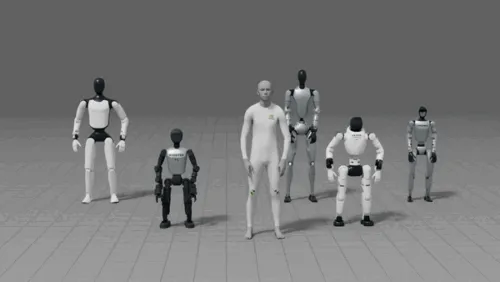
NVIDIA has released version 0.2 of its open-source SOMA Retargeter, a tool that adapts human motion data to the proportions, joints and range of motion of humanoid robots. The release includes reference configurations and retargeted motion examples for five robots.
- SOMA Retargeter v0.2 adapts human motion to humanoid robot bodies.
- The release includes configurations for five humanoid robots.
- Input motion can come from capture, video reconstruction or generative models.
- Newton inverse kinematics runs through NVIDIA Warp.
- Outputs can support motion libraries and policy training workflows.
From human movement to robot trajectories
Human motion can be captured through motion-capture sessions, reconstructed from video, downloaded from datasets or generated by models. Because these sources can use different skeletons and file formats, SOMA Retargeter uses the SOMA skeleton as a shared representation for compatible input.
The tool reads a Biovision Hierarchy animation on the SOMA base skeleton. It scales motion targets to a robot’s proportions, solves for joint poses and applies configured corrections. The output is a comma-separated values file containing the robot’s root position, orientation and joint angles for each frame.
These trajectories can be combined into motion libraries for downstream reference preparation, learning or control. NVIDIA says the process is needed because a robot cannot directly copy a human’s joint motion when its proportions, joint structure and range of motion differ.
Five robot configurations in version 0.2
The v0.2 release includes sample motions supplied by Bones from the BONES-SEED motion-capture dataset. It also provides reference retargeting results and configurations for Unitree G1, Unitree H2, Booster T1, AgiBot X2 Ultra and AgiBot A3T3.
The examples show how joint angles and foot placement change across robot embodiments. Developers can use the supplied Unitree G1 configuration to retarget a forward walk, inspect the human and robot animations together in the viewer, and save the resulting robot motion as a CSV file.
Human motion can also come from GEM-X, which reconstructs whole-body 3D motion from a single video using the SOMA body model. Kimodo and ARDY generate movement from text and pose constraints, with ARDY adding interactive steering as motion unfolds. Both provide models that generate motion on the SOMA skeleton.
Tools for configuring and refining motion
SOMA Retargeter includes a Robot Configurator for refining an existing robot configuration or creating one for a new robot. Developers can load a robot description, align human and robot reference poses, adjust scale and map the source skeleton to robot body parts. Configurations can then be saved and reused across motion clips.
The inverse-kinematics solver uses Newton, built with NVIDIA Warp, to find joint poses that follow scaled human targets. When a robot cannot satisfy every target at once, IK weights determine which body parts have priority. An experimental IK weight optimizer tests adjustments on representative motions and saves selected weights in a new retargeting configuration.
Foot-plant correction addresses sliding feet by adjusting foot motion during detected contact intervals. Developers can also refine contact timing and correction settings before using the motion in a training pipeline. NVIDIA’s announcement points developers to the SOMA Retargeter repository, the Robot Configurator guide and the batch-retargeting guide for further use.
NVIDIA Developer: Adapt Human Motion for Robots with NVIDIA SOMA Retargeter