NVIDIA reports up to 4.45x faster FLUX 3 image generation
NVIDIA says its TensorRT LLM VisualGen runtime can accelerate FLUX 3 Image Klein generation by up to 4.45x for image-to-image workloads on a single Blackwell GPU. The results come from a tutorial covering quantization, attention, caching and multi-GPU execution.
- NVIDIA reported up to 4.45x faster FLUX 3 image-to-image generation.
- NVFP4 delivered up to 1.62x faster text-to-image generation than BF16.
- VC-Attention FP8 reached a 1.18x speedup for the Base model.
- Eight B200 GPUs reduced Base median text-to-image latency to 3.00 seconds.
- The tutorial includes YAML configurations and deployment instructions.
Blackwell optimizations target FLUX 3 latency
In a post dated Nov 06, 2026, NVIDIA described deployment and optimization techniques for FLUX 3 Image Klein, an image generation and editing model from Black Forest Labs. The model was trained on NVIDIA GB200 NVL72 and is optimized for NVIDIA GPUs.
FLUX 3 Image Klein combines Qwen3-VL-4B-Instruct for text conditioning, a diffusion transformer that refines image latents, and an autoencoder that decodes latents into images and encodes reference inputs for image-to-image generation. It is available in Base and distilled checkpoints, which support different latency and fidelity requirements.
NVIDIA reported combined optimizations of up to 3.46x faster text-to-image generation and 4.45x faster image-to-image generation for the Base model at 2048×2048, compared with uncompiled BF16 inference on one NVIDIA B200 GPU.
Quantization and attention reduce the main bottleneck
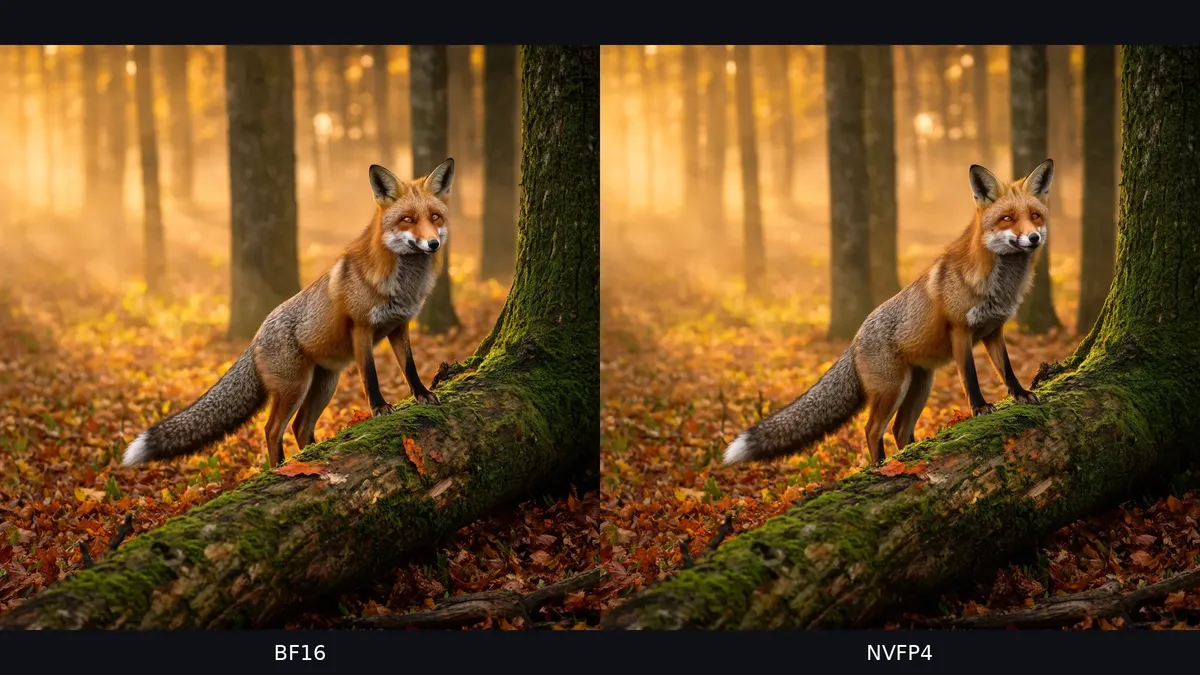
TensorRT LLM VisualGen supports BF16, FP8 and NVFP4 variants. In NVIDIA's tests on a Blackwell GPU, NVFP4 delivered up to 1.62x faster text-to-image generation and 1.58x faster image-to-image generation than BF16.
The tutorial identifies denoising as the main source of latency on B200. At 2048×2048, denoising accounted for 96.8% of the Base text-to-image pipeline and 97.8% of its image-to-image pipeline in the reported tests. The Base model used 50 denoising steps and a classifier-free guidance scale of 3.5, while the distilled model used 16 steps without classifier-free guidance.
VisualGen uses optimized GEMM kernels, fused operations, quantized attention and sparse attention to reduce this cost. NVIDIA reported that VC-Attention FP8 delivered 1.18x faster generation for Base and 1.16x for the distilled model, with LPIPS scores of 0.086 and 0.151. LPIPS measures perceptual differences from the corresponding baseline, with lower scores indicating greater similarity.
Scaling across GPUs and accessing the tutorial
The post also describes Sol-Attention, Cache-DiT step caching and multi-GPU execution. With Sol-Attention at τ=1.0 and 12 initial dense steps, NVIDIA reported 1.30x faster denoising plus decoding for Base. Using 16 dense steps prioritized fidelity and delivered 1.24x faster performance. Cache-DiT reached a 1.94x speedup for Base at 2048×2048, with an LPIPS score of 0.033.
Using classifier-free guidance and Ulysses parallelism across eight B200 GPUs reduced median text-to-image latency from 14.90 to 3.00 seconds for Base and from 2.73 to 1.08 seconds for the distilled model. The corresponding denoising speedups were 6.01x and 4.44x.
Developers can run NVIDIA's FLUX 3 example with the provided YAML configurations, explore the VisualGen runtime and optimization utilities, and share results or file issues on the TensorRT LLM GitHub. The tutorial is aimed at design tools, image editors and visual production workflows where high-resolution inference latency matters.
NVIDIA Developer: Speed Up Image Generation with FLUX 3 Image Klein on NVIDIA Blackwell GPUs