Ai2 releases OlmoEarth v1.3 with open satellite embeddings for the whole planet
Ai2 has released OlmoEarth v1.3, a satellite embedding model, together with precomputed annual embeddings for the whole planet at 10-meter resolution and a browser-based tool called the OlmoEarth Embeddings Explorer. According to Ai2, anyone can use it right away, without signing in or having advanced technical knowledge.
- Ai2 released OlmoEarth v1.3 with precomputed annual global embeddings at 10m, in 64 and 128 dimensions.
- According to Ai2, the 128-dimensional embeddings score highest on 20 of 27 evals against AlphaEarth Foundations and Tessera v2.
- The browser-based OlmoEarth Embeddings Explorer needs no sign-in and lets users train small classifiers and export GeoTIFFs.
- Ai2 says v1.3 took 53% of the computing time of v1.2 and 18% of v1 to train.
- Weights, data and code are open under the OlmoEarth Artifact License.
From fine-tuning to ready-made embeddings
Until now, the main way to use OlmoEarth was fine-tuning in OlmoEarth Studio: training a model for each task and running it over satellite imagery to produce a map. Ai2 says that requires GPU access and the ability to download and store the imagery.
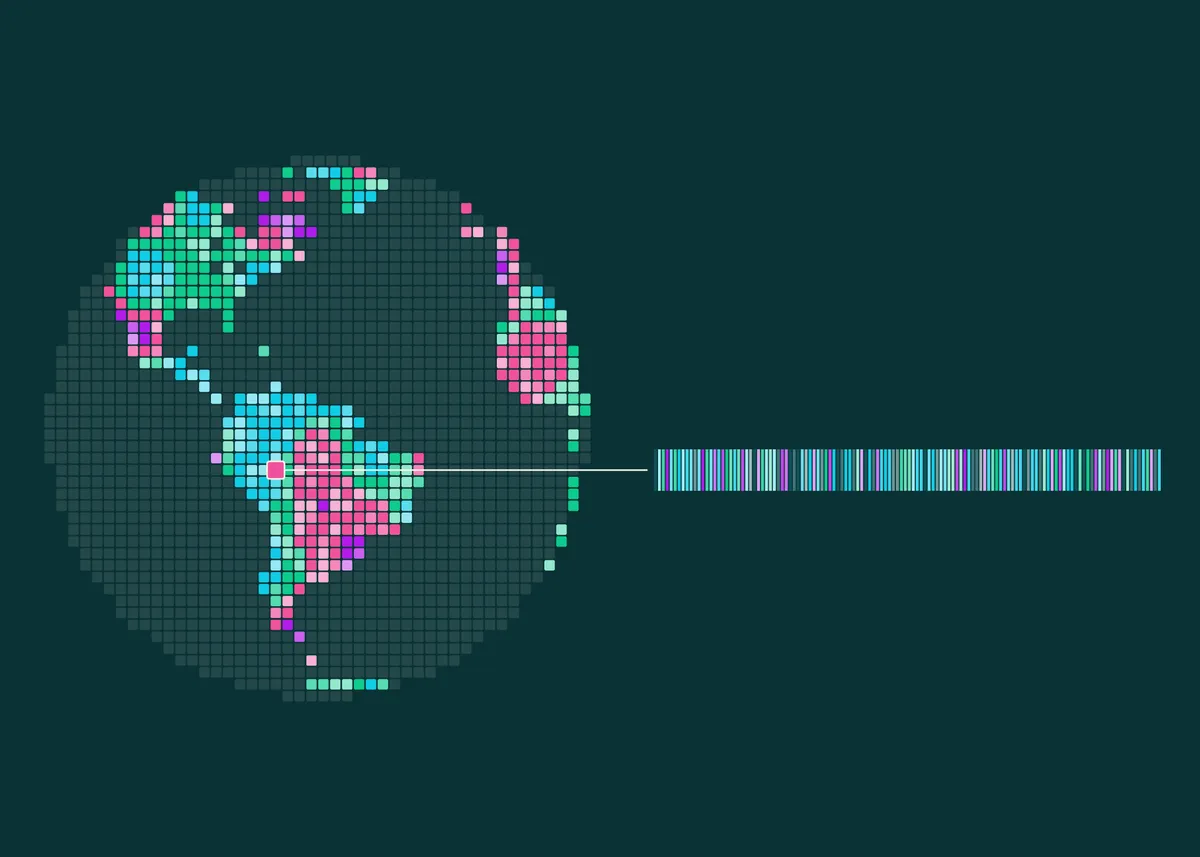
Embedding models take a different route. They compress satellite data into ready-to-use features that can be reused cheaply for many tasks. OlmoEarth v1.3 reads a year of radar (Sentinel-1) and multispectral (Sentinel-2 and Landsat) time series and produces one 128-dimensional vector for every 10-meter pixel on Earth. The first 64 dimensions also work on their own as a smaller embedding.
Ai2 has computed the embeddings for the entire planet and shared them on Source Cooperative. From there, a crop map, a land-cover map or a change analysis becomes a lightweight problem: train a small classifier on top and run it locally.
Benchmark results and training cost
Ai2 evaluated the embeddings against AlphaEarth Foundations (AEF) and Tessera v2 across 27 evaluations covering six continents. According to Ai2, the 128-dimensional embeddings score highest on 20 of 27 evals and rank highest overall, while the 64-dimensional version, at half the size, still leads on 18 of 27. The team also introduced PLANTEUR, a new crop-type benchmark for tropical farming, and says the embeddings generalize best to places a classifier has never seen.
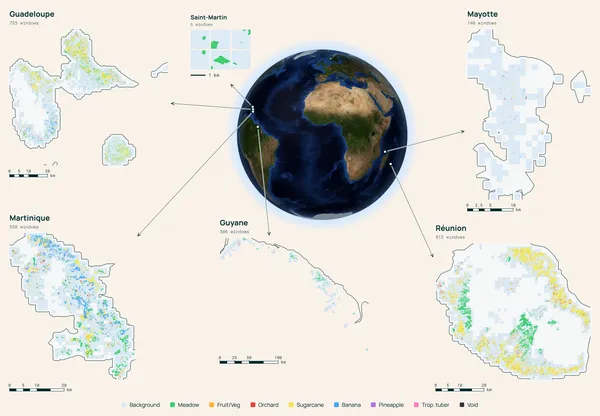
The model weights, pretraining data and pretraining code are all open. Ai2 gives examples of what a small classifier on the embeddings can do: classifying smallholder crops in Kenya, detecting brick kilns west of Dhaka, assessing fire damage in Indonesia and tracking gold mining in the Peruvian Amazon.
Ai2 also reports that v1.3 was its cheapest OlmoEarth model to train. It took 53% of the computing time of v1.2 and 18% of v1, with 50% and 22% of the carbon emissions. The model remains a strong fine-tuning model, matching v1.2's performance across research and partner labels. Reproducing the pre-training of OlmoEarth v1.3 Base would cost roughly $2,720 of rented H100 time for the final run, according to Ai2.
The Embeddings Explorer and the Madre de Dios example
The Explorer renders the embeddings as a false-color map of the planet. Users can pan anywhere, switch between years, and pull up the underlying Sentinel-2 imagery to check the map. They can click a place to find similar ones, or drop a few labeled points, train a small classifier on the spot and export the result as a GeoTIFF. Ai2 says a first pass takes seconds, whereas testing an idea against OlmoEarth previously meant a fine-tuning run on the order of hours.
As a showcase, Ai2 looks at illegal gold mining around La Pampa in Peru's Madre de Dios region. According to Amazon Conservation's MAAP program, mining peaked in 2017 and 2018 and cleared more than 1,200 hectares of forest in the buffer zone of the Tambopata National Reserve. Peru's Operation Mercurio shut most of it down in February 2019. Comparing each pixel's vector across years, with no model training, the 2017 to 2020 pair shows mining spreading southeast, while the 2020 to 2025 comparison shows that area quiet and change concentrated in the older mining zone to the west. Ai2 cites the Associated Press as reporting that in August 2026 Peru sent navy patrols back into the reserve.
Coverage, provenance and availability
The archive holds embeddings at 10-meter resolution, roughly 150 TB per year, covering land and adjacent coastal waters. At launch, 2025 and 2024 are global, 2023 is near-global, and 2017 to 2022 cover select countries, with more coverage planned. Users can choose the 128-dimensional or the lighter 64-dimensional version.
For each 20-kilometer tile and year, open provenance tables list the Sentinel-1, Sentinel-2 and Landsat scenes the model read, with links to the public catalogs, so any pixel can be traced back to its imagery.
What it means for users
The release includes the OlmoEarth v1.3 Base model, the global embeddings, the Explorer and the technical report, all under the OlmoEarth Artifact License, the same open license as v1 and v1.2. For teams without GPUs or large imagery storage, the embeddings offer a cheaper entry point. Ai2 also suggests using them to decide whether a task deserves a fine-tuning run in OlmoEarth Studio, which can run the same model over chosen dates, modalities and resolution. A tutorial shows how to generate embeddings on your own compute.