OpenAI's GPT-6 Astra Ultrafast Runs on NVIDIA Blackwell, Up to 8x Faster
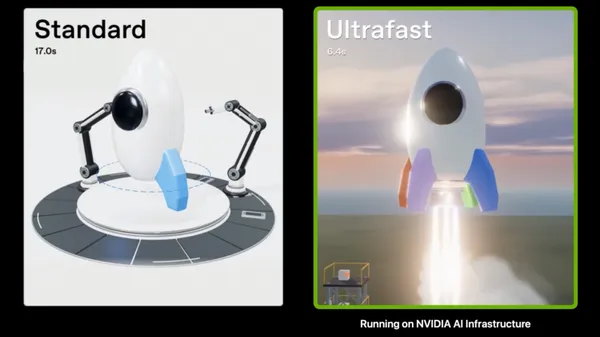
GPT-6 Astra Ultrafast, a faster mode of OpenAI's Astra model running on NVIDIA Blackwell GPUs, is available now in the OpenAI API and to eligible ChatGPT Work and Codex users. According to NVIDIA, it generates tokens up to 8x faster than the Astra Standard mode.
- GPT-6 Astra Ultrafast is available now in the OpenAI API and to eligible ChatGPT Work and Codex users.
- It runs on NVIDIA Blackwell GPUs and offers up to 8x faster token generation than Astra Standard, according to NVIDIA.
- OpenAI uses its own models to refine inference software on NVIDIA GPUs, including after deployment.
- Access, pricing and implementation details are in the Ultrafast guide.
What Ultrafast offers
NVIDIA says Ultrafast is accelerated by inference optimizations in OpenAI's models that take advantage of the NVIDIA Blackwell architecture. The result, according to the company, is up to 8x faster token generation compared with Astra Standard.
The mode is aimed at developers. NVIDIA argues that faster generation can shorten the edit-test-debug cycles of coding agents, cut the time spent generating responses between tool calls and make interactive applications feel more responsive.
The company stresses that speed matters most when it is repeated across a workflow. An agent writes code, uses a tool, checks the result and decides what to do next. Ultrafast, NVIDIA says, brings Astra's capabilities into these time-sensitive loops.
Models that optimize their own serving
Philippe Tillet, inference lead at OpenAI, said that "NVIDIA's deep investment in tooling and documentation has enabled us to make our models exceptionally good at programming Blackwell and Rubin GPUs." He added that Astra can turn that knowledge into high-performance kernels that make NVIDIA hardware compelling across latency, throughput and cost.
Uday Ruddarraju, chief technology officer of compute at OpenAI, said the company used its internal models to optimize inference on NVIDIA GPUs, and that NVIDIA's programmability helped deliver the acceleration behind Astra Ultrafast.
According to NVIDIA, this work continues after deployment. OpenAI is using its own models to refine the inference software running on NVIDIA GPUs, testing and implementing improvements. That ongoing effort can make model responses faster and deployed infrastructure more productive over time.
Flexibility across workloads and access for developers
NVIDIA also points to the programmability of its platform. It says developers and researchers can reuse infrastructure across training, inference and reinforcement learning as models evolve. That flexibility, the company says, helps teams repurpose compute as demand changes, improving utilization and avoiding overprovisioning for each workload.
Developers can use GPT-6 Astra Ultrafast through the API today. NVIDIA directs readers to the Ultrafast guide for access, pricing and implementation details. The announcement itself does not list prices or other specifics.
For teams building coding agents and interactive applications, the pitch is shorter waits at each step of a multi-step task. The 8x figure is a maximum stated by NVIDIA, so real-world gains will depend on the workload.