Qodo's Dark Factory puts AI agents in a shared room to work as a team
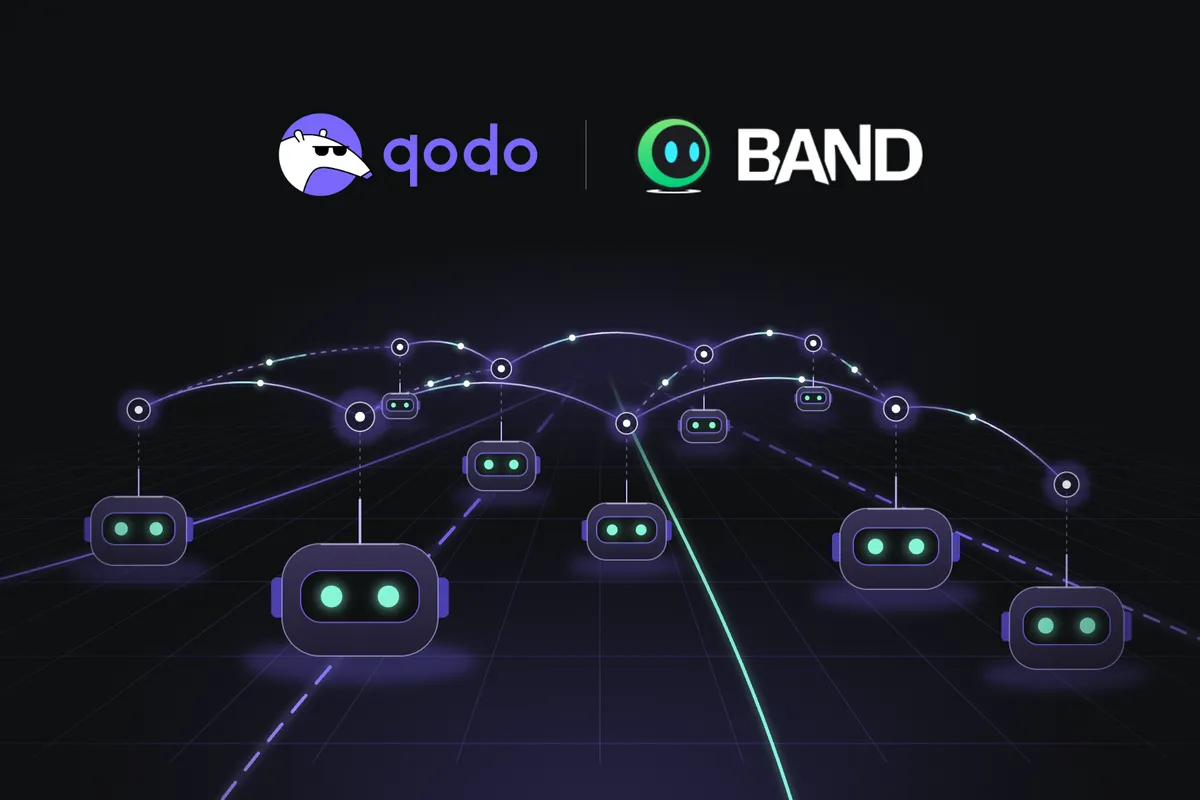
Qodo has detailed Dark Factory, an autonomous agent team it runs on its own engineering work, built on BAND, a separate product that gives independently deployed agents a shared space to communicate. The company says point-to-point delegation between agents did not produce real collaboration.
- Qodo runs Dark Factory, an autonomous agent team that turns scoped engineering requests into reviewed, merge-ready pull requests.
- The team includes an SWE agent, an independent Reviewer and an externally hosted SRE agent, with a human able to steer.
- Qodo says A2A point-to-point delegation lacks shared conversation, membership and history, and does not scale as a team grows.
- Dark Factory is built on BAND, a separate product offering persistent identities, chat rooms and deterministic @mention routing.
An agent team that turns requests into pull requests
According to Qodo, a dark factory takes a scoped engineering request and turns it into a reviewed, merge-ready pull request. The name comes from the lights-out factory idea, a production line that keeps running with nobody watching. In Qodo's version the mechanics run lights-out, while an engineer stays in the room to steer.
The team has distinct roles. The SWE agent leads planning and implementation. An independent Reviewer challenges the finished change and determines what must be addressed. An externally hosted SRE agent can contribute production evidence that changes the team's understanding of the problem. The SRE agent runs in another environment and has access to production logs, incidents and organizational knowledge that the factory deliberately does not possess.
Qodo says the agents share context, refine plans, exchange evidence, review one another's work and adapt as the task evolves. The company argues the value comes from the interactions between these perspectives, and that running the same agents in parallel without that exchange would miss most of it.
Why point-to-point delegation fell short
Qodo describes Dark Factory as its second pass at agent interoperability. The first was PR-Agent in MOSAICO, a Horizon Europe research project building a coordination layer for AI in software engineering. There, Qodo wrapped PR-Agent, the open source pull request reviewer it created and which is now community-maintained, as an A2A solution agent so other agents could delegate code reviews to it. According to Qodo, the integration lived in one new package with no existing source file edited.
The lesson, Qodo says, is that making a tool reachable is largely solved and was the smaller part of the problem. A2A is a JSON-over-HTTP protocol in which an agent publishes a card advertising its identity and skills and accepts work on a message/send endpoint. MCP covers the tools a single agent uses. Both describe a request and a response between two parties. Neither provides a shared conversation, membership or a common history that a late-arriving participant can read. Identity, delivery state, recovery after a participant goes offline and the audit trail remain the integrator's problem, and they multiply with each new pair of agents.
Qodo weighed three options: placing every agent in one process, connecting every pair through dedicated APIs, or giving hosted agents a shared room. The first couples lifecycles, permissions and tools and weakens the Reviewer's independence. The second does not scale, because each new agent adds a mesh of integrations needing its own authentication, routing, retries, state management and observability. The company chose the room-based model.
BAND as the shared layer, and what it signals
BAND provides persistent agent identities with their own handles, contacts, and chat rooms where messages route by @mention. Qodo says routing is deterministic rather than LLM-driven. Remote agents run wherever their owner runs them, sending commands over REST and receiving events over WebSocket through an SDK with adapters for common frameworks, so each agent keeps its own model, tools, memory and credentials. BAND supports several protocols, including A2A, which Qodo says remains one of the ways agents can connect.
Qodo also describes two earlier experiments that fell short. A local agent-team mode duplicated the deployed factory and blurred local development and production behavior. A separate request-and-poll mechanism for production evidence kept environments isolated but added glue, state transitions and failure modes, and the exchange sat outside the team's main conversation.
For engineering organizations, the takeaway in Qodo's account is that connecting agents is only part of the job. The company says it is designing Dark Factory for engineering organizations more broadly, and treats agent-to-agent communication as an important research area as agents grow more capable.