Roboflow adds full anomaly detection support, trained on good images only
Roboflow has announced full support for anomaly detection models, which learn from images of normal items and flag anything that looks different. The models can be deployed in the cloud or on a user's own hardware, according to the company.
- Roboflow now fully supports anomaly detection models, deployable in the cloud or on user hardware.
- Models train only on normal images and return a score, a verdict and an optional heatmap.
- Two architectures are offered: PatchCore (trains in minutes) and FoundAD (better with few images, slower to train).
- In Roboflow's egg test, PatchCore caught 14 of 15 real defects at 2 false alarms, FoundAD caught 10.
- Roboflow says benchmark results are one example and depend on data and hardware.
Finding defects without defect examples
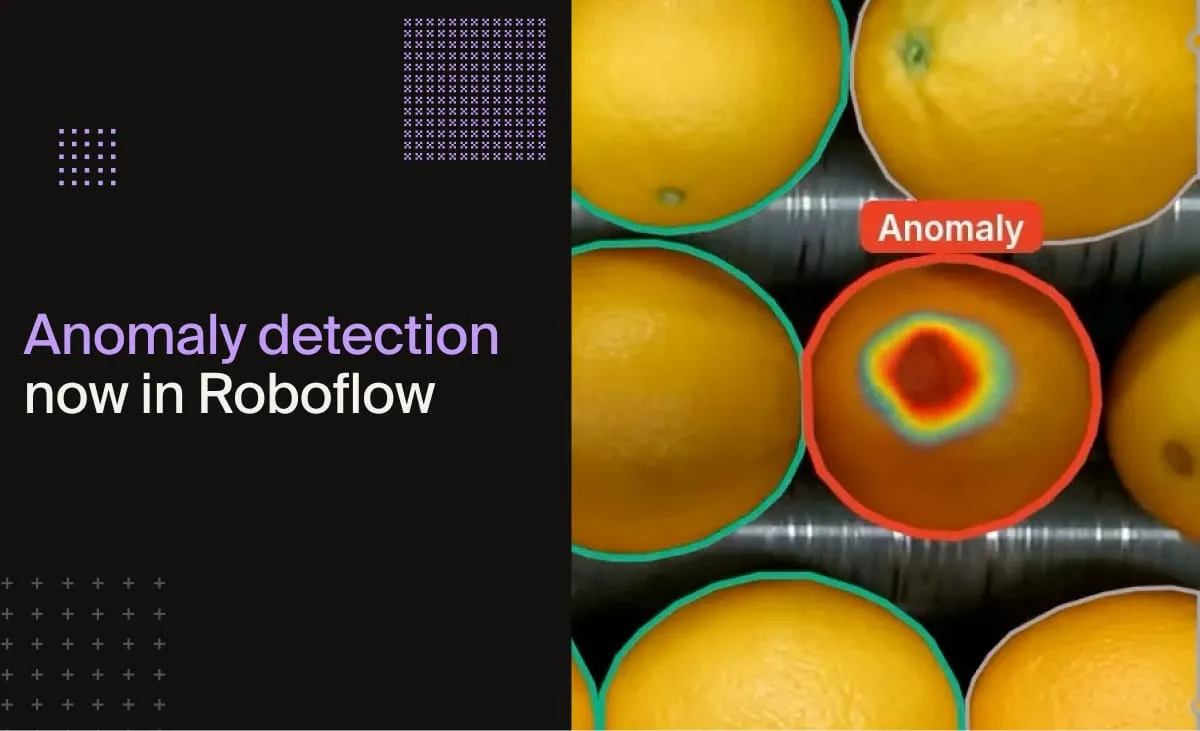
An anomaly detection model is trained on images that show what "good" looks like. When new images are run through it, the model says whether each one is normal or anomalous, returns an anomaly score, and can produce a heatmap of the areas that differ the most. Roboflow gives examples such as a damaged component or a stray bolt on a conveyor belt.
The company argues that this suits quality assurance and quality control (QA/QC). On a well-run production line, a defect might show up once in thousands of parts, and no two look the same, so collecting enough labeled examples for an object detection or classification model takes a long time. Good parts, by contrast, are easy to collect.
Roboflow lists food and agriculture, manufacturing, electronics, packaging and labels, and textiles as fitting areas. It also suggests the approach as a first model when no defect data exists yet: run it on the line, review what it flags, and the results become the start of a labeled defect dataset for an object detection model later.
PatchCore and FoundAD
Roboflow supports two architectures. Both start from an image model pre-trained on millions of images and use it to describe every small patch of an image.
- PatchCore runs each training image through a WideResNet-50 and stores the patch features in a memory bank. At inference, each patch is compared to its nearest normal patch. There is no gradient training, so it trains fast, in minutes according to Roboflow.
- FoundAD uses a frozen DINOv3 encoder and trains a small projector that learns the shape of the normal feature space. Patches that do not fit get high scores. Training takes longer, hours on large datasets.
Roboflow trained both on four categories of the VisA dataset, once with 4 normal images and once with all of them. FoundAD is the better pick when only a few good images are available, the company says, while more data helps both, PatchCore the most.
On speed, FoundAD's inference time does not depend on the training set size, while PatchCore searches a memory bank that grows with the data. Which is faster depends on the hardware, and resolution matters even more, so FoundAD is usually more applicable for higher-resolution inputs. Roboflow stresses that the results come from one benchmark on Roboflow Inference 1.8 and should be treated as an example.
Workflow and the egg line example
Users create a project of type "Anomaly Detection", upload images of good products and label them "normal". Labels are per image, with no boxes or masks. Anomalous images can optionally be labeled "anomalous"; they are not used for training but help pick the threshold and report precision and recall. Without them, the threshold is set from normal validation images, so roughly 1% of them would be flagged.
Roboflow recommends one object per image, since in a full conveyor frame with 60 eggs one dirty egg barely moves the score. In its egg example, the team cropped each egg using an instance segmentation model. The final dataset had 962 normal training crops, 208 validation images (12 anomalous) and 130 test images (11 anomalous). On that test set, PatchCore caught 14 of 15 real defects at 2 false alarms, while FoundAD caught 10.
Trained models are called through the Serverless API. The response includes anomaly_score, anomaly_threshold and is_anomalous, and adding include_anomaly_map returns the heatmap.
What it means for users
For teams that inspect products but lack defect images, the release offers a way to start from normal samples alone. Roboflow advises scoring inside the object rather than across the whole crop: taking the top 1% of heatmap values inside the egg raised AUROC on its test set from 0.97 to 0.999. It also says results depend on images, defects, image size and hardware, so both models should be tried on a user's own data.