MountAIn's Solar-Powered IBEX Camera Can Now Run Roboflow-Trained Models
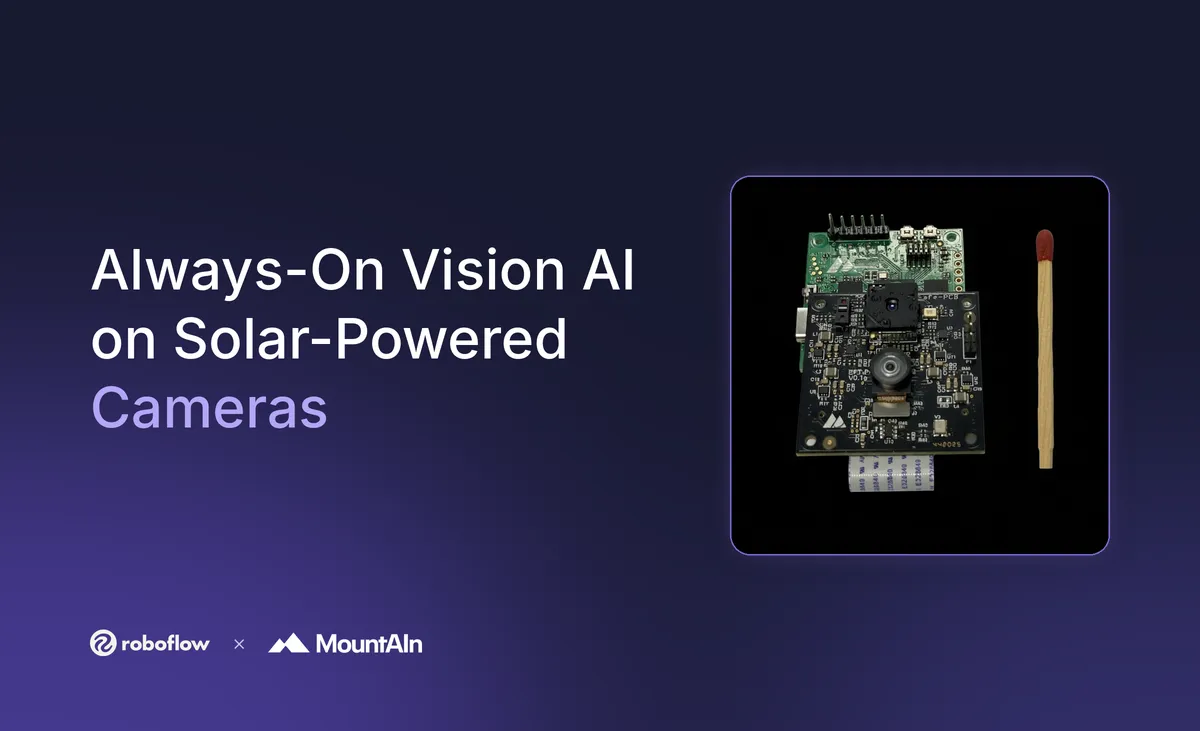
MountAIn says its MountAIn Core software now connects Roboflow's community of more than one million developers to low-power microcontrollers, starting with the solar-powered IBEX camera. Developers can train YOLO models in Roboflow and deploy them to a camera that runs without a grid or network connection.
- MountAIn Core now connects Roboflow users to low-power microcontrollers, starting with the solar-powered IBEX camera.
- YOLO11n, YOLOv8n and YOLO26n models can be exported to IBEX with a few lines of Python; RF-DETR Nano support is coming soon.
- According to MountAIn, its software cuts memory use by 3x and keeps power under 100 milliwatts on Alif Semiconductor hardware.
- In early tests, a YOLO nano model runs at up to 22 frames per second on IBEX.
- MountAIn plans to deploy 1,000 IBEX units by the end of 2027.
Roboflow models on a microcontroller
According to the announcement, most vision models run in the cloud or on Linux cameras, and both become expensive when a deployment grows from one camera to a thousand. On October 21, 2026, MountAIn announced that MountAIn Core now links Roboflow users to low-power microcontrollers, with the IBEX camera as the first target.
Developers can export YOLO11n, YOLOv8n and YOLO26n models trained in Roboflow to IBEX with a few lines of Python. Support for RF-DETR Nano is coming soon. MountAIn is focusing first on construction sites, traffic monitoring, critical infrastructure and logistics.
Vincent Huard, co-founder and CEO of MountAIn, said the company builds on Roboflow because "no other platform keeps pace with the research the way it does."
How IBEX works off the grid
IBEX was built by Grenoble-based MountAIn for sites with no outlet and often no cell signal. It runs on a solar panel and a small battery, processes video on the device, and sends a short alert over satellite when it sees the event it was trained to find.
Fire detection is the first use case. Since July 2024, a pilot in the south of France has used IBEX to spot wildfire smoke and warn crews before fires spread. IBEX was named a CES 2026 Innovation Awards honoree. Operators can also train it to count people, track wildlife and livestock, detect intruders or watch flood levels.
The hardware challenge is power. Device makers have had to choose between microprocessors that handle complex vision models but draw more power, and microcontrollers that use little power but leave little room for AI. MountAIn says its MountAIn Core compiler, middleware and runtime cuts memory use by 3x and keeps power under 100 milliwatts on Alif Semiconductor hardware.
MountAIn also offers the same stack to device makers through MountAIn Ready and MountAIn Onboard, for products ranging from smart cameras to smart glasses.
From labeling to deployment
Each IBEX deployment watches for something different, in scenes no public dataset covers, so each needs a model trained on its own images. Customers upload images from their own cameras, and Roboflow's auto-labeling drafts the annotations so people only review and correct them. Each dataset version records its preprocessing, which lets a team trace which data trained which model. Hosted training removes the need to set up GPUs.
Roboflow's Python package then passes the trained weights to MountAIn Studio, which compiles them for the camera's neural processor and deploys them over USB from the same script. MountAIn Studio reports accuracy after each compile stage, so teams can see what quantization costs before a model ships.
Huard said most customers do not have a machine learning team, and that Roboflow lets an embedded engineer "label data, train a model and hand it to our compiler in an afternoon."
Early results and what comes next
In MountAIn's early tests, a YOLO nano model trained in Roboflow runs at up to 22 frames per second on IBEX. When field data shows a miss, a team can add those frames in Roboflow, retrain, and push a new model to the camera without reflashing its firmware.
MountAIn is preparing a fire-detection deployment in Canada and plans to put 1,000 IBEX units in the field by the end of 2027. The company has published a step-by-step guide to deploying Roboflow models on IBEX, and developers can request access to MountAIn Studio through its Early Adopter Program.
For teams without cloud connectivity or a firmware specialist, the pairing offers a route from a labeled dataset to a working remote camera using tools they may already know. The performance figures come from MountAIn's own early tests.