Nobel laureate Kailash Satyarthi urges Berkeley AI students to build in compassion
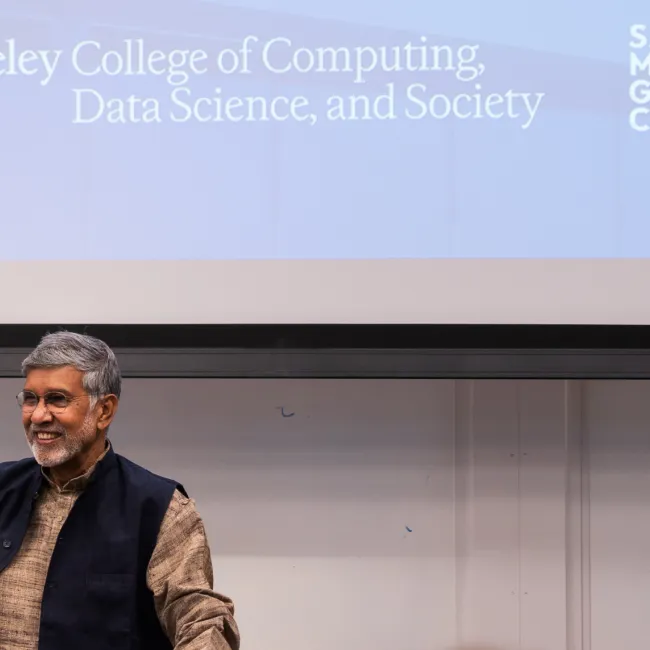
Nobel Peace Prize laureate Kailash Satyarthi visited UC Berkeley on Sept. 30, 2026, and urged students and faculty developing AI to center compassion in their work. A panel of Berkeley researchers then discussed how that goal could be put into practice.
- Nobel laureate Kailash Satyarthi spoke at UC Berkeley on Sept. 30, 2026, urging AI developers to center compassion.
- The event was hosted by CDSS with the Satyarthi Movement for Global Compassion and Arete Youth Academy.
- Jennifer Chayes suggested open-weight, open source models could give communities control of their data and wider access.
- Stuart Russell said the current reinforcement learning signal is "precisely profit."
- Rose Niousha said measuring how a human becomes better is the first step to embedding compassion in models.
A call to rethink success
Satyarthi, who shared the 2014 Nobel Peace Prize with Malala Yousafzai, spoke at an event hosted by the UC Berkeley College of Computing, Data Science, and Society (CDSS), in partnership with the Satyarthi Movement for Global Compassion and Arete Youth Academy. An electrical engineer by training, he became an activist in the 1980s working to end child slavery and exploitation, according to the CDSS account of the event.
"We are achieving many things, but we have to rethink success. We have to rethink accomplishment," he said. He described compassion as "a disruptive, dynamic and transformative force" and said he wants to bring it into the dialogue on AI to steer the technology away from potential catastrophe and toward the service of humanity.
Satyarthi listed what he sees as the products of globalization, from markets and data to climate crisis, extremism and terrorism. "This is the time to globalize compassion," he said. On what "compassionate AI" means, he said engineers need to be trained and worked with to raise their level of compassion, which he described as "not kindness only or empathy, but the level of mindful, pragmatic problem solving."
Panel: access, incentives and open models
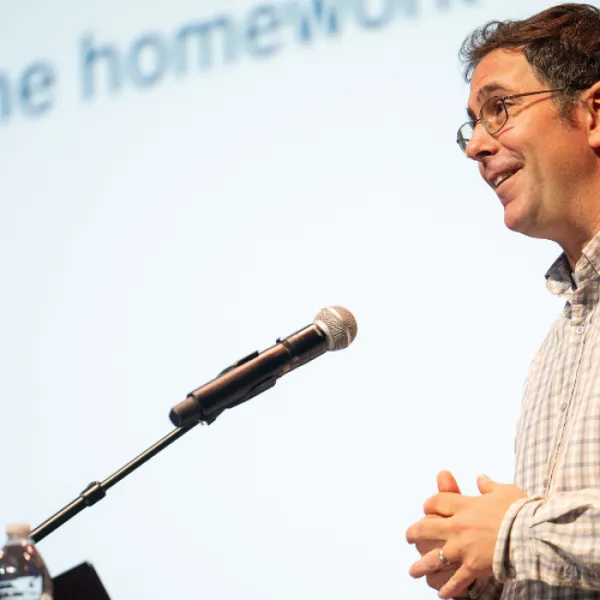
Satyarthi's remarks were followed by a panel with Jennifer Chayes, CDSS dean; Stuart Russell, professor of computer science; and Rose Niousha, a Ph.D. student in computer science. The discussion took place in the Barbara and Gerson Bakar Gateway building and included audience questions.
Chayes said AI pulls together human knowledge, which could be "a great equalizing force" if it is built to serve humanity and not to further empower those who are already powerful. She suggested open-weight, open source models as a way for communities to keep control of their data and gain greater access to the technology. "AI is the best and worst of humanity together, which is why it's so powerful," she said.
Russell argued that for any given amount of resource, systems do the most good by helping those most in need, so maximizing the collective interests of all human beings would lead naturally to that outcome. He was critical of current incentives, however: "I'm afraid that in our current system, the reinforcement learning signal is precisely profit," he said. He added that he wished people would listen to the objectives frontier AI companies state and reject those they do not support.
How to measure compassion in training
Niousha, whose research looks at how AI systems can collaborate better with humans in learning contexts, raised a technical obstacle. According to her, models are currently trained heavily on verifiable rewards such as math and coding, which are short term and easy to check. Compassion is harder to verify.
She said the first step is to quantify "what is it when a human becomes better?" and to find a way to measure it. Encoding that into models, she said, would move toward systems that do not only produce correct output that makes people happy in the short term but also help them build better skills over the long term.
Advice for students
Asked by an audience member for practical guidance, Chayes told students to question the purpose of their technical work. "As you're doing very technical things and applying what you've learned in class, ask 'to what end?'" she said. When deciding which objectives to put into AI systems, she advised considering "to achieve what and for whom?"
The event shows how questions about AI objectives, training incentives and access are being put directly to the students who will build future systems. The panelists offered no formal proposals, but they pointed to concrete directions: more open models, scrutiny of company objectives, and better ways to measure human benefit.
Berkeley CDSS: Nobel Peace Prize Laureate Kailash Satyarthi asks students to embed compassion in AI