Berkeley's John DeNero: AI Cannot Replace Human Skill in Computing
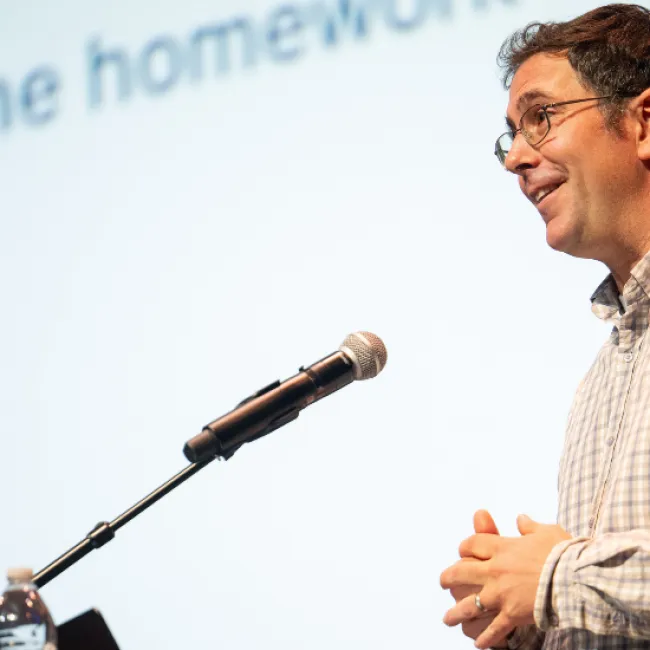
John DeNero, a teaching professor at UC Berkeley, told Homecoming attendees on Oct. 9 that AI cannot yet replace human competence in computing, and that students learn best when AI guides them instead of handing over answers. He described tutoring tools Berkeley is building around that idea.
- John DeNero spoke at UC Berkeley Homecoming on Oct. 9, 2026 about AI in computing education.
- He cited a 2026 Anthropic study: Claude Code session success rates ranged from 39% for novices to 65% for experts.
- DeNero argues that having AI give homework answers does not provide real practice.
- Berkeley's 61A Bot tutor explains conceptually why answers are wrong without giving them away.
- A student said an 'interviewing assistant' approach improved his understanding in an applied math class.
Why human competence still matters
DeNero Ph.D. '10 is a teaching professor in the Department of Electrical Engineering and Computer Sciences and faculty director of pedagogy for the Data Science Undergraduate Studies program. He spoke to students, parents and alumni about designing curriculum and educational support tools for computer and data science students. According to Berkeley CDSS, he received the Fiat Lux Faculty Award earlier this year and co-founded the data science undergraduate major, currently the largest major at Berkeley by enrollment.
He opened by acknowledging that current uses of AI in education are "not all positive at the moment." He pointed to recent news that OpenAI claimed to have solved hundreds of math problems, which has led mathematicians and computer scientists to consider the role of humans in their fields. Asked whether AI can simply do this work for us now, he answered: "The answer right now is definitely not."
To support the point, DeNero cited a 2026 Anthropic study. It found that success rates of Claude Code sessions varied from 39% for novice users to 65% for expert users. He said students who have built software themselves tend to scrutinize the AI's plan, read the code it produces and make highly specific requests for changes, which leads to the higher success rate. He added that human evaluation of AI remains necessary, because attempts to have AI evaluate itself "don't work yet."
Practice, not shortcuts
DeNero then turned to how students should learn computer science. He compared it to music: "You have to practice the piano in order to learn piano. You can't just watch videos of people playing piano."
He said homework serves several purposes: practice in applying techniques and concepts, discovering new ways they can apply, and helping students assess their own capabilities. When students ask AI to explain how to do their homework, which usually includes receiving the answers, they may feel they are learning. "It feels very productive, but I don't think it works," he said. In his view, it does not give practice, does not help students discover applications and does not help them assess what they can do.
AI tutors that guide instead of answer
DeNero noted early AI course tutoring tools developed separately in 2023 by UC Berkeley, Harvard University and Khan Academy. "The idea was to build an AI that wouldn't give the answers away, but would guide students to their mistakes," he said. Humans still write the problems, while AI provides individualized feedback as students work on them.
His main example was 61A Bot, an interactive AI assistant built by a Berkeley team and deployed in the CS 61A course as a personalized homework tutor. DeNero said it explained why an answer was wrong at a conceptual level and what the student needed to do next.
He also described further interventions that Berkeley computer science education researchers are investigating, inside and outside the classroom. In one, students are interviewed about their answer each time they complete a homework problem correctly.
A student's early result
The last audience speaker was Max Nguyen, an electrical and computer engineering major taking CS 61A this semester. He said he had replicated the tutoring approach from that course in an applied math class. "Since using the 'interviewing assistant' approach in my applied math class, my understanding of the problems has gone up," Nguyen said.
The account is a single student's report, not a study result. Still, it shows how Berkeley's approach, in which AI questions and guides rather than supplies answers, can carry over to other subjects. For educators, DeNero's message is that AI support tools should be designed to preserve the practice that builds skill.
Berkeley CDSS: How AI is transforming computing education at UC Berkeley