Shield AI and Kraken Demo Hivemind Steering Two Autonomous Boats as a Team
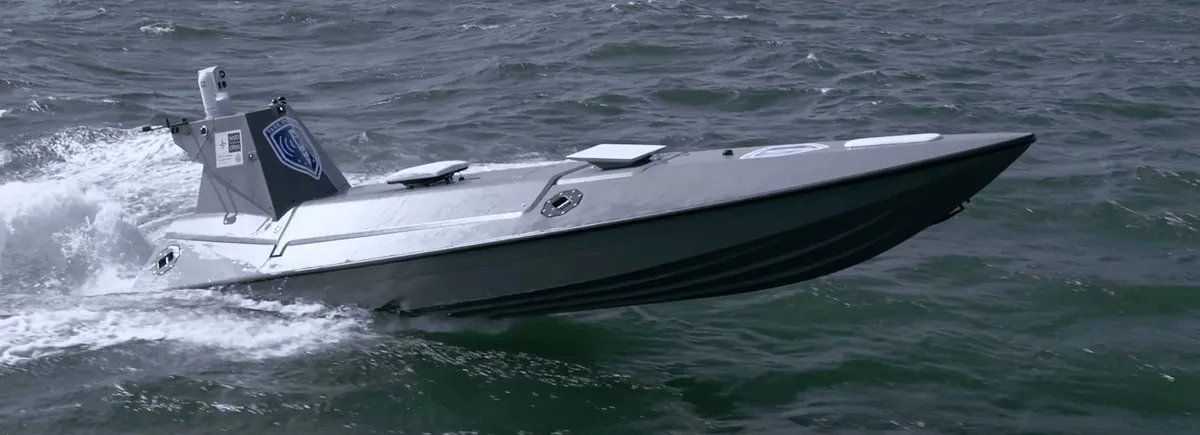
Shield AI and Kraken Technology Group have demonstrated two K3 SCOUT uncrewed surface vessels working as an autonomous team under Shield AI's Hivemind mission autonomy software. The demonstration took place in Portsmouth, U.K., and covered an intelligence, surveillance and reconnaissance (ISR) mission.
- Two Kraken K3 SCOUT uncrewed surface vessels ran an ISR mission as an autonomous team under Shield AI's Hivemind software in Portsmouth, U.K.
- Hivemind used radar, cameras and AIS data to search, classify, track and escort a vessel of interest, then replanned and resumed searching.
- K3 SCOUT is 8.4 m long, reaches up to 55 kt and carries a 600 kg payload, according to the release.
- It was Shield AI's first maritime autonomy demonstration in the U.K.
- The companies plan joint trials in contested environments with U.K. and NATO partners over the coming year.
What the demonstration showed
According to the companies, two Hivemind-enabled K3 SCOUT vessels searched a designated area together, using onboard radar, cameras and Automatic Identification System (AIS) data. Hivemind coordinated the search autonomously.
After the system detected and classified a vessel of interest in the search area, it directed the two boats to track and escort the contact out of the operating area. Hivemind then dynamically replanned the mission and the vessels resumed searching.
The companies say the point of the demonstration was to show multiple autonomous vessels acting as a coordinated team on complex missions, rather than as independent assets.
How Hivemind is meant to change operations
Shield AI describes Hivemind as an AI pilot that lets platforms sense, decide and act independently, within operator-defined parameters and under established command authority. The company contrasts it with traditional autopilots, which cannot deviate from preplanned routes. According to Shield AI, Hivemind reroutes mission plans, responds to unexpected conditions, avoids obstacles and carries out complex tasks.
The release says that, instead of needing one operator per vessel plus extra staff to manage onboard sensors, Hivemind lets several autonomous platforms share sensor data, adapt to changing conditions and execute missions together, while humans keep decision authority.
Christian Gutierrez, senior vice president of Hivemind at Shield AI, said maritime operators face "vast blind spots at sea and more data than any watch stander can sift through in real time." He said Hivemind pushes operator intent directly into an autonomous USV team, helping systems prioritise contacts of interest and work alongside the crew "instead of adding to their cognitive load."
The K3 SCOUT and Kraken
Kraken's K3 SCOUT is a high-performance, high-speed and scalable USV with a modular architecture. According to the release, it can be purposed or rerolled for missions including logistics, search and rescue, survey, ISR, strike or kinetic capabilities. It measures 8.4 m in length, can reach speeds of up to 55 kt and can carry a 600 kg payload.
Kraken recently delivered 20 K3 SCOUTs to the Royal Navy in a matter of months under Project BEEHIVE, the company says. Mal Crease, CEO and Founder of Kraken, said the successful integration of Hivemind "further validates our technology" and called pairing Kraken's platforms with proven autonomy a force multiplier in the transition to a hybrid fleet.
Kraken was founded in 2020 and is a British company. It lists the K3 SCOUT, K5 KRAKEN and K7 SABRE uncrewed surface vessels, plus the K4 MANTA uncrewed surface/subsurface platform. Each of its facilities can produce up to 1,000 units per year, according to the company, which says it recently raised $175m in Series B and has been valued at $1bn.
What comes next
Shield AI says this was its first maritime autonomy demonstration in the U.K., and presents it as a milestone in extending Hivemind beyond aviation into maritime operations. Its product line also includes V-BAT and X-BAT aircraft.
The two companies plan to expand their collaboration with future joint trials in contested environments with U.K. and NATO partners over the coming year. Gutierrez said that working with a scaling manufacturer like Kraken lets allied navies "field this capability on a platform today."