SimReady Central puts 2,000+ simulation-ready 3D assets on Hugging Face
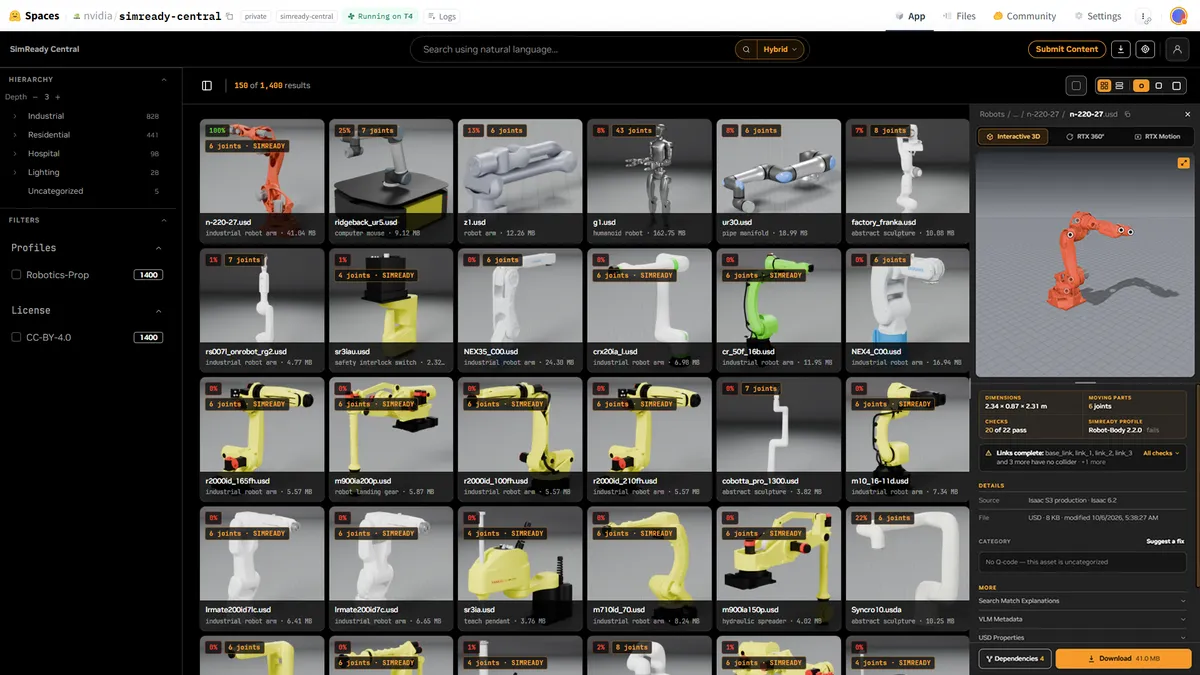
SimReady Central Library brings together more than 2,000 simulation-ready OpenUSD assets on Hugging Face, giving developers a free, ungated starting point for physical AI training environments and AI factory digital twins. The library is described in a blog post by NVIDIA authors published on Hugging Face.
- SimReady Central Library offers more than 2,000 simulation-ready OpenUSD assets on Hugging Face, free and ungated.
- Assets include robot arms, grippers, warehouse equipment, racks and cooling infrastructure.
- SimReady Foundation profiles define the features an asset needs for a given simulation use case.
- OEMs such as FANUC, Universal Robots, Vertiv and LG Electronics can validate and submit assets.
- NVIDIA USD Search enables natural-language asset discovery for developers and AI agents.
What SimReady assets are and what the library contains
Building robotics simulations and high-fidelity AI factory digital twins takes more than 3D models, according to the post. Developers often have to add properties such as collision geometry, mass and friction by hand. SimReady assets are 3D models that come prepared with the properties needed for simulation workflows, which reduces that manual work.
The library covers infrastructure and equipment assets, from robot arms and grippers to warehouse equipment, racks and cooling infrastructure. Developers can check which capabilities each asset supports and then combine assets from different suppliers into one scene.
The assets are OpenUSD files. OpenUSD is an open, extensible framework for describing and composing 3D scenes. A detailed CAD model is a useful starting point, the authors write, but simulation needs more information about how an object should be interpreted. For a robot manipulation task that can mean mass, collision geometry and friction. For AI factory work it can mean equipment geometry plus the electrical or thermal metadata an application needs.
Profiles define what an asset must include
SimReady Foundation supplies specifications, profiles and validation tools that make these requirements explicit. A profile defines the logical grouping of features and capabilities an asset needs for a particular use case. Depending on the asset and profile, the features can include:
- Collision geometry and physical properties: contact and physics simulation in a supported runtime.
- Joint structure and limits: movement of articulated robots and equipment.
- Semantic labels: object identification and annotated synthetic data.
- Materials and sensor attributes: rendering and supporting sensor simulation.
Developers are advised to pick assets whose profiles match their workflow and compose them into an OpenUSD scene.
Manufacturers and providers contributing assets
Equipment manufacturers (OEMs) can prepare and validate assets against SimReady requirements and publish them in the library to reach developers. They manage their own Hugging Face datasets. To contribute, OEMs use the SimReady Central submission skill to validate assets against the relevant profiles, package them and submit them for inclusion.
The post names several participants. Vertiv is cited as an AI factory OEM for assets such as server racks and cooling equipment. Robotics OEMs named are Comau, FANUC, Franka Robotics, Robotiq, Standard Bots and Universal Robots, whose robot arms and grippers become discoverable for training and evaluation environments. Palatial contributes the NVIDIA Robotics 1K Dataset, released in collaboration with NVIDIA Robotics, along with complex articulated assets generated from text, images, scans, datasheets and CAD. LG Electronics (LGE) can share assets such as refrigerators and dishwashers for household robot simulation, and ForgeCAD offers articulated robotics props with high-quality textures.
Search and AI-assisted scene building
NVIDIA USD Search powers natural-language search in the library, helping developers and AI agents find assets across participating datasets. Hugging Face has also integrated USD Search into its platform search, with indexed USD properties and simulation metadata. The environments can support projects such as Microduck, an open-source robot from Hugging Face and Pollen Robotics.
The authors also describe AI-assisted authoring with frontier models such as OpenAI's GPT-6 Astra, combined with asset search and scene-authoring tools. Given task requirements and spatial constraints, Astra can help find suitable assets, write code to assemble a scene and create scenario variations, according to the post. OEMs can use it to prepare and refine assets before validation and submission.
As an example, a developer could prompt for a warehouse pick-and-place scenario in Isaac Sim using PhysX, with a FANUC arm, a compatible Robotiq gripper and warehouse assets. The authors expect Astra to query the SimReady Search API, reference the assets into an OpenUSD stage, generate Python code for the workcell, configure the task and render a preview for review. The post also says the same approach can support an ISV building an AI factory digital twin, though the available text of the source ends before that part is explained.
What it means for developers and manufacturers
For developers, the library offers a free, ungated place to start physical AI training environments instead of preparing each model from scratch. For manufacturers, it is a way to make their equipment discoverable and let end customers test and simulate scenarios faster, which the authors say can accelerate decision making.