Slack Code API goes live, letting any developer's agent open code channels
The Slack Code API is now generally available on all Slack plans, according to Salesforce. Any developer can build an agent that starts a code channel, adds people and files, posts updates as it works and archives the channel when the task is done.
- The Slack Code API is generally available on all Slack plans, according to Salesforce.
- Any developer's agent can open a code channel, add people and files, post updates and archive the channel.
- Salesforce says GitHub Copilot opens a code channel on 30% of its agent sessions.
- More than 150 customers and partners had asked for access to build code channel experiences for their own agents.
- Pull Request improvements with GitHub sync and an enhanced Agents & Tools tab are listed as available soon.
From launch partners to every developer
Salesforce launched Slack Code in August on the idea that agentic development should not be a single-player activity. Instead of vanishing into a private tab, agent work is meant to happen in Slack, where a team can see it. Launch partners including Anthropic, Cognition, GitHub and Vercel tested the concept.
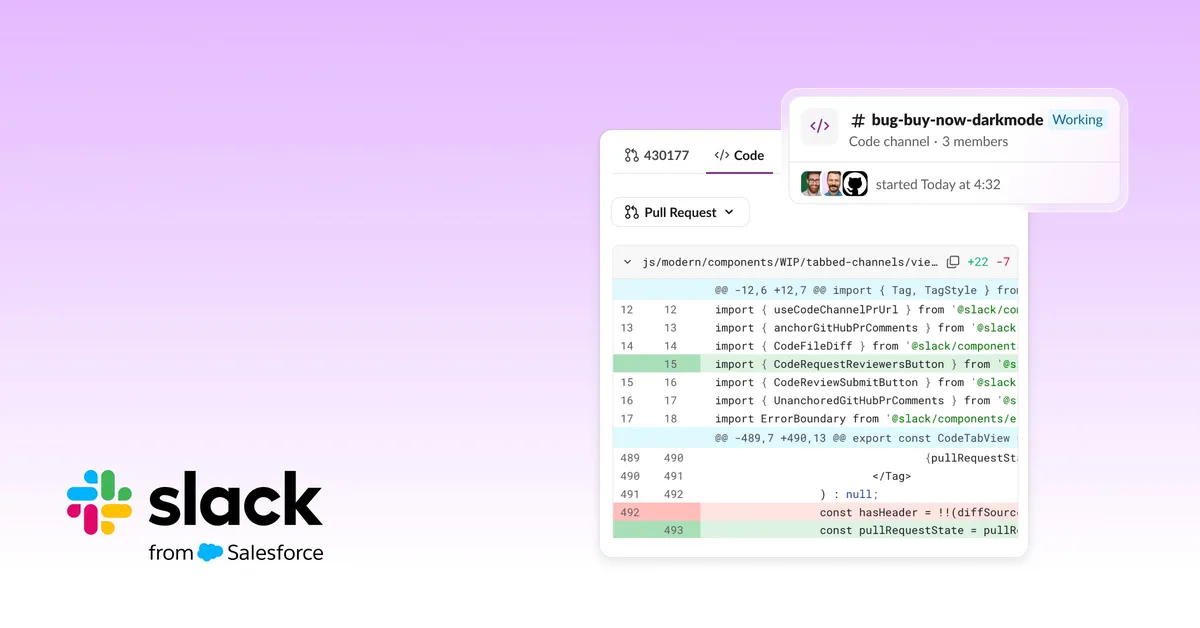
The core of it is the code channel: a dedicated space that an agent can open for a task, with the right people, context and plan already in it. Teammates can watch the agent work, add context and approve changes without leaving Slack.
Salesforce says GitHub Copilot opens a dedicated code channel on 30% of its agent sessions. The company reads that as nearly a third of the time involving work big enough for a task-sized workspace.
Demand followed. According to Salesforce, more than 150 customers and partners asked for access to build code channel experiences for their own agents, but only a handful of partners had been able to deliver them. The general release removes that limit.
What the API gives developers
Salesforce describes the problem the API addresses. Bringing coding agents into Slack has meant working with API calls and standard components such as channel threads or DMs. When an agent needs to attach a massive log file, propose a 50-line code diff or run a multi-step execution plan, a standard thread can get cramped quickly. Enterprises with strict security requirements, the company adds, could not use off-the-shelf third-party agents at all.
The company highlights three capabilities:
- Agents that work in the open. Code channels are a new primitive built for agents, and an agent can create one on its own when a request deserves its own space.
- Agents the whole team can steer. The APIs let an agent show its work and add bookmarks, so a coworker can step into a task someone else started and see the full execution history.
- Agents an enterprise can trust. Users can see what the agent is doing and who approved it. Message compliance is built in, along with the workspace controls and data boundaries admins already use.
Developers decide what the agent does and how it shows its work, while Slack handles the interface. The APIs can display code diffs, HTML previews and thinking steps, so developers can skip building their own UI screens and review steps. Salesforce also says Slack stays an agent-neutral hub, so teams can swap agents or models later and keep working in the same place.
How it works and what is still to come
Developers add the Slack Code API to their agent manifest and set the properties of a code channel, such as name, commands and views. When a teammate mentions the agent in a channel or DM and the request needs more than a quick reply, the agent creates a code channel and adds bookmarks and artifacts so people can follow along. It posts updates and status as the work progresses and can archive the channel when finished.
On governance, Salesforce says the agent inherits the permissions and admin controls of the channel it works in. There is no separate access model to build, and IT has nothing new to configure. A person can approve each high-stakes change, and everything stays searchable after the work is done.
Two features are listed as available soon. The first is an improved Pull Request experience in Slack Code. For teams using GitHub, users will be able to request reviews from people in Slack and share the full context of the agent's work. Comments will sync bi-directionally between Slack and GitHub. Once a PR is approved and tests pass, a prompt will offer to merge it directly from the code channel.
The second is an enhanced Agents & Tools tab, which will give a view of all agent conversations and code channels, including status, channel membership and recent context. Users will also be able to browse public code channels to see what teammates are working on.
What it means for developers and teams
The release opens the code channel format to anyone building agents, whether a homegrown agent for an enterprise or one for the Slack Marketplace. Developers can read the Slack Code API docs, add the API to their agent manifest and have an agent start its first code channel. Those building for customers can submit agents to the Slack Marketplace.
Teams that want to see the format first can browse Slack Code agents in the Marketplace, including Claude, Devin, GitHub Copilot and Vercel. Salesforce gives a sample scenario: a custom observability agent opens a code channel after a 2:00 a.m. production alert, an on-call engineer redirects it, and a teammate adds missing context. The company argues that this way of working lets knowledge build up across a team instead of disappearing into a private, stateless session.
Salesforce: Introducing the Slack Code API: Your agents, your team, one code channel