Supermicro ships H15 servers with AMD’s 6th-generation EPYC 9006 CPUs
Supermicro is now shipping its H15 server portfolio with AMD EPYC 9006-series processors from the 6th generation, formerly codenamed Venice. The systems target cloud, high-performance computing and agentic AI workloads, while the company says they have achieved multiple SPEC CPU world records.
- Supermicro is shipping H15 servers with 6th-generation AMD EPYC 9006 processors.
- The portfolio offers up to 33% more cores and double the PCIe bandwidth.
- Systems provide 1.6 TB/s of memory bandwidth per processor socket.
- H15 servers have achieved multiple SPEC CPU world records, according to Supermicro.
- Helios and Helion target large-scale and agentic AI deployments.
Higher density and bandwidth for AI infrastructure
The H15 portfolio forms part of Supermicro’s Data Center Building Block Solutions architecture and is optimized for next-generation GPUs, including AMD Instinct accelerators. According to Supermicro, the systems provide up to 33% more cores, double the PCIe bandwidth and 1.6 TB/s of memory bandwidth per processor socket.
The company says the combination of AMD’s 6th-generation EPYC processors and its server designs delivers a 2.6 times increase in memory bandwidth compared with earlier generations of AMD CPUs. Supermicro and AMD also say enterprise customers can achieve 1.8 times higher token processing per second for host nodes running advanced AI models, compared with previous-generation AMD CPUs.
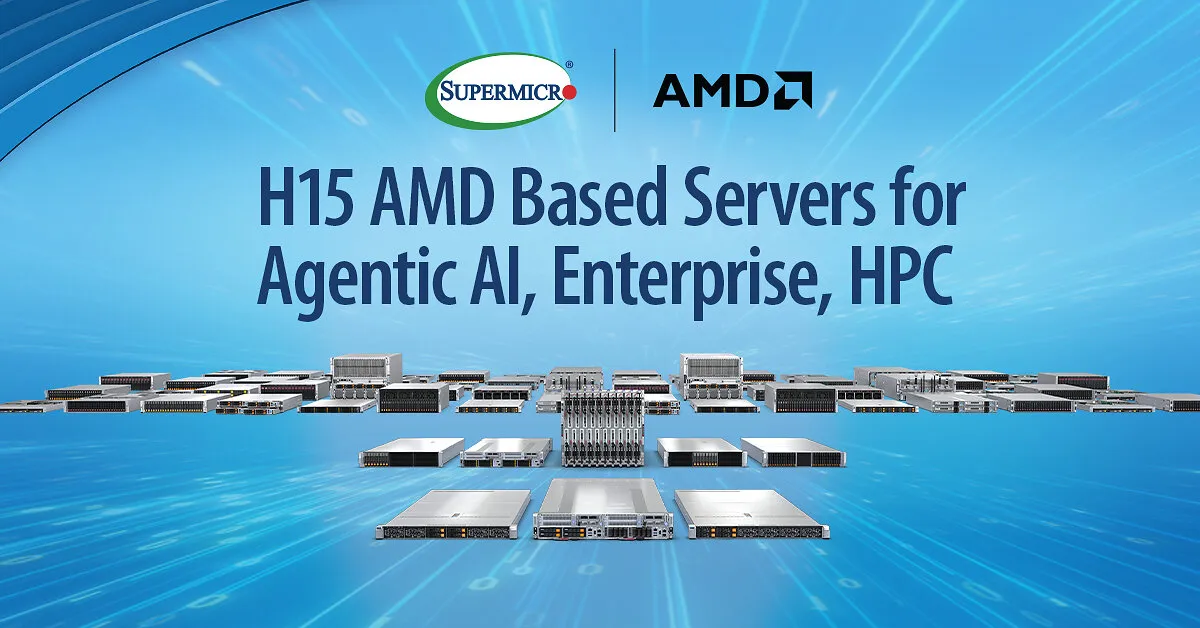
The H15 systems have recorded multiple SPEC CPU world records on Supermicro’s 2U Hyper and CloudDC platforms. The portfolio includes more than 20 optimized systems, spanning workstations, edge systems, high-density multi-node servers and enterprise GPU servers.
A broad portfolio for cloud and enterprise workloads
Supermicro’s H15 range includes the two-socket Hyper platform for enterprise applications, AI inference, virtualization and cloud workloads. CloudDC is a single-socket system for large-scale cloud environments, based on the Open Compute Project’s Data Center Modular Hardware System specification.
Other systems include the liquid-cooled, two-node FlexTwin platform, the two-node GrandTwin architecture, and Petascale Storage, a 2U all-flash platform designed for AI data lakes, large-scale analytics and HPC environments. Petascale Storage supports up to 4.8 PB per system. The H15 6U SuperBlade supports blade configurations with one or two processor sockets and air- or liquid-cooled versions.
Supermicro says the H15 portfolio includes SP7 and SP8 socket systems, allowing it to offer a single source for CPUs, GPUs and storage in data centers.
Helios and Helion extend the offering to rack scale
Supermicro and AMD are also bringing Helios and Helion rack-scale solutions to enterprise customers. Both are designed for large-scale and agentic AI deployments and integrate with Supermicro’s DCBBS architecture.
Helios is focused on maximum GPU performance and uses AMD Instinct MI455X GPUs to accelerate advanced AI model training and high-throughput inference. Helion is designed for high compute performance and deployment flexibility, using AMD’s latest 6th-generation EPYC CPUs.
For users, the announcement means Supermicro is positioning a broad set of immediately available H15 systems alongside rack-scale platforms for different AI, cloud and HPC requirements. The company and AMD say the modular designs can help customers deploy AI infrastructure faster, improve utilization, reduce energy consumption and lower total cost of ownership.