TCL unveils CPE X5 5G with agentic AI at Network X 2026 in Vienna
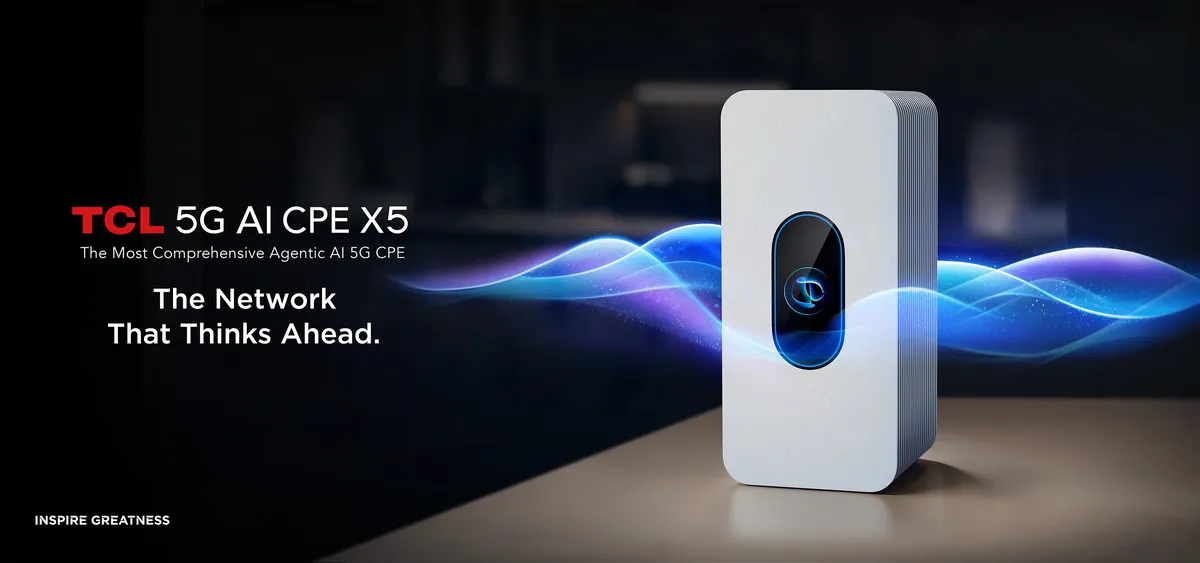
TCL has presented the CPE X5 5G, a home broadband device built around an agentic AI system, at the Network X 2026 trade show in Vienna. According to the company, it lets users describe a desired outcome in natural language while the device handles network optimization, diagnostics and recovery.
- TCL presented the CPE X5 5G with an agentic AI agent at Network X 2026 in Vienna.
- The 8Rx antenna design delivered 51% higher downlink speed than a 4Rx design in TCL's lab tests.
- The X5 supports 3GPP Release 18 and a theoretical maximum downlink of 7.01 Gbit/s.
- A closed-loop system detects, diagnoses, recovers and logs network problems, and the "AI QoS" feature prioritizes gaming, streaming and video call traffic.
- TCL says the X5 won an IFA 2026 innovation award; no price or availability was given.
An AI agent that acts on user intent
TCL, which describes itself as one of the world's leading consumer electronics companies, calls the X5 a 5G customer premises equipment (CPE) with full agentic AI. According to TCL, the device offers natural-language interaction, AI-based network optimization, application-aware quality of service (QoS), proactive diagnostics with self-recovery, and an extensible AI services platform.
The company says the unified agentic architecture lets the AI agent interpret what a user wants and coordinate detection, decision-making, execution and recovery. Instead of going through individual settings, users can state the result they are after. For supported tasks, the agent can coordinate network checks, traffic prioritization, mode switching and control of compatible devices. TCL gives the example of a user asking the X5 to optimize the network for a gaming session, after which the agent could adjust supported parameters according to network conditions.
TCL targets the X5 at households and small businesses looking for a premium broadband experience, whether for remote work, gaming or smart home connectivity. The company adds that the device recently won an IFA 2026 innovation award.
Specialized AI models for 5G and Wi-Fi
The X5 uses specialized AI models along the whole connectivity path, from 5G reception to indoor Wi-Fi coverage. On the mobile side, the AI analyzes signal quality to help choose the antenna configuration that gives better reception.
TCL describes an 8Rx architecture that combines four directional C-band antennas with gain of up to 13 dBi and four omnidirectional C-band antennas. In laboratory tests, the company says, this delivers a downlink speed 51% higher than a 4Rx design. The device is compatible with 3GPP Release 18 and offers a theoretical maximum downlink speed of 7.01 Gbit/s.
For indoor Wi-Fi, AI-assisted signal path selection, combined with congestion detection and channel adjustment, is meant to keep connectivity fast and stable.
Self-management, traffic control and device security
The X5 monitors the Wi-Fi connection, the local network, mobile connectivity and system operation in a closed loop: it detects problems, diagnoses supported incidents, carries out recovery actions, verifies the results and logs its findings. According to TCL, supported recovery scenarios include certain congestion situations, module anomalies, resource overload and parameter drift. Network status reports give users and support teams visibility, and when integration is enabled, cloud and operator management systems can link local diagnostics to additional support services.
A local feature called "AI QoS" identifies supported gaming, streaming and video call traffic and prioritizes selected latency-sensitive flows when several applications share the connection. Adaptive power management adjusts power modes to usage scenarios and application traffic. Device identification helps users spot unknown devices, and AI-assisted traffic analysis can detect certain unusual access patterns. Parental controls and guest access settings are also included.
- Proactive diagnosis and recovery in a closed loop
- Prioritization of latency-sensitive traffic
- Unknown device identification and unusual access detection
A wider AI hub vision and the rest of TCL's lineup
TCL also presents a broader vision for the X5 as an AI platform at the center of connected life, combining on-device computing power, a unified AI operating system and a home computing center. The envisioned architecture aims to support local multi-agent planning and offline execution of supported tasks, with an emphasis on users controlling their personal data. The company says built-in model and skill repositories and a unified runtime environment are being considered to make it easier for developers to extend and deploy features.
Operators could consider tailored AI agents and service offerings, some of which would extend to compatible NAS devices, AI cameras and mesh network equipment. These points describe a planned direction, not features confirmed as available.
Alongside the X5, TCL is showing the TCL LINKHUB HH516 5G FWA CPE, which is prplWare certified, plus Wi-Fi 8 CPEs and routers, smart watches for children, and the TCL Tbot, a smart desktop assistant designed to enrich the experience of those watches. TCL says its connectivity portfolio explores AI, next-generation Wi-Fi, 5G and 5G-A to help operators build more adaptive and user-friendly connectivity services.
What it means for users and operators
For households and small businesses, the pitch is simpler broadband management: stating a goal instead of tuning settings, and a device that tries to detect and fix problems itself. For operators, TCL says the X5 can reduce the operations and maintenance workload. The source does not give pricing or availability details, and the performance figures cited come from TCL's own laboratory testing.