Texas Instruments adds agentic AI to CCStudio for faster embedded development
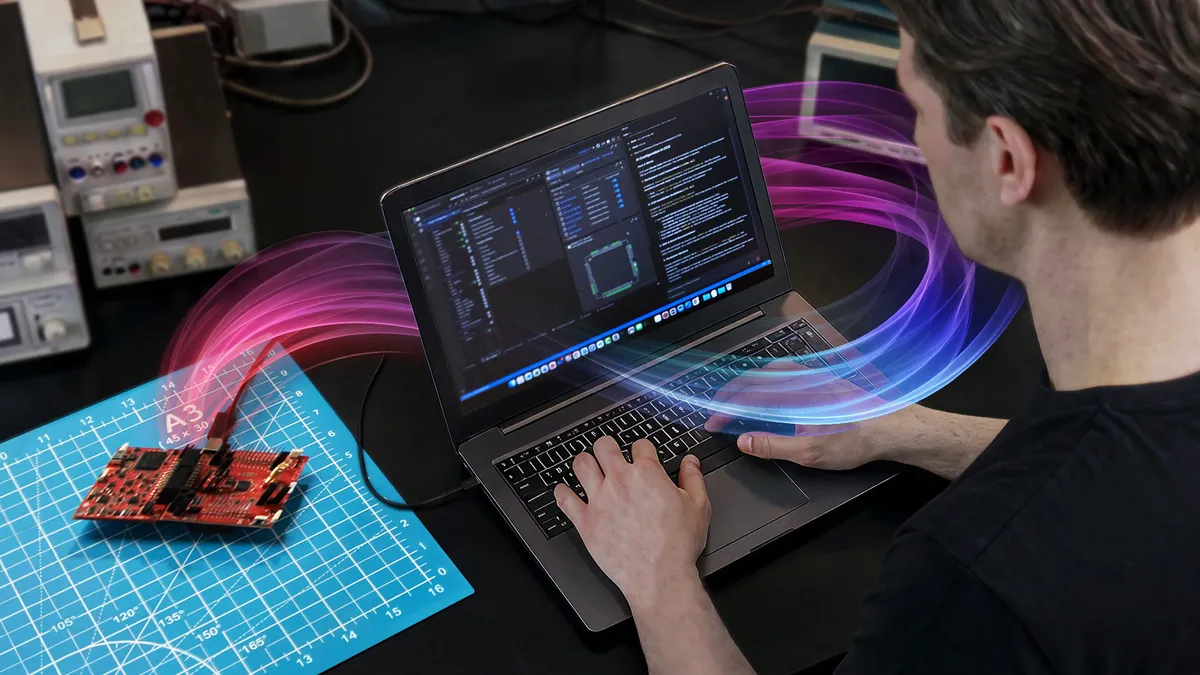
Texas Instruments has enhanced its CCStudio development ecosystem with agentic AI capabilities for embedded software development, including a device migration skill that the company says can reduce migration work from months to days or even hours. The tools are designed for development involving TI microcontrollers, wireless connectivity devices and radar systems-on-chip.
- TI enhanced CCStudio with agentic AI for embedded software development.
- A device migration skill can reduce migration work from months to days or hours, according to TI.
- The tools support TI MCUs, wireless connectivity devices and radar systems-on-chip.
- CCStudio is available now as a free download from TI.com.
AI tools gain hardware-specific context
TI says the updated CCStudio ecosystem moves beyond generative code assistance by connecting industry-standard AI agents and models to its resource library and embedded development tools. The framework injects device-specific information, including software development kits, pin configurations and peripheral data, into AI workflows through Model Context Protocol servers.
According to TI, grounding models in its technical data improves accuracy, reduces hallucinations and produces implementation-ready outputs. The system retrieves only the relevant context for a task, which the company says can reduce latency and token costs.
CCStudio's integrated development environment can expose capabilities to AI agents so they can generate code, configure peripherals, build applications, flash devices and debug them autonomously. Engineers can use natural language in CCStudio IDE or CCStudio for Visual Studio Code without switching tools or rebuilding context.
Migration skill targets a manual bottleneck
The announcement's main new capability is what TI describes as the industry's first agentic device migration skill. A developer can ask a preferred AI tool to migrate code from a competing device to a TI device, after which the skill navigates the migration process while preserving the existing software investment.
Specialized subagents handle separate stages of the work. They analyze the source project, configure peripherals, update code and application programming interface calls, and iterate through build errors until they are resolved. TI says the workflow can turn a process that historically required months of manual effort into one completed in days, or even hours.
This is intended to leave engineers more time for system architecture and application-specific features rather than repetitive migration tasks.
Available across TI's embedded portfolio
TI says the agentic AI capabilities are available today across its general-purpose and real-time MCUs, wireless connectivity devices and radar systems-on-chip. The modular CCStudio architecture combines task-specific skills, MCP server integrations and context injection, with support designed to expand to additional devices, updated SDKs and emerging edge AI development workflows.
The CCStudio development ecosystem is available now as a free download from TI.com. Its IDE supports multiple agents and models, allowing development teams to work within the AI environment of their choice.
What the update means for developers
For embedded engineers, the update brings device knowledge and development actions into the AI tools they already use, rather than treating code generation as a standalone task. TI's stated aim is to make work such as configuration, migration and debugging more efficient and accurate while allowing developers to focus on system-level design.
TI is showcasing the capabilities at electronica 2026 in Munich from Nov. 10 to Nov. 13. Demonstrations cover end-to-end application development in CCStudio IDE and CCStudio for Visual Studio Code, from system configuration through debugging.