Databricks expands Genie Agents across documents, tools and partners
Databricks is expanding Genie Agents beyond structured business data, adding analysis of documents in Unity Catalog volumes, connections to enterprise tools and governed sharing for external users. The company says the updates are designed to help organizations move from natural-language questions to trusted insights and action.
- Unstructured data analysis for Genie Agents is now in Public Preview.
- Native MCP connectors are generally available for tools such as Jira, Slack and Google Drive.
- OpenSharing and Genie Clean Rooms are in beta for governed external collaboration.
- Agents can analyze thousands of files and provide page-level citations.
- Genie Agents respect Unity Catalog permissions when retrieving file content.
Genie Agents add documents, tools and external sharing
Unstructured data analysis is now in Public Preview. Users can ask questions across governed tables and thousands of documents stored in Unity Catalog volumes, with citations that point to specific pages.
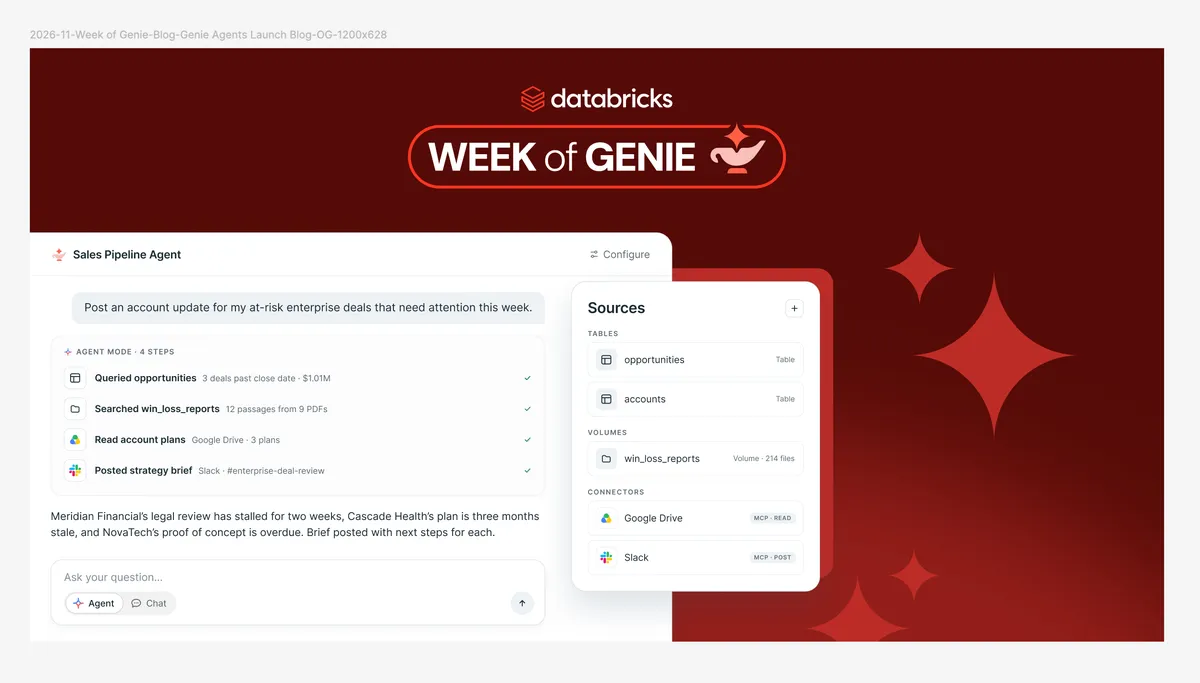
Databricks says Genie Agents can automatically parse, index and retrieve relevant content from PDFs, documents, slide decks and images. Its custom AI document parsing function recognizes tables, figures, headers and footers while preserving surrounding context. Agents can then reason over file content together with structured data in the same conversation.
The agents can also pull application data through Lakeflow and use native MCP connectors, which are now generally available, to read from tools including Jira, Slack and Google Drive and act on them. OpenSharing, in beta, allows organizations to give partners, suppliers and customers a governed agent that is pre-loaded with data, instructions and knowledge. Genie Clean Rooms, also in beta, allow recipients to chat with data while the underlying dataset and intellectual property remain hidden.
From SQL questions to broader business context
Genie Agents began as a no-code way to turn business questions into SQL insights. Databricks now positions them as agents that understand a company's broader context, combining business analytics, document analysis and connections to enterprise tools.
The company says this expansion addresses a gap in enterprise AI workflows. According to Databricks, 80% of the context that runs an enterprise lives in documents such as contracts, invoices, claims, medical records, financial reports and call transcripts. Basic enterprise search can attach a limited number of documents and retrieve raw text, but larger collections and complex file structures require document relationships, compliance controls and scalable retrieval.
Databricks says teams building those workflows independently may need custom retrieval-augmented generation, advanced parsing, an AI Search endpoint, an embedding pipeline and a supervisor-agent framework with permissions. Genie Agents handle parsing and indexing at scale, enabling one agent to search thousands of files and cite the page supporting an answer. The feature respects Unity Catalog permissions, so users only see files they can access.
Businesses are using Genie Agents across industries
Databricks cites deployments and use cases in retail, energy, technology, automotive, healthcare and life sciences. Unilever uses Genie Agents to help finance teams explore profitability, credit risk and financial performance in natural language. HelloFresh uses them to increase ad-testing velocity by 4x by bringing marketing performance insights together across media, creative and finance teams.
S&P Global Energy uses Genie Agents to bring data products to market in days rather than through traditional development cycles. Atlassian uses them to help security teams investigate billions of security events through natural language. General Motors has deployed over 1000 Genie agents across sales, engineering, supply chain, HR operations and other teams.
Databricks also describes document-focused workflows. An investment analyst could combine margin trends from governed tables with evidence from analyst reports and earnings transcripts. A technician could search thousands of manuals and bulletins for model-specific instructions, while a clinical trial analyst could compare trial-tracking data with reasons recorded in doctors' reports. In each example, page-level citations are intended to let users check the evidence before acting.
For users, the changes mean Genie Agents can work across more of the information and tools involved in an enterprise task. For organizations, OpenSharing and Genie Clean Rooms extend that governed access to external stakeholders, while permissions and citations provide controls for using sensitive business context.