UC Berkeley wins $1.7 million Google.org grant to make medical AI interpretable
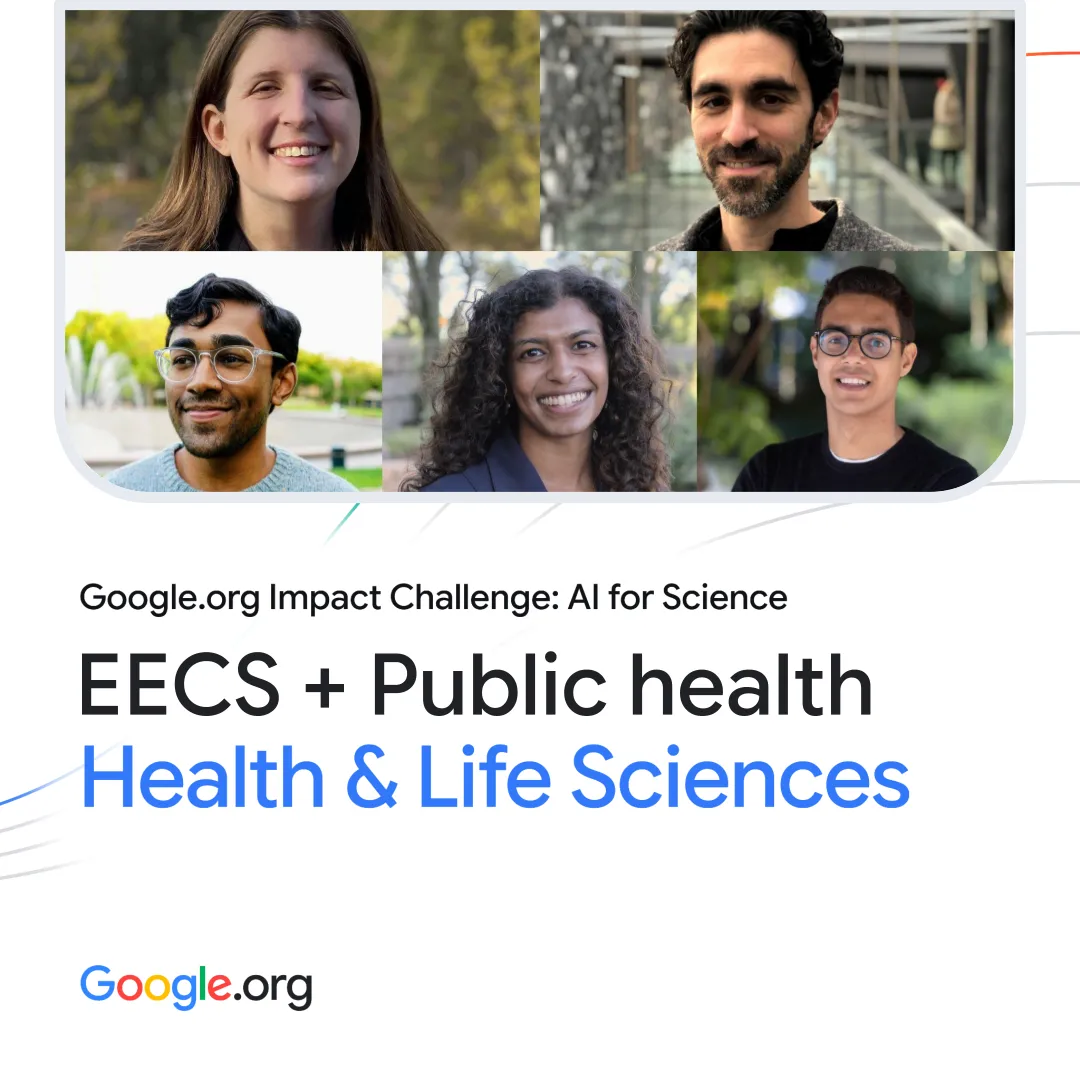
UC Berkeley researchers led by Emma Pierson and Ziad Obermeyer have been awarded $1.7 million through the Google.org Impact Challenge: AI for Science. The grant will fund work on using AI interpretability and agentic AI techniques to support medical discovery.
- UC Berkeley researchers Emma Pierson (EECS) and Ziad Obermeyer (Public Health) received $1.7 million from the Google.org Impact Challenge: AI for Science.
- Berkeley is one of 17 organizations chosen from more than 3,000 applicants across 30 countries, sharing $36 million in total.
- The project uses interpretability and agentic AI to turn medical foundation model representations into human-readable, physiologically grounded concepts.
- The work focuses on cardiology and oncology.
A selective grant program
Pierson works in Electrical Engineering and Computer Sciences (EECS) at Berkeley, while Obermeyer is in Public Health. Their project is one of the winners of the Google.org Impact Challenge: AI for Science, a program that drew more than 3,000 applicants from 30 countries.
According to Berkeley EECS, UC Berkeley is one of 17 organizations selected globally. Together, the selected organizations share a total of $36 million in funding.
Turning model representations into medical concepts
The project aims to establish a general framework for medical discovery. The researchers plan to use interpretability and agentic AI techniques to translate complex foundation model representations into human-readable, physiologically grounded concepts. The work will cover two fields: cardiology and oncology.
Berkeley EECS describes the underlying problem as a barrier. On one side are the opaque predictions and safety risks of today's medical AI models. On the other is potentially transformative biomedical knowledge that, according to the announcement, remains inaccessible and unusable by clinicians who want to improve patient care. The project is meant to break down that barrier.
In practical terms, the focus is on making what medical foundation models have learned readable to people, so that the knowledge inside them can be examined and used rather than remaining hidden in the model.
Google.org's view and what it means
Leslie Yeh, director of scientific progress at Google.org, said: "We're at an extraordinary moment for science, as advances in AI open up new possibilities for discovery that were difficult to imagine just a few years ago." She added that "UC Berkeley is bringing together AI and deep scientific expertise in ambitious, creative ways to address some of humanity's most important questions."
Yeh also said Google.org is honored to support the team as they apply AI to interpret medical foundation models, with the goal to "push the boundaries of scientific discovery and turn breakthrough ideas into real-world impact."
For the field, the grant signals funding interest in interpretability as a route to safer and more useful medical AI. The announcement does not give a timeline or specific results, so the outcomes of the project remain to be seen. What it does set out is a direction: moving from opaque predictions toward concepts that clinicians can read and relate to physiology.