UC Davis and Penn Team Up to Find Precision Therapies for Ion-Channel Disorders
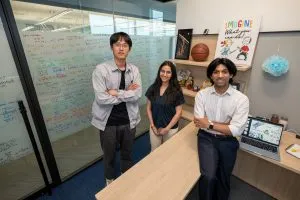
Researchers at UC Davis Health and the University of Pennsylvania are working together to identify precision therapies for children with neurodevelopmental disabilities caused by ion-channel disorders. The project is backed by a Biomedical Research Collaboration Award from The Hartwell Foundation.
- UC Davis Health and the University of Pennsylvania are collaborating on precision therapies for children with ion-channel neurodevelopmental disabilities.
- Roy Ben-Shalom and Pranam Chatterjee received a Biomedical Research Collaboration Award from The Hartwell Foundation.
- Both researchers were 2022 Hartwell Individual Biomedical Research Award recipients.
- Channelopathies arise when genetic changes alter ion channel function and can lead to conditions such as autism or childhood epilepsy.
A joint award for two Hartwell recipients
The collaboration brings together Roy Ben-Shalom, assistant professor of neurology at UC Davis Health and the UC Davis MIND Institute, and Pranam Chatterjee, assistant professor of bioengineering and computer science at the University of Pennsylvania. According to the story published by Penn Engineering and written by Nadine Yehya of UC Davis, the two recently received the Biomedical Research Collaboration Award from The Hartwell Foundation, which will support the research.
Both investigators were already recipients of a 2022 Hartwell Individual Biomedical Research Award. The new award builds on that earlier recognition by funding joint work across the two institutions. The Ben-Shalom Lab studies brain neuronal circuits in neurodevelopmental conditions, while Chatterjee's appointment spans bioengineering and computer science.
What ion channels do in the brain
The source explains the biology behind the project. Ion channels are proteins that act as tiny gates in brain cells. Each one forms a pore that can open and close in a fraction of a millisecond. These channels control the movement of charged ions, such as sodium and potassium, in and out of neurons.
That movement of ions generates the electrical signal a neuron uses to fire, and how quickly the channels open and close sets how readily it fires. This neural activity in turn affects the brain's circuitry and functioning.
When channels go wrong
Ion-channel disorders, known as channelopathies, occur when genetic changes affect how ion channels work. A mutation can leave a channel opening too easily, closing too slowly or barely opening at all. As a result, neurons fire too much, too little or at the wrong moments, and the circuits they form develop differently.
The outcome can be a neurodevelopmental disability, such as autism or childhood epilepsy. Because the underlying cause is a change in how a specific channel behaves, the researchers are aiming for therapies matched to the individual child rather than a single approach for all patients.
What it means
The announcement describes the goal and the funding, not results. The source does not give a timeline, a budget or details of the methods the teams will use, and it does not report any findings so far. For families affected by channelopathies, the project signals continued research effort toward precision treatments, though the source offers no information on when any therapy might become available. The story is tagged under AI, but the excerpt does not say how artificial intelligence will be used in the work.
Penn Engineering: Research to Develop Personalized Treatments for Children with Neurodevelopmental Disabilities