UChicago Workshop Calls for Humanities to Help Co-Design AI
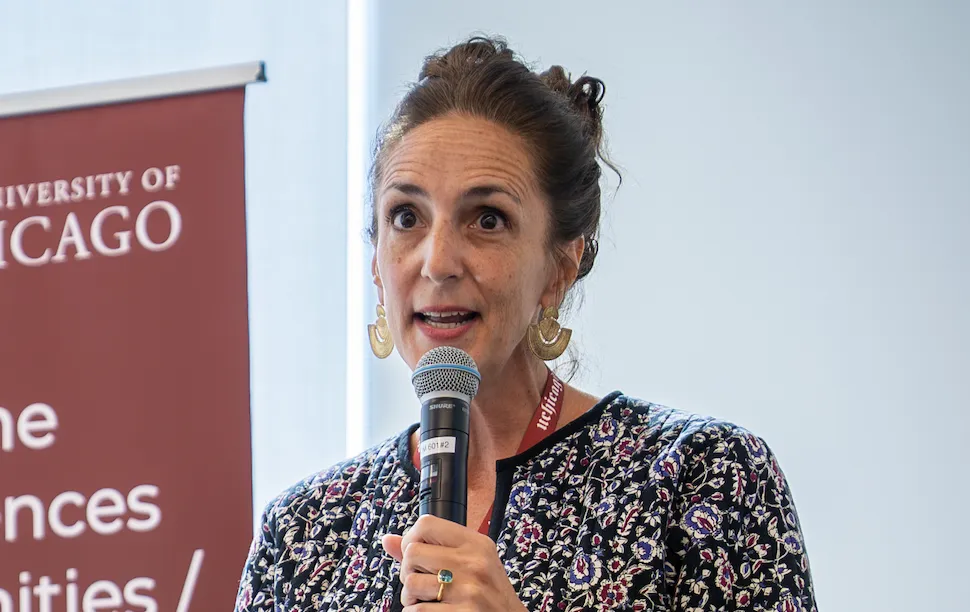
Social sciences and humanities scholars should help shape AI’s foundational architectures, rather than limiting their role to auditing its harms, according to a University of Chicago workshop. The October 21-22 gathering brought together 20 scholars from France and the United States.
- Twenty scholars from France and the United States attended the October workshop.
- Organizers called for SSH scholars to help co-design AI architectures.
- Heritage Watch combines AI alerts with multidisciplinary human judgment.
- Most tested LLM reading personas failed to follow their knowledge limits.
- The workshop’s second part is planned for Paris in Summer 2027.
From criticism to AI design
The workshop was co-hosted by CNRS’ AI for Science, Science for AI, the University of Chicago Data Science Institute, and the UChicago-CNRS International Research Laboratory for the Humanities and Social Sciences. Opening remarks from Laetitia Zecchini, Rebecca Willett, Matthieu Husson, and Hoyt Long framed the central question: how can social sciences and humanities, known as SSH, contribute directly to the design of AI systems?
The organizers said current AI models gain their power by aggregating large quantities of data and compressing them into general patterns. That process can flatten the context, perspective, and individual experience that SSH research treats as essential. Rather than removing this tension, participants examined how it could guide new principles for AI research.
Human judgment remains central
Several presentations focused on the risks of reducing human agency and cultural differences. Ben Zhao of the University of Chicago described tools that make changes to images invisible to people but disruptive to AI models, helping protect artists whose work has been collected by generative AI platforms. Bridget Fahey said the use of large language models is “unbundling” writing and credibility in law. “When you receive something written now, you don’t know whether someone’s individual taste, judgment, and expertise has gone into that work.”
The workshop also examined AI monitoring in heritage protection. Paul Goguel Masson presented Heritage Watch, which combines satellite observation, AI pattern recognition, and human decision-makers to monitor millions of heritage sites threatened by conflict and natural disasters. AI can flag possible looting, erosion, and other disruptions, but experts must distinguish those alerts from authorized excavation, farming, seasonal changes, and other activity.
That work requires archaeologists, remote-sensing analysts, conservation architects, art historians, and local authorities. As the source puts it, AI provides infrastructure, while the multidisciplinary team turns model outputs into action.
Plural voices and the limits of automation
Other sessions explored what AI can reveal about memory, art, and language. Wilma Bainbridge described ResMem, a neural network trained to predict image memorability across human populations. The system predicted the memorability of canonical works it had not been trained to recognize as famous, including Grant Wood’s American Gothic and Georgia O’Keeffe’s Cow’s Skull with Calico Roses. Jason Salavon compared AI’s effect on visual art with photography’s arrival, while Ada Ackerman discussed AI-related artistic practices as forms of anti-colonial resistance.
Participants also questioned whether AI systems can represent multiple perspectives. Hoyt Long said tests of LLMs prompted to act as different reader personas found that most failed to stay within their assigned knowledge limits. Matthieu Husson called for research communities that bring SSH scholars and computer scientists together, while cautioning that some humanistic questions may be more valuable when they remain unresolved.
The workshop will continue in Paris in Summer 2027. Organizers aim to develop the Chicago discussions into work that uses SSH categories, methods, and historical memories to build AI tools, rather than treating these disciplines only as observers of AI’s harms.
UChicago Data Science Institute: From Critique to Co-Design: How Social Sciences and Humanities Shape AI