Ultralytics and AMD Demonstrate YOLO26 for Embedded AI in Dublin
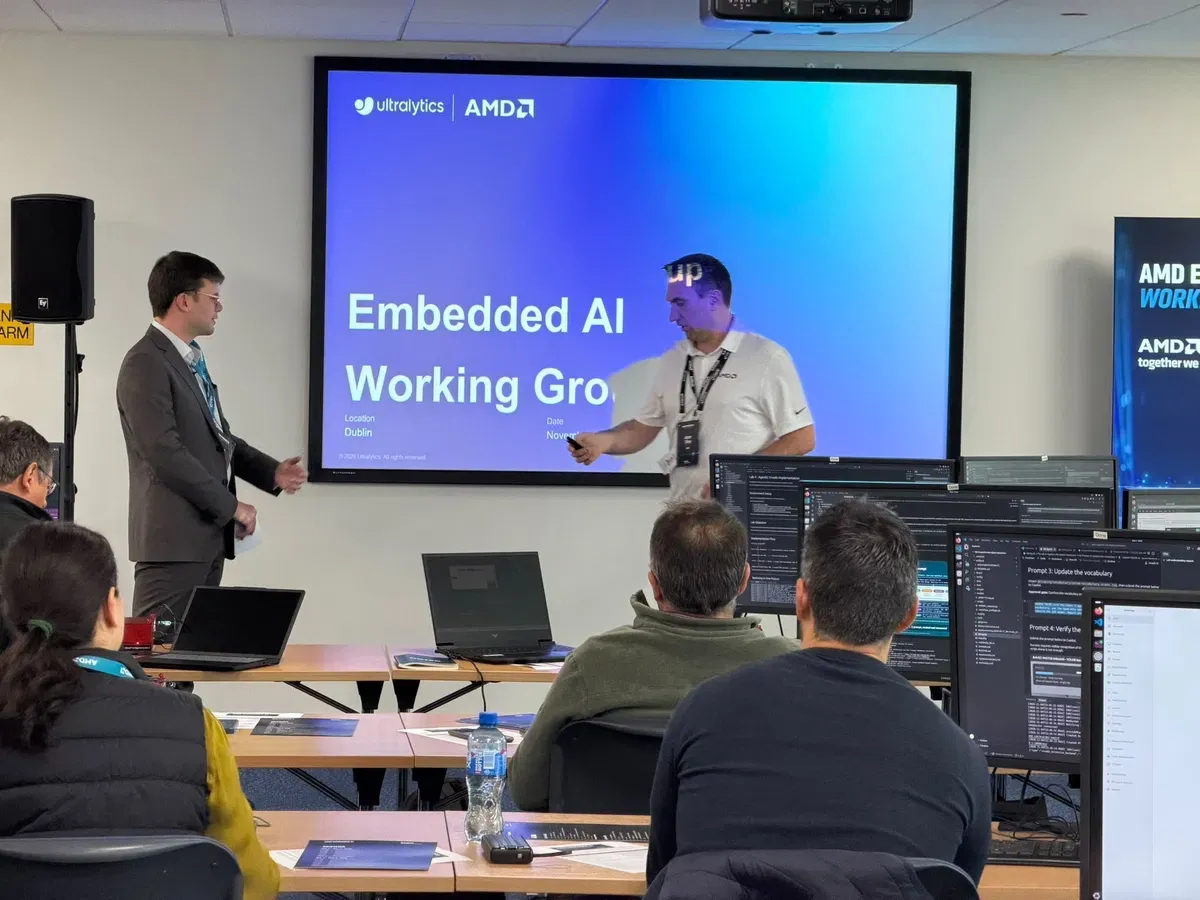
Ultralytics showcased YOLO26 across AMD edge hardware at AMD’s Embedded AI Working Group in Dublin, highlighting computer vision workflows for robotics, industrial inspection, and smart cameras. The November 3-4 event combined technical sessions, workshops, and live demonstrations focused on moving embedded and Physical AI applications toward deployment.
- Ultralytics joined AMD’s Embedded AI Working Group in Dublin on November 3-4, 2026.
- YOLO26 was used in workshops covering pose estimation, ROS 2, and robotics.
- Ultralytics demonstrated all seven YOLO26 tasks on AMD edge hardware.
- YOLO models can be trained with ROCm and deployed through ONNX and MIGraphX.
- The showcased use cases included robotics, industrial inspection, and smart cameras.
AMD and Ultralytics connect cloud-to-edge workflows
The event was hosted at AMD’s Dublin office and brought together AMD engineers, technology partners, and developers. Ultralytics was represented by Manuel Calve, Head of Ecosystem and Partnerships, and Zinnia Pourdad, Global Events Manager.
The company used the event to highlight recent developments in Ultralytics YOLO and its support for computer vision applications across AMD hardware. The collaboration includes official support for AMD GPUs in Ultralytics YOLO, including AMD Radeon GPUs, along with deployment options across AMD Ryzen AI processors and edge devices.
Developers can train Ultralytics YOLO models using AMD ROCm software, export them to ONNX, and deploy them with AMD MIGraphX for accelerated inference. According to Ultralytics, this gives developers flexibility to build computer vision applications across different computing environments, including industrial inspection, robotics, and smart cameras.
YOLO26 workshops focus on robotics and Physical AI
The first day covered AMD Ryzen AI, ROCm, robotics, and embedded AI development. Ultralytics YOLO26 appeared in two AMD-led workshops, where attendees worked with YOLO26 pose estimation and explored how computer vision can interpret movement and interact with physical surroundings.
One workshop placed YOLO26 pose in a ROS 2 robotics context. The applications discussed included person-following robots, distance monitoring, and gesture recognition. Ultralytics said the sessions showed how YOLO26 can fit into robotics and Physical AI workflows, helping developers bring computer vision into practical development environments.
On the second day, Calve presented a session titled Building real-world AI with Ultralytics YOLO and AMD: From Cloud to Edge. The session covered training on supported AMD GPUs with ROCm, exporting models to ONNX, and using MIGraphX for inference across AMD’s hardware ecosystem.
Seven YOLO26 tasks run live on AMD edge hardware
Ultralytics said its live demonstrations ran all seven YOLO26 tasks on AMD edge hardware side by side. They included object detection, instance segmentation, semantic segmentation, image classification, pose estimation, oriented bounding boxes, and depth estimation.
- Object detection identifies objects with boxes and labels.
- Instance segmentation produces a pixel mask for each detected object.
- Semantic segmentation assigns a class to every pixel.
- Image classification provides one label for the whole image.
- Pose estimation identifies 17 keypoints per detected person.
- Oriented bounding boxes provide rotated boxes for aerial and top-down views.
- Depth estimation provides distance in meters for every pixel.
For developers, the event points to a supported path from model training to edge inference on AMD systems. Ultralytics directs users to its AMD integration documentation for supported hardware, installation instructions, training workflows, and MIGraphX inference. The company also says YOLO26 can run in a ROS 2 node through the standard Ultralytics Python API.
Ultralytics: Ultralytics at AMD Embedded AI Working Group in Dublin