UNESCO panel: AI in courts must be judged by who it helps reach justice
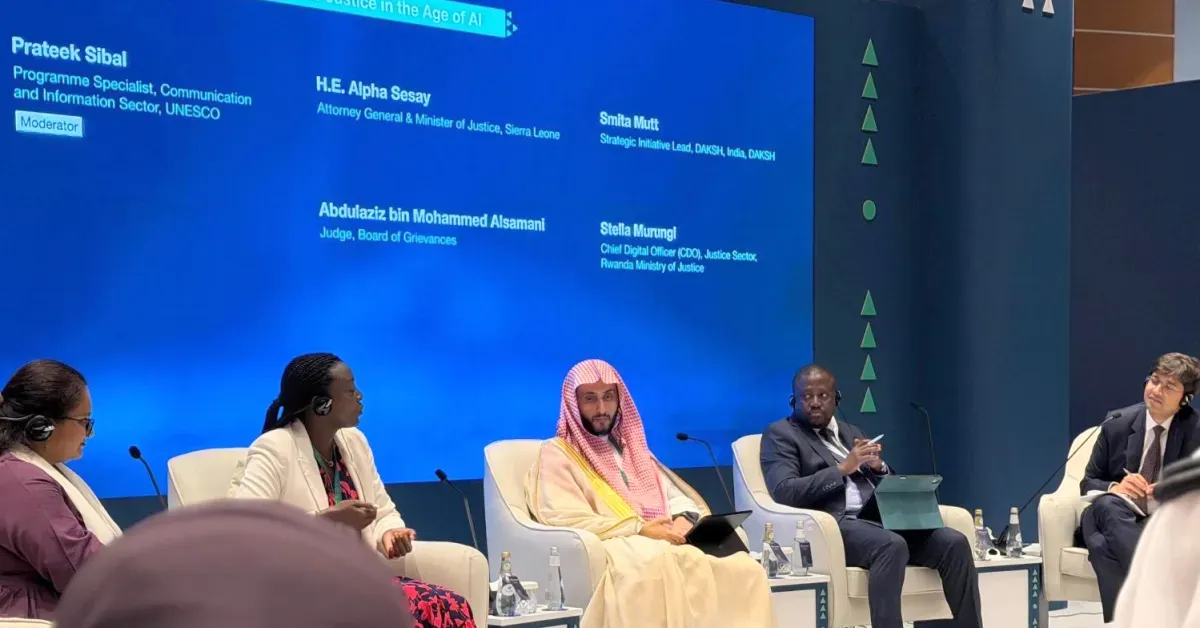
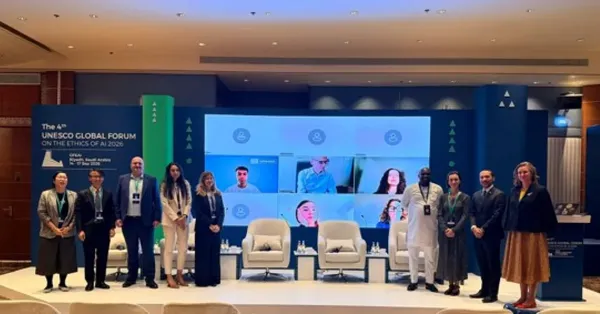
A panel at the 4th UNESCO Global Forum on the Ethics of Artificial Intelligence in Riyadh concluded that courts should measure AI by whether the people most likely to be left behind can still get justice. Speakers from Sierra Leone, Saudi Arabia, India and Rwanda warned that adoption is moving faster than governance.
- A UNESCO forum panel in Riyadh examined whether AI in courts closes or deepens the gap in access to justice.
- A UNESCO survey found 44% of judicial operators globally use some form of AI, while only 9% have received formal training.
- Rwanda classifies cases by risk and keeps a human as final decision-maker for high-risk uses such as sentencing.
- UNESCO offered its Ethical Impact Assessment, AI Readiness Assessment Methodology and a free MOOC with the University of Oxford.
Who is a digital court built for?
The panel on justice and inclusion, held in Riyadh, Saudi Arabia, examined how AI could close, or deepen, the gap between people who can access justice and those who cannot, according to UNESCO.
Alpha Sesay, Attorney General and Minister of Justice of Sierra Leone, said a significant share of his country's population meets its justice needs outside the formal court system, and that less than 30% of the country has mobile internet access. For him, digitalisation must start by asking who could be excluded, such as a domestic violence victim in a rural community or a farmer who cannot afford to travel to court.
Judge Abdulaziz bin Mohammed Al-Samaani of the Board of Grievances in Saudi Arabia agreed. He argued that a judiciary's AI strategy should be judged not by how much technology it introduces, but by whether it improves access to knowledge and services without compromising the fundamental safeguards of justice.
Adoption is outpacing governance
Smita Mutt, Strategic Initiatives Lead at DAKSH, a civil society and research organization in India, cautioned that the risk of exclusion grows when adoption moves faster than governance. She cited a UNESCO survey that found 44% of judicial operators globally were already using some form of AI, while only 9% had received formal training. According to the UNESCO account, this means AI tools are already shaping outcomes for litigants with little oversight of their use and impact.
Mutt pointed to case scheduling as an area where the effects can be significant. Case lists released late in the evening can disproportionately affect female advocates, who have caregiving responsibilities, while last-minute rescheduling can leave already at-risk litigants exposed. She argued that assessments of AI in the courts need to capture these second-order effects on vulnerable groups.
Judge Abdulaziz added that AI outputs must be verified rather than trusted outright. UNESCO noted an earlier known case in which a judge in Colombia acknowledged relying on a generative AI tool's reasoning to decide a child's insurance benefits, raising concern about exclusion if the tool's output had concluded otherwise.
Rwanda's approach
Stella Murungi, Chief Digital Officer at Rwanda's Ministry of Justice, presented a model she said closes rather than widens the gap. In Rwanda, a network of community-based agents operating through local shops under the IremboGov e-government platform extends digital government services into rural areas, with pricing harmonised among agents. She also mentioned Rwanda's constitutional quota of a minimum of 30% women in decision-making positions, which has been exceeded to around 50% among judges.
Murungi said Rwanda checks the accuracy of AI-generated language before deployment, particularly to ensure translations are accurate for non-English speakers. The country also classifies cases by risk, automating low-risk administrative tasks while always keeping a human as the final decision-maker for high-risk uses such as sentencing.
Tools and takeaways for judiciaries
Speakers agreed that closing the justice gap will take more than any single AI tool. It requires a mix of digital services, community participation and appropriate governance in place before deployment.
UNESCO shared with participants its Ethical Impact Assessment methodology and AI Readiness Assessment Methodology as practical starting points. It also pointed to its free MOOC on AI, Justice and the Rule of Law, developed with the University of Oxford. According to UNESCO, its AI and Rule of Law programme has supported over 38,000 judicial operators from 165 countries through the flagship MOOC.
As more judiciaries turn to AI, the panel's main message was that success is measured not by how much technology a court adopts, but by whether the people most likely to be left behind can still get the justice they came for.
UNESCO (AI): UNESCO panel maps an inclusive path for AI in justice