UChicago physicist Vincenzo Vitelli named 2026 MacArthur Fellow
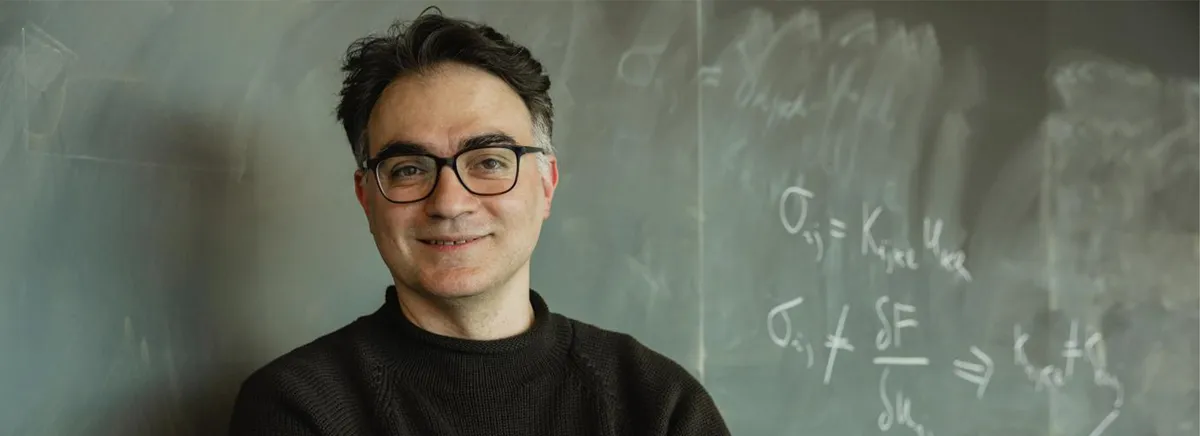
Vincenzo Vitelli, a professor of physics at the University of Chicago, has been named a 2026 MacArthur Fellow. He plans to use the $800,000 grant to explore what he calls "agentic many-body theory," a framework for the collective behavior of adaptive, information-processing agents.
- Vincenzo Vitelli, a University of Chicago physics professor, is a 2026 MacArthur Fellow.
- The fellowship carries a no-strings-attached grant of $800,000.
- His research covers metamaterials, active matter and non-reciprocal systems.
- He plans to explore "agentic many-body theory," on the collective behavior of adaptive agents such as humans, bots, cells or molecules.
- Vitelli is an affiliated scholar of the Data Science Institute and partners with the AI+Science initiative.
A fellowship for original work in unconventional materials
Vitelli is known for his work on unconventional materials. According to the University of Chicago's Data Science Institute, he is an affiliated scholar of the institute, partners with the AI+Science research initiative and mentors Eric and Wendy Schmidt AI in Science Fellows at the university.
The John D. and Catherine T. MacArthur Foundation gives the fellowships each year. They recognize individuals across different fields who demonstrate "exceptional originality in and dedication to their creative pursuits." Recipients receive a no-strings-attached grant of $800,000.
Vitelli is described as a pioneer in several subfields of physics, including metamaterials, active matter and non-reciprocal systems. His lab has demonstrated unusual forms of motion and adaptive behavior. Examples include robots that use simple principles of physics to navigate complex terrain, spontaneous rotations arising from "frustration" in nonreciprocal matter, 'hidden' symmetries linking apparently unrelated systems, and patterns emerging from turbulent fluids. The source says these and other discoveries could give rise to future technologies that employ such principles.
In awarding the fellowship, the committee wrote: "Vitelli's research is inspiring new metamaterials in mechanical engineering, robotics, and biophysics, and he is opening up new research directions into how non-reciprocal physics principles could apply to biology, human behavior, and artificial intelligence."
Studying what emerges when many parts interact
Vitelli's work centers on the surprising behavior that can arise when many constituents, from molecules to macroscopic objects, interact. Metamaterials are artificially created materials that can display unusual properties. Active matter arises when groups of energy-harvesting constituents act together, like fish forming a school.
Describing why he sees theoretical physics as a creative pursuit, Vitelli said: "There are two features of theoretical physics that in my opinion make it a creative endeavor: it is visionary and minimalist." He added that it is visionary "because you are imagining things that do not (yet) exist" and minimalist because researchers try to represent them in the language of mathematics.
He also recalled how he received the news. "I thought it was somebody playing a prank on me," Vitelli said. He said it was only when the foundation asked him to call back at an official number that he realized it could be real.
Next step: agentic many-body theory
Vitelli said he will use the award to pursue a research direction he has been considering for a while. "What that means is a theory for the collective behavior of information processing agents such as humans, bots, cells or even molecules that individually possess the capacity for adaptive, intelligent behavior," he said.
The guiding question, in his words: "what laws emerge when many such agents interact?" He said the MacArthur Foundation's support "will provide the personal freedom and peace of mind to launch in this direction."
The direction links his physics background with the AI-related themes of his affiliations at Chicago, though the source does not describe a specific project plan or timeline.
Background and Chicago's MacArthur record
At UChicago, Vitelli is affiliated with the James Franck Institute, the Leinweber Institute for Theoretical Physics, the Data Science Institute and the Institute for Biophysical Dynamics. He received his bachelor's of science degree from Imperial College London and his Ph.D. from Harvard University. Before joining UChicago, he was on the faculty at Instituut-Lorentz for Theoretical Physics at Leiden University and was a postdoctoral fellow at the University of Pennsylvania. He is a fellow of the American Association for the Advancement of Science and the American Physical Society.
He joins other UChicago colleagues who have received MacArthur Fellowships, most recently writer Ling Ma in 2024, statistician Rina Foygel Barber in 2023, sociologist Reuben Jonathan Miller in 2022 and film scholar Jacqueline Stewart in 2021.
UChicago Data Science Institute: UChicago physicist Vincenzo Vitelli named 2026 MacArthur Fellow