AI Futures Project proposes compute disclosures to slow frontier AI
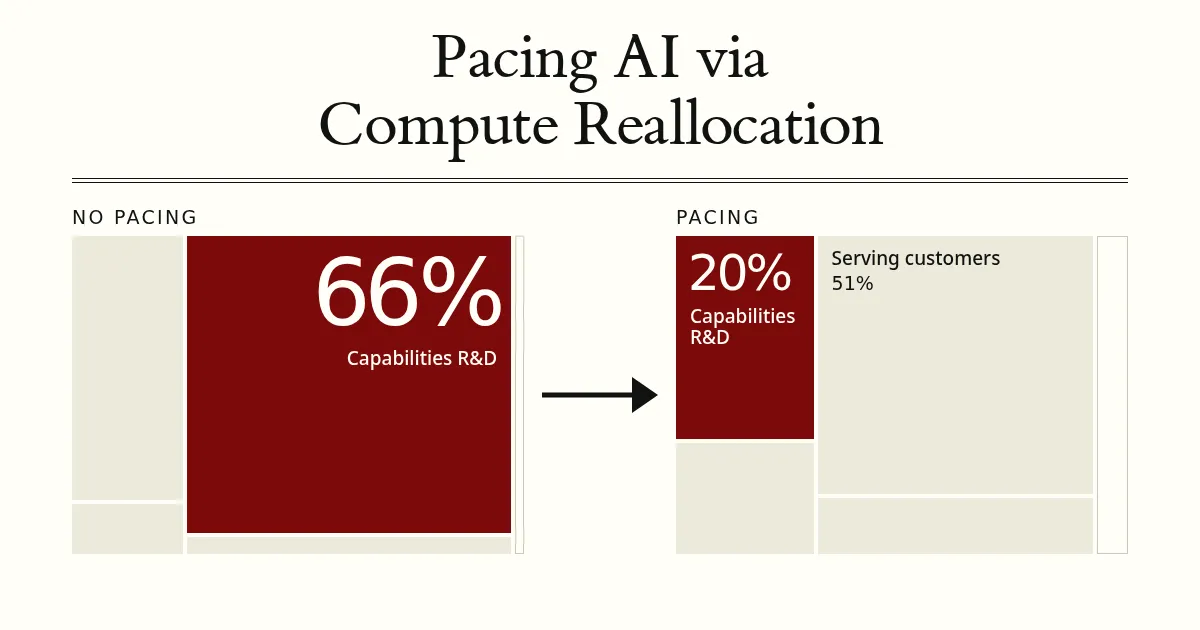
AI Futures Project has proposed shifting compute away from capabilities research and requiring companies to disclose their allocations through an independently verified system. The group estimates that starting the approach in January 2027 with a 15% cap could delay the intelligence explosion by a year.
- VCAD would require regular, independently verified compute allocation disclosures.
- The proposal would shift compute away from capabilities R&D.
- A 15% cap beginning in January 2027 is estimated to delay the intelligence explosion by a year.
- Companies would log workloads, classify them and report compute use by category.
- Baseline audits could begin today but may not withstand deliberate deception.
A two-part proposal for pacing AI
The proposal, published in a linkpost for pacing-ai.com, combines transparency with compute reallocation. Its first component is Verified Compute Allocation Disclosures, or VCAD. Under the system, AI companies would regularly report how they use compute, while an independent auditor verifies those disclosures.
The second component would shift compute away from capabilities R&D and toward other uses, including serving customers and safety research that does not contribute significantly to capabilities. AI Futures Project says this could provide a concrete way to slow frontier development without stopping all compute use.
The group roughly estimates that a 15% cap, introduced from January 2027, would delay the intelligence explosion by a year. It also says that this delay would most likely be insufficient to prevent AI takeover or mitigate other problems created by recursive self-improvement, and argues that the period should instead be used to implement a more durable policy regime such as Plan A or Plan S.
How companies would measure and report compute
VCAD would begin with logging. Companies would create infrastructure that records all workloads running inside the organization, with compute measured in GPU-hours and accompanied by relevant metadata.
The logged workloads would then be classified according to whether they contributed to capabilities R&D. The proposal calls for aggregating GPU-hours across different types of GPUs into a unified metric, such as H100-equivalents, classifying workloads through a combination of AI systems and human review, and estimating idle compute. Idle compute includes hot spares, downtime and new racks that have not started use.
Capabilities compute would include experiments to improve algorithms and data, data generation or filtering, training more capable AI systems, and internal inference supporting those activities. Other categories would include customer-serving compute, safeguard classifiers, internal safety inference, non-capabilities R&D and capabilities R&D.
Companies could publish a breakdown every two weeks, according to the proposal. Each disclosure would include the overall allocation, the methodology used to estimate and audit it, unresolved discrepancies and estimated error rates, chip-conversion ratios, and descriptions of a randomly sampled set of non-capabilities projects.
Audits are central to the system
AI Futures Project recommends publishing disclosures through channels that punish misreporting. It suggests beginning with inclusion in the company’s SB 53 frontier AI framework, then moving toward financial disclosures or direct regulation with enough liability to deter violations.
Third-party auditors would verify the process. The proposed baseline audit would examine whether the company’s records include all compute, whether workload data is accurate, and whether the classification process can be reproduced. Auditors could compare reported chip-hours with compute expected from contracts, build a database of the company’s datacenters and capacity, spot-check workloads, and independently rerun a classification pipeline.
The project says this baseline process could be implemented today and would be sufficient to estimate current compute allocation accurately. However, it would not be enough to withstand adversarial pressure from a company actively trying to misrepresent its disclosure under a pacing regime.
Why the project says VCAD matters
According to AI Futures Project, nearly every approach to pacing would benefit from verified compute accounting. Restrictions could otherwise be evaded by hiding compute, misreporting it, or failing to apply a safeguard to some workloads.
The group says credible disclosures could allow competitors and the public to trust companies that claim to be pacing their development. It also argues that an established and tested VCAD process would make future regulation faster to write and more workable. The project acknowledges that it has low confidence in some details, but presents the proposal as a concrete starting point for developing a workable pacing policy.
AI Futures Project: Pacing AI via Compute Reallocation