AI Futures Project proposes verified compute disclosures for frontier AI
The AI Futures Project has proposed verified compute allocation disclosures as a first step toward slowing the development of frontier AI systems. The approach would require companies to regularly classify how their compute is used, with the reports checked by third-party auditors.
- AI Futures Project proposes verified compute allocation disclosures, or VCAD.
- Companies would classify compute use and submit records for third-party verification.
- The project says monitoring compute is needed for many pacing and safeguard proposals.
- The post argues that slowing software progress is more effective than delaying training runs alone.
- The proposal has a listed confidence level of medium.
A proposed foundation for AI pacing
In a Nov. 10, 2026 post, AI Futures Project author Eli Lifland argues that frontier AI companies should begin “pacing” as soon as possible. The post defines pacing as intervening to delay the point at which AI systems with a given capability level are developed.
The proposal is called verified compute allocation disclosures, or VCAD. Companies would report how their compute is allocated, such as between AI research and development, safety research and external inference. Third-party auditors would verify the reports, ideally with government support.
According to the AI Futures Project, these disclosures would allow companies to credibly demonstrate facts about their workloads, including the percentage of compute used for AI R&D. Public disclosure of the allocations is preferred, although the post says it is not essential to the verification system itself.
Why the project says monitoring compute is necessary
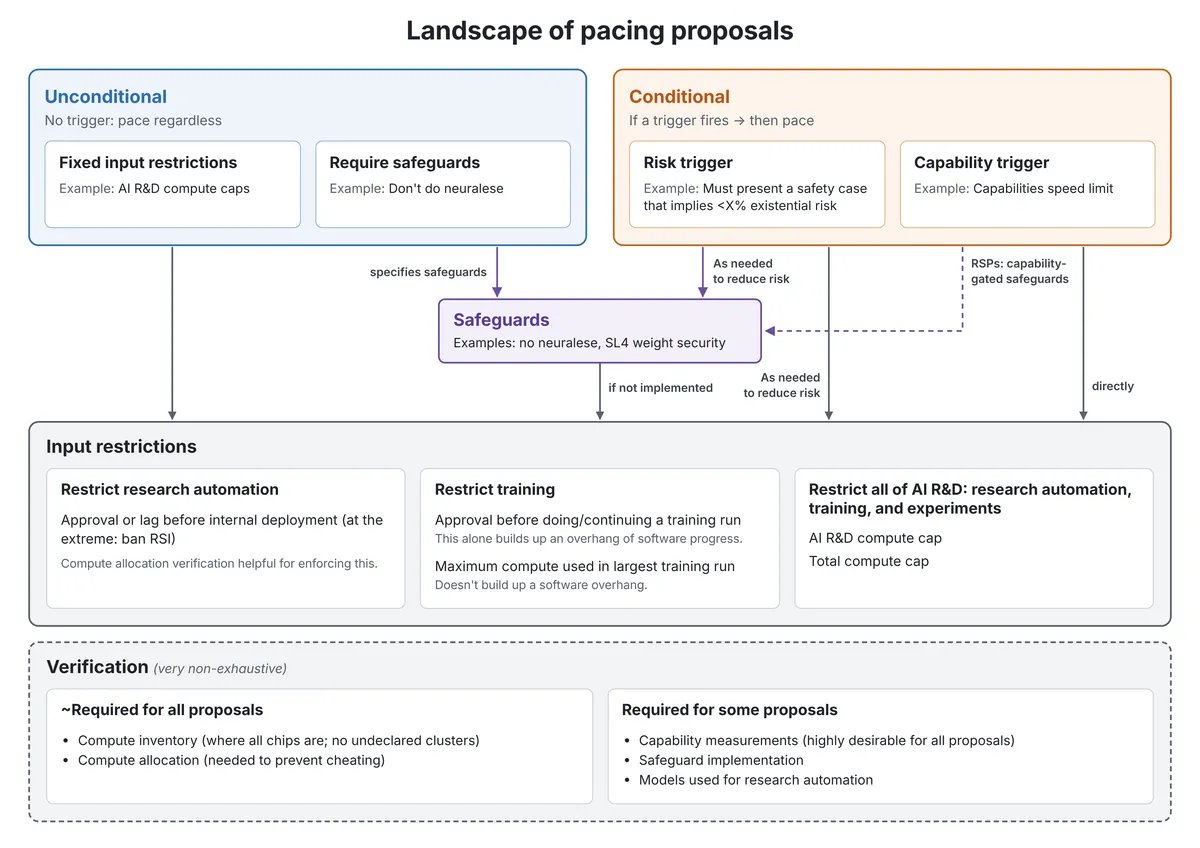
The post presents a framework for comparing pacing proposals. It distinguishes between unconditional pacing, which applies a consistent restriction, and conditional pacing, which depends on conditions such as risk assessments or capability thresholds. It also separates input restrictions, such as limits on R&D compute, from safeguards designed to make AI development safer.
AI Futures Project argues that nearly all pacing proposals short of shutting off GPUs require verification of both compute inventory and compute allocation. The reason, it says, is that a company could evade a restriction by using compute that auditors cannot effectively monitor, or by presenting auditors with an incorrect allocation.
That concern applies beyond direct limits on AI R&D compute. The post gives internal deployment lags as an example. Verifying such a restriction would require checking that restricted models are not running on internal workloads, distinguishing internal from external workloads, and accounting for all compute. It also says VCAD could help verify requirements for approval before training runs by checking that no unverified compute is being used for training.
The project acknowledges that extreme restrictions could make VCAD unnecessary. If all GPUs were shut off, for example, power monitoring could make verification relatively straightforward. It says such proposals are less politically feasible than less extreme restrictions.
The case for slowing software progress
A central argument in the post is that pacing should address more than the timing of training runs. If training runs are delayed while the rest of the R&D process continues, algorithmic and data progress could accumulate in the meantime. The project calls this buildup a “software overhang.”
According to the AI Futures Project, that overhang could produce sudden bursts of progress once training runs are approved. The unused software progress could also be stolen by China or diffuse to other actors. Delaying training runs alone may therefore provide only a limited slowdown when software progress continues to accumulate.
VCAD is presented as an urgent first step because the project believes it can support verification of broader restrictions on AI R&D, including measures intended to slow software progress. The post’s confidence level is listed as medium, and Lifland says the authors may be missing important considerations.
AI Futures Project: Verified Compute Allocation Disclosures as a Foundational Governance Tool